Clear Sky Science · en
Secure and intelligent SDN-IoV framework with blockchain-based authentication and optimization-based QoS routing
Smarter roads for connected cars
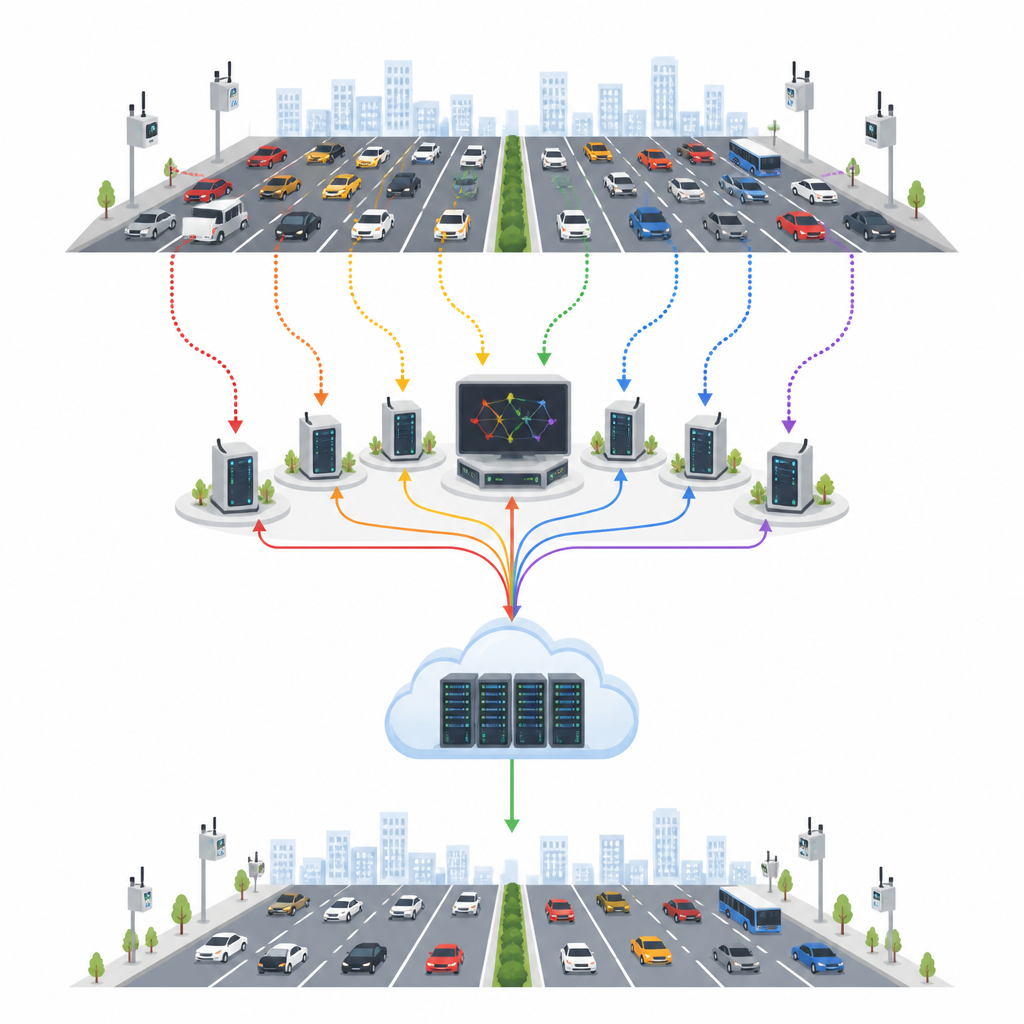
Modern cars are turning into rolling computers that constantly talk to nearby vehicles, roadside devices and distant data centers. This nonstop chatter can help avoid crashes, ease traffic and support self-driving features, but only if messages travel quickly, reliably and safely. This paper explores a new way to manage that flow of data so that urgent safety alerts get through first, attackers are kept out and the network does not grind to a halt as streets grow busier.
Why connected vehicles need extra care
In the Internet of Vehicles, cars exchange information with roadside units and cloud services to warn of hazards, share traffic conditions and deliver entertainment. That makes life easier but also opens many doors for failure. Fake cars can send false alarms, slow systems or even create unsafe situations. At the same time, the network must juggle very different needs: a crash warning may need a reply in a fraction of a second, while a music download can wait. The authors argue that current systems either focus on security or speed, but rarely balance both well in the real world.
Mixing new network control with shared records
The study brings together two ideas that have reshaped digital networks. First, Software Defined Networking separates the “brain” that decides how data flows from the hardware that forwards it, letting a central controller tailor routes in real time. Second, blockchain replaces a single, central authority with a shared ledger where many trusted nodes record who is allowed to talk. In this design, each car and roadside device gets a hidden identity and key pair from a trust authority, and its logins are recorded on a permissioned blockchain using a lean approval method so that checks stay fast.
Giving urgent messages the fast lane
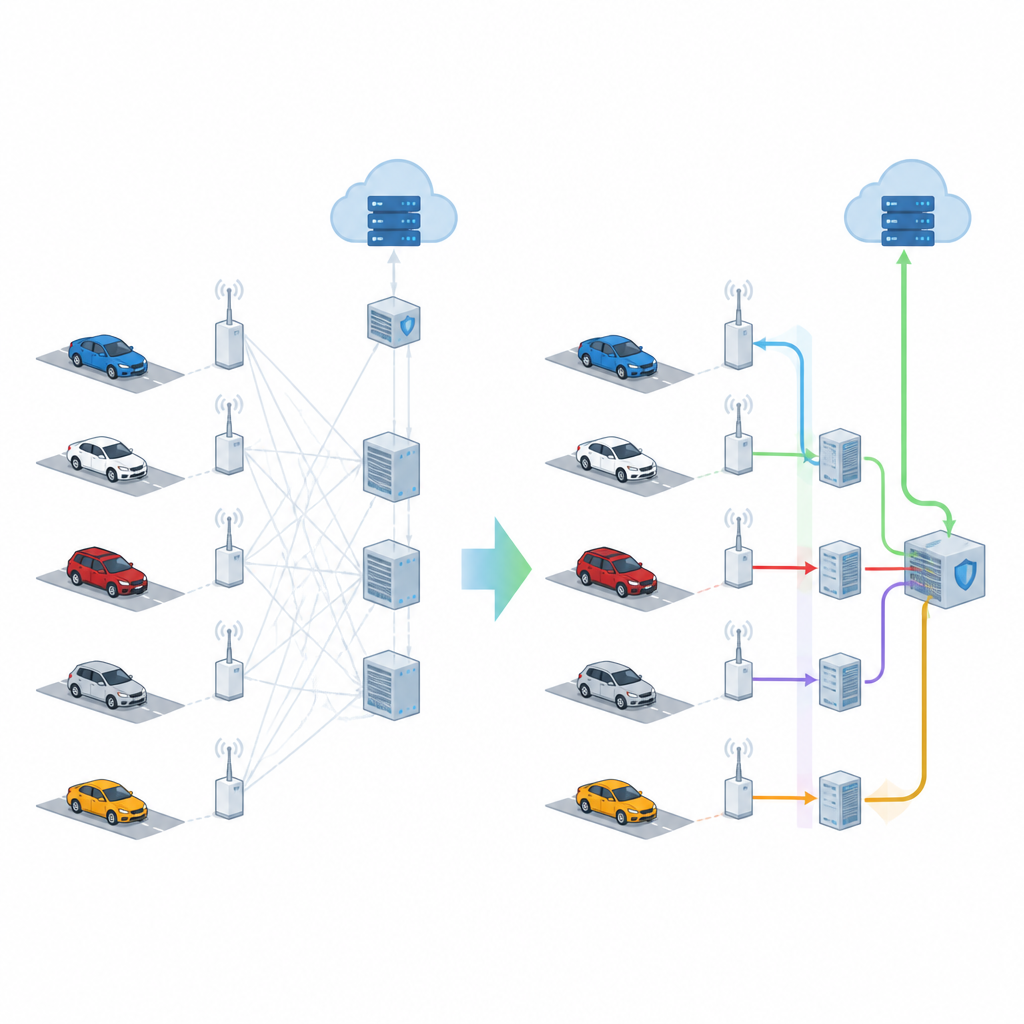
Once a car is cleared as legitimate, its request is scored for urgency. The system looks at how soon the task must finish, how much data it carries, how fast the vehicle is moving and whether it is marked as an emergency. High priority requests, such as safety alerts, are routed to nearby edge servers that can answer quickly. Low priority jobs, like bulk uploads, are sent to distant cloud servers that have more capacity but add delay. Middle cases are steered to edge or cloud depending on how busy the edge is. This simple traffic triage prevents local devices from being clogged by noncritical tasks while keeping life-saving messages near the front of the line.
Finding better paths through a busy network
Deciding which exact path each high or medium priority message should take is a complex puzzle. The authors use a nature-inspired search method modeled on how an agile predator explores and narrows in on prey. In their version, each potential route is treated as a candidate, and the algorithm repeatedly improves these options. It favors routes that keep total delay low, preserve battery energy in vehicles, use stable links with few lost packets and avoid nodes that show signs of suspicious behavior. A special kind of controlled randomness helps the search escape weak choices and converge more quickly on stronger ones.
How well the new approach performs
The team simulated a city-sized grid of roads with dozens of vehicles and roadside units, then compared their framework to several existing schemes. Their system reduced the time needed to generate keys and register new vehicles, cut delays for message delivery and lowered the extra network chatter needed for coordination. It also increased the share of packets that arrived successfully, kept more energy in vehicle devices, improved measured security and boosted overall data throughput. In short, it allowed more cars to talk at once while maintaining speed and trust.
What this means for everyday drivers
For nonexperts, the key takeaway is that safe connected driving is not just about sensors on a car but also about how all those cars share information. This work shows that by blending a shared, tamper-resistant record of who is allowed on the network with smart traffic rules and an adaptive routing engine, it is possible to move critical data quickly without sacrificing security. While there are still open questions about scaling to very dense traffic and trimming computing costs, the proposed framework points toward road systems where digital messages are treated much like vehicles themselves: checked, prioritized and guided along the best possible route.
Citation: M, H.C., Thanarajan, T. Secure and intelligent SDN-IoV framework with blockchain-based authentication and optimization-based QoS routing. Sci Rep 16, 15006 (2026). https://doi.org/10.1038/s41598-026-44224-x
Keywords: Internet of Vehicles, blockchain security, software defined networking, vehicular routing, edge computing