Clear Sky Science · en
Research on the integrated technology of bearing structure reconstruction and support control in high risk area of top coal roadway in thick coal seam
Why safer coal tunnels matter
Deep inside thick coal seams, workers travel and move coal through long underground tunnels. In some places these tunnels suffer from sagging roofs, crumbling walls and sudden falls of coal and rock, putting miners at risk and slowing production. This study looks at why these problems are so severe in certain high risk sections and tests a new way to strengthen the rock so that tunnels stay safer and more stable over time.
Where the trouble starts
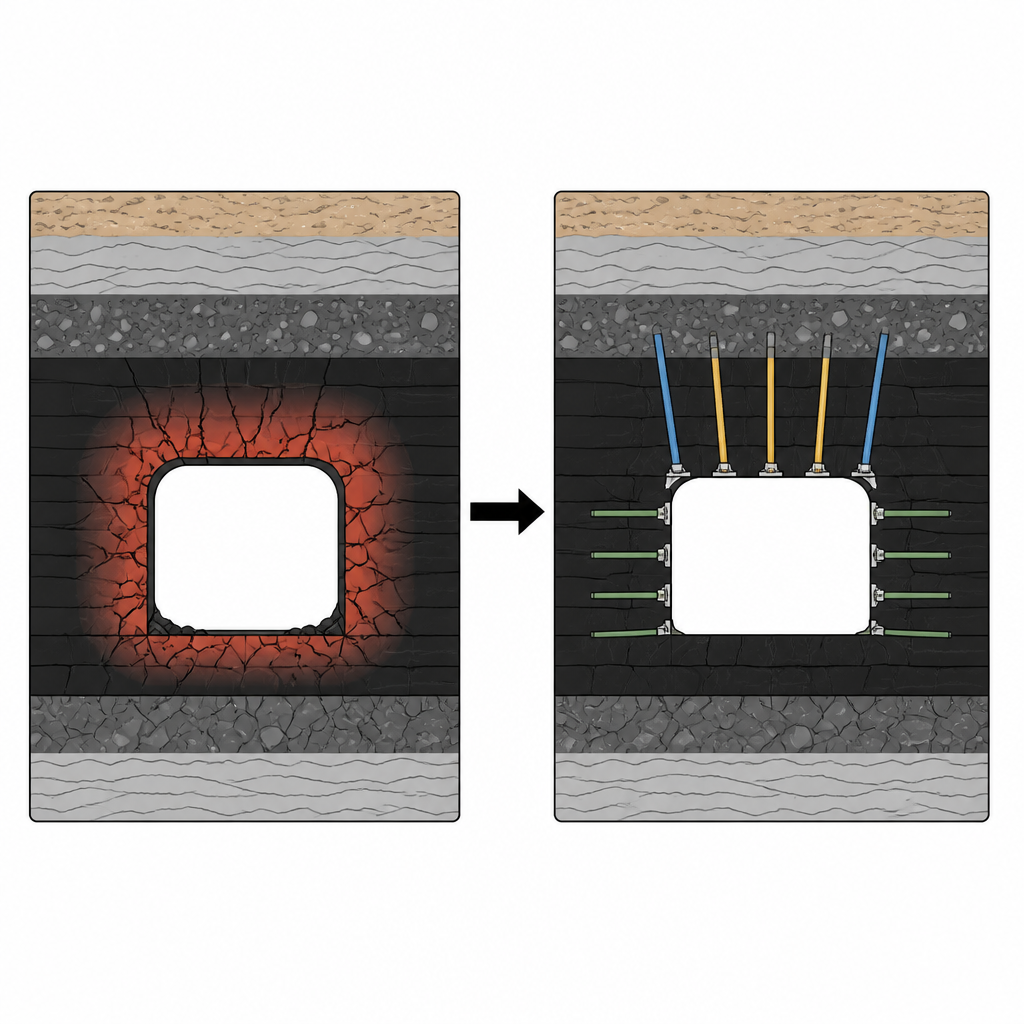
The research focuses on a large roadway in a Chinese coal mine that runs through a very thick coal seam. In this setting the tunnel passes through coal rather than strong rock, and the coal above and beside the opening is weak and broken. Natural faults in the rock and great weight from the layers overhead concentrate stress around the tunnel, leading to roof separation, roof falls, bulging sidewalls and the need for constant repairs. Earlier support methods, such as simple grouting and pipe sheds, often failed because grout could not penetrate the tight coal and could not create a strong, unified support structure.
How the tunnel moves and deforms
To understand this behavior, the team combined field measurements, lab tests and mechanical modelling. They treated the coal above the roadway roof as a loaded beam and showed that roof sag increases very quickly as tunnel width grows and as the coal becomes weaker. They also found that the roof and sidewalls do not deform in isolation. When the side coal softens and pushes inward, it effectively widens the opening, which then increases roof sag. In turn, extra roof movement squeezes the sidewalls further. This linked top and side movement helps explain why local, piece by piece support often fails in thick coal seams.
Tests with virtual tunnels
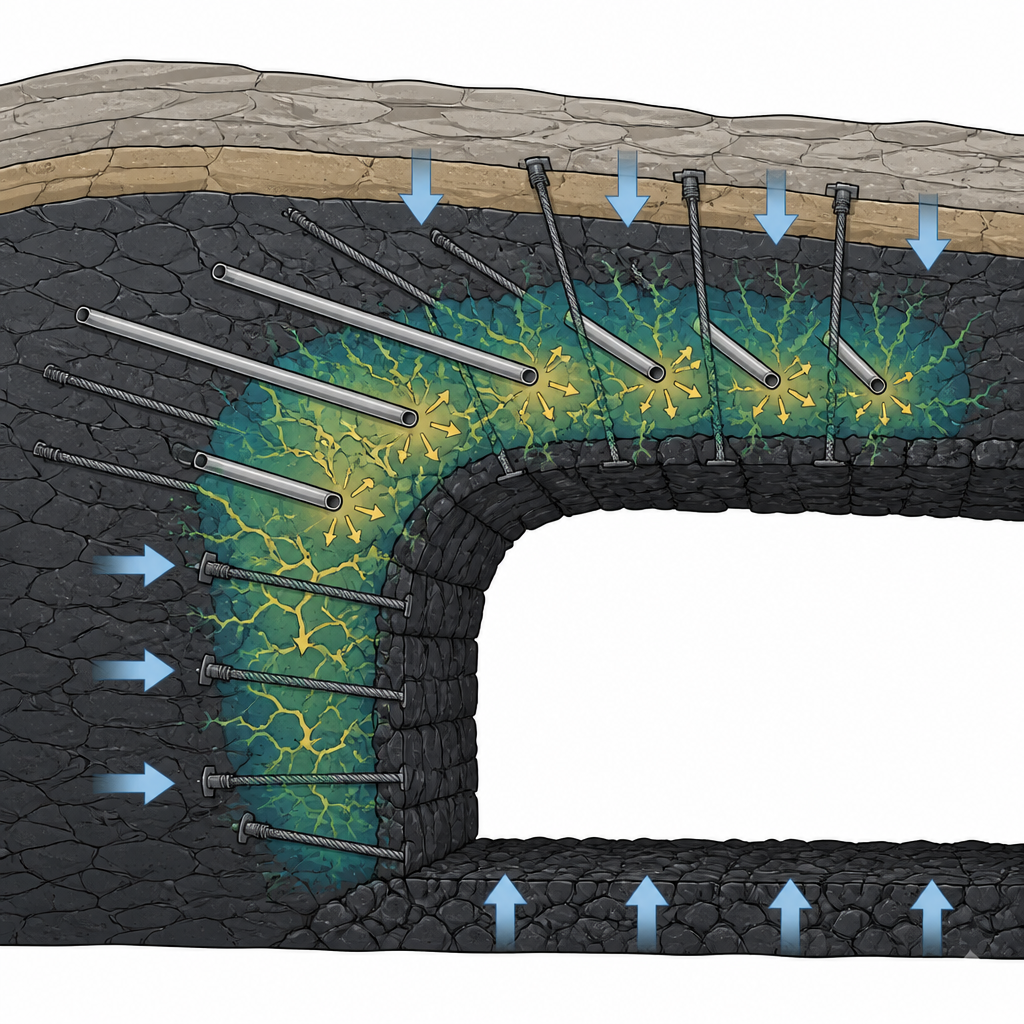
Using three dimensional computer simulations, the researchers changed two key factors: the thickness of the coal left above the tunnel and the strength of that coal. Making the coal layer above the roof thicker increased roof sag but reduced floor heave, while sidewall movement changed little. Raising the strength of the top coal sharply decreased both roof sag and inward movement of the walls, even though the overall stress pattern changed only slightly. The calculations showed that cracks and plastic zones in the rock first formed near the roof and then spread deeper, with characteristic “butterfly” shaped damage near the sidewalls, highlighting the need to strengthen a broad zone rather than only a thin shell.
A new way to shore up weak areas
Guided by this understanding, the authors designed a combined support system using advance pipes with grout and a network of bolts and cables. Before driving the tunnel into a risky zone, workers drill rows of steel pipes into the coal ahead of the face and pump in a fast setting grout. This grout quickly hardens inside and around the pipes, stitching cracks and turning the broken coal into a more solid block. As excavation continues, bolts and cables connect the strengthened roof and sidewalls into a single bearing frame. Computer models of various layouts showed that a moderate pipe spacing provided almost the same reduction in movement as a very dense layout, but with less cost.
Proof from the working mine
The team then applied the chosen scheme in the real roadway. They monitored roof sag, sidewall convergence, floor heave, separation between rock layers and the forces in bolts and cables. After excavation and support with the new method, roof sag stayed around 110 mm, sidewall movement about 80 mm and floor heave was very small. Layer separation above the roof remained far below warning levels, and the loads in the bolts and cables became steady and lower than in the old design. Because the grout gained strength within minutes, crews could advance several times faster than before while keeping a safe distance between the tunnel face and the reinforced zone.
What this means for miners
In simple terms, the study shows that making the weak coal around a tunnel act like a single, well tied arch and wall can greatly reduce dangerous roof falls and collapses. By reinforcing the coal ahead of time with grouted pipes and then tying the roof and sides together with bolts and cables, the roadway can carry the heavy load from above with smaller movements and lower support forces. The authors argue that this integrated approach offers a practical guide for safer, more efficient tunneling in thick coal seams with similar geological conditions, reducing both safety risks and maintenance demands in underground coal mining.
Citation: Xiaokang, S., Bacha, S., Heng, Z. et al. Research on the integrated technology of bearing structure reconstruction and support control in high risk area of top coal roadway in thick coal seam. Sci Rep 16, 14822 (2026). https://doi.org/10.1038/s41598-026-44215-y
Keywords: coal roadway stability, roof support, grouting reinforcement, rock bolts and cables, underground mining safety