Clear Sky Science · en
Phonon frequency comb close to an isolated Einstein mode in $$\hbox {InSiTe}_{3}$$
A new way to see tiny vibrations in crystals
Inside every solid, atoms are constantly jiggling. These tiny vibrations, called phonons, usually behave like independent musical notes. In this work, researchers show that in a layered crystal named InSiTe3, the vibrations can spontaneously organize themselves into a finely spaced pattern of tones known as a phonon frequency comb — a highly ordered structure that could one day help control heat, sound, or even quantum information in ultra-thin materials.
A special layered crystal with tidy building blocks
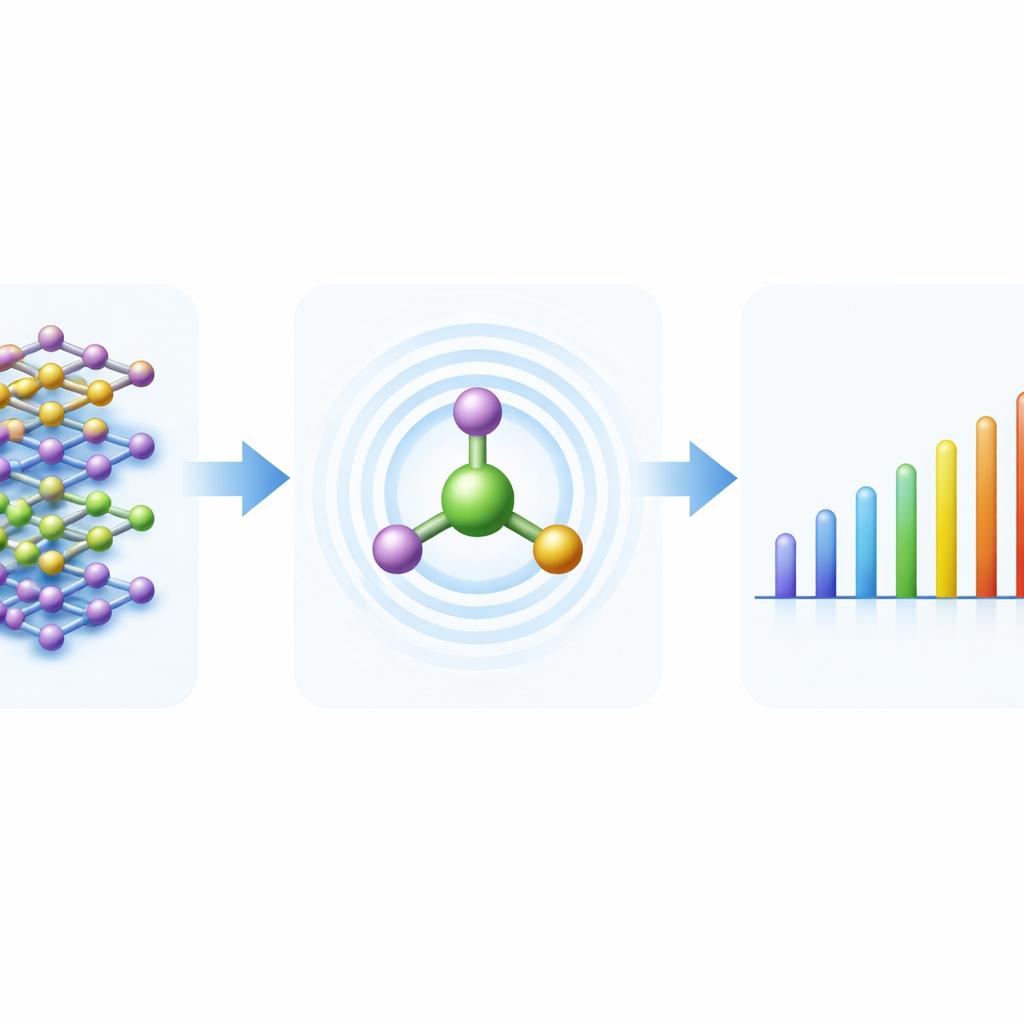
InSiTe3 belongs to a growing family of materials made of weakly bonded layers, known as van der Waals crystals. These are the same broad class that includes graphene and many other two‑dimensional materials. The team grew high‑quality InSiTe3 single crystals and checked their cleanliness and composition with electron microscopy and elemental mapping. The images show broad, flat terraces and a very uniform mix of indium, silicon, and tellurium in the precise 1:1:3 ratio, with no detectable contamination or missing atoms. This structural perfection is crucial: it means that unusual vibrational effects can be tied to the material’s intrinsic behavior, not to dirt or defects.
Listening to lattice vibrations with laser light
To probe how the atoms move, the researchers used Raman scattering, a technique where laser light scatters off the crystal and shifts in color depending on how it exchanges energy with atomic vibrations. By rotating the polarization of the incoming and outgoing light and cooling or heating the crystal between 80 and 300 kelvin, they could separate out different families of vibrational modes and follow how their frequencies and sharpness change with temperature. They also performed detailed computer simulations based on quantum theory to predict which vibrational modes should exist, how localized they are, and how separated they are from the rest of the vibrational spectrum.
An isolated tone that turns into a comb
The calculations reveal one particularly striking feature: a high‑energy vibration mainly involving silicon atoms that sits by itself, far above all other phonon branches, like a lone note on a piano key well away from the rest. In a simple, nearly harmonic crystal this “Einstein mode” would appear as a single, sharp spectral line in Raman measurements. Instead, the experiments reveal three evenly spaced lines clustered around this mode. As the temperature rises, all three lines move together to slightly lower energy and broaden, but they stubbornly preserve their equal spacing. This pattern — multiple, regularly spaced peaks around what should be a single vibration — is the hallmark of a phonon frequency comb. The authors model the data using a coherent‑state description: rather than three independent vibrations, the spectrum is consistent with a single, strongly anharmonic vibrational state that naturally produces a ladder of discrete frequency components.
A temperature trigger and hidden partner vibrations
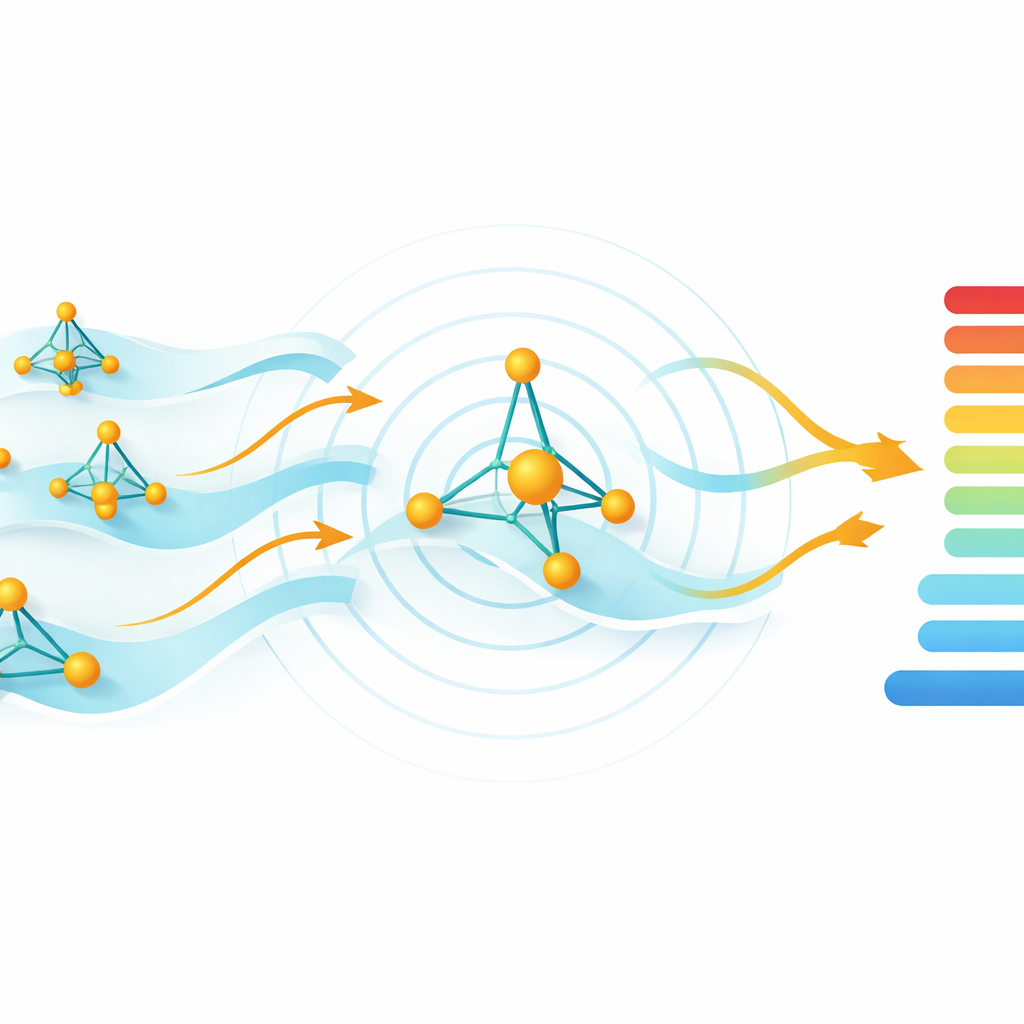
Not all of the phonons in InSiTe3 behave smoothly with temperature. Two low‑energy, fully symmetric modes broaden and shift in a way that can be explained by standard anharmonic effects only up to about 200 kelvin. Near this temperature, their behavior suddenly deviates, and new, broad features appear in the spectra at roughly twice the energy of certain low‑lying vibrations. These extra bands are best understood as two‑phonon overtones: pairs of phonons excited together, drawing strength from strong interactions among vibrations spread across the crystal. The timing is telling — as thermal energy populates more vibrational and electronic states in this narrow‑gap semiconductor, multi‑phonon processes become much more likely, and the coupling between modes jumps rather than changing gradually.
Why this strange vibrational order matters
By combining precise light‑scattering experiments with advanced calculations, the study shows that InSiTe3 is not just another layered semiconductor. Its crystal structure creates an isolated, long‑lived high‑energy vibration that, because of strong non‑linear forces in the lattice, splits into a self‑organized “comb” of equally spaced frequencies. At the same time, strong interactions among lower‑energy vibrations give rise to abrupt changes around 200 kelvin and to clear overtone bands where none are expected from simple models. For a non‑specialist, the message is that this material naturally arranges its atomic vibrations into highly patterned spectra without the need for ultrafast pulsed lasers or engineered cavities. Such intrinsic vibrational order in a clean, layered crystal points toward new ways of controlling energy, heat flow, and potentially quantum behavior in next‑generation electronic and photonic devices.
Citation: Belojica, T., Blagojević, J., Djurdjić Mijin, S. et al. Phonon frequency comb close to an isolated Einstein mode in \(\hbox {InSiTe}_{3}\). Sci Rep 16, 13944 (2026). https://doi.org/10.1038/s41598-026-44212-1
Keywords: phonon frequency comb, InSiTe3, van der Waals materials, Raman spectroscopy, lattice vibrations