Clear Sky Science · en
Wearable sensor big data analysis reveals spatiotemporal injury patterns in professional tennis players
Why tracking tennis injuries matters
Professional tennis looks elegant on television, but behind every serve and sprint lies intense strain on the body. This study uses wearable sensors and modern data analysis to ask a simple question with big consequences for players and coaches: when, where, and how do injuries really happen over the course of a season, and can we spot warning signs early enough to prevent them?
Turning players into moving data
To tackle this problem, the researchers equipped 45 professional players with a network of light, body-worn sensors during a full year of training and matches. Small units on the wrists, shoulder, lower back, and shoes recorded motion and impact forces, while other sensors tracked heart rate and position on court. Together they captured thousands of hours of movement, from explosive serves to long baseline rallies, creating a detailed picture of how the body is loaded in real tennis environments.

When injuries strike during the year
By following these players through pre-season, tournament months, and off-season, the team found that injuries do not occur at random. Instead, they rise and fall in a seasonal rhythm. Problems peaked during heavy training blocks and busy competition periods, especially when overall workload built up quickly. Overuse injuries, which develop gradually, were most common in pre-season and high-intensity training weeks, while sudden acute injuries were more often tied to competition and match-like situations. These patterns suggest that how training is scheduled over weeks and months plays a crucial role in injury risk.
Where the body breaks down most
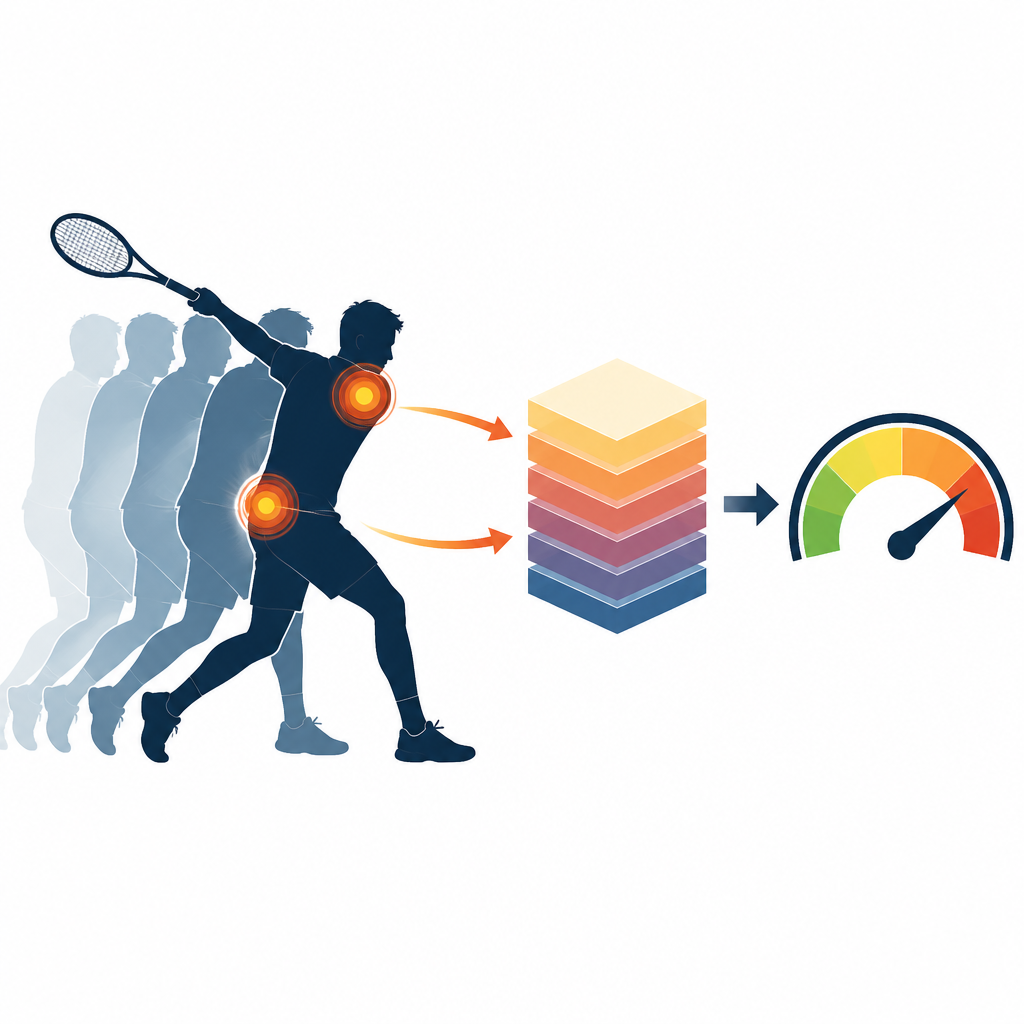
The sensor data also revealed clear hotspots on the body. Nearly half of all injuries clustered around the shoulder and elbow, the key joints for serving and hitting forehands, while roughly one third affected the lower back and hips, which drive trunk rotation and court coverage. By mapping injuries onto a simple body coordinate system, the study showed dense clusters in these regions, with far fewer problems in the knees and ankles. The analysis linked these hotspots to specific movement traits, such as very high rotation speeds during the serve and asymmetric loading between the two legs during lateral movements.
Letting algorithms search for warning signs
Because the sensor streams are massive and complex, the researchers used modern machine learning tools to sift through them. They trained advanced models, including a Transformer network similar to those used in language technology, to connect patterns in movement, workload, and heart signals with later injury events. By combining information about when in the season the data were recorded with where on the body problems appeared, the best model correctly flagged high-risk periods in about nine out of ten cases and captured most subtle, slow-building risk changes that simpler methods missed.
What this means for players and coaches
For a non-specialist, the key message is that injuries in professional tennis follow recognizable patterns in time and space rather than being pure bad luck. Most problems concentrate in the serving arm and lower back–hip area, and they tend to flare up during intense training and competition stretches when overall stress is poorly balanced with recovery. By using wearable sensors and smart algorithms, coaches and medical staff could move from reacting to injuries after they happen to receiving early alerts when movement quality, workload, or body signals suggest that a player is drifting into the danger zone.
Citation: Han, G., Zhang, Y. & Sun, B. Wearable sensor big data analysis reveals spatiotemporal injury patterns in professional tennis players. Sci Rep 16, 14804 (2026). https://doi.org/10.1038/s41598-026-44199-9
Keywords: tennis injuries, wearable sensors, sports data, injury prediction, machine learning