Clear Sky Science · en
Assessment of thermally induced strength loss in alkali-activated concrete through ensemble regression models
Why hot concrete matters
When a building faces a serious fire, the strength of its concrete can make the difference between standing and collapse. Engineers are now turning to a greener type of concrete, called alkali-activated concrete, that reuses industrial waste and stands up better to heat than traditional cement. But testing every possible recipe in a furnace is slow and expensive. This study shows how modern data-driven tools can learn from past experiments and quickly predict how strong this greener concrete will remain after being exposed to extreme temperatures.
A greener kind of concrete
Alkali-activated concrete replaces much of the usual cement with industrial by-products such as fly ash from power plants, blast furnace slag from steelmaking, and even finely ground waste glass. This swap cuts carbon emissions and gives these waste materials a second life. Thanks to its different internal gel-like binding structure, this concrete often holds up better when heated. However, its behavior in fire is highly sensitive to details: the mix of powders, the chemicals used to activate them, how long and how hot the mix is cured, and the peak temperature it later experiences. That complexity makes it hard to predict, from first principles alone, how much strength will remain after a fire.
Letting data learn the patterns
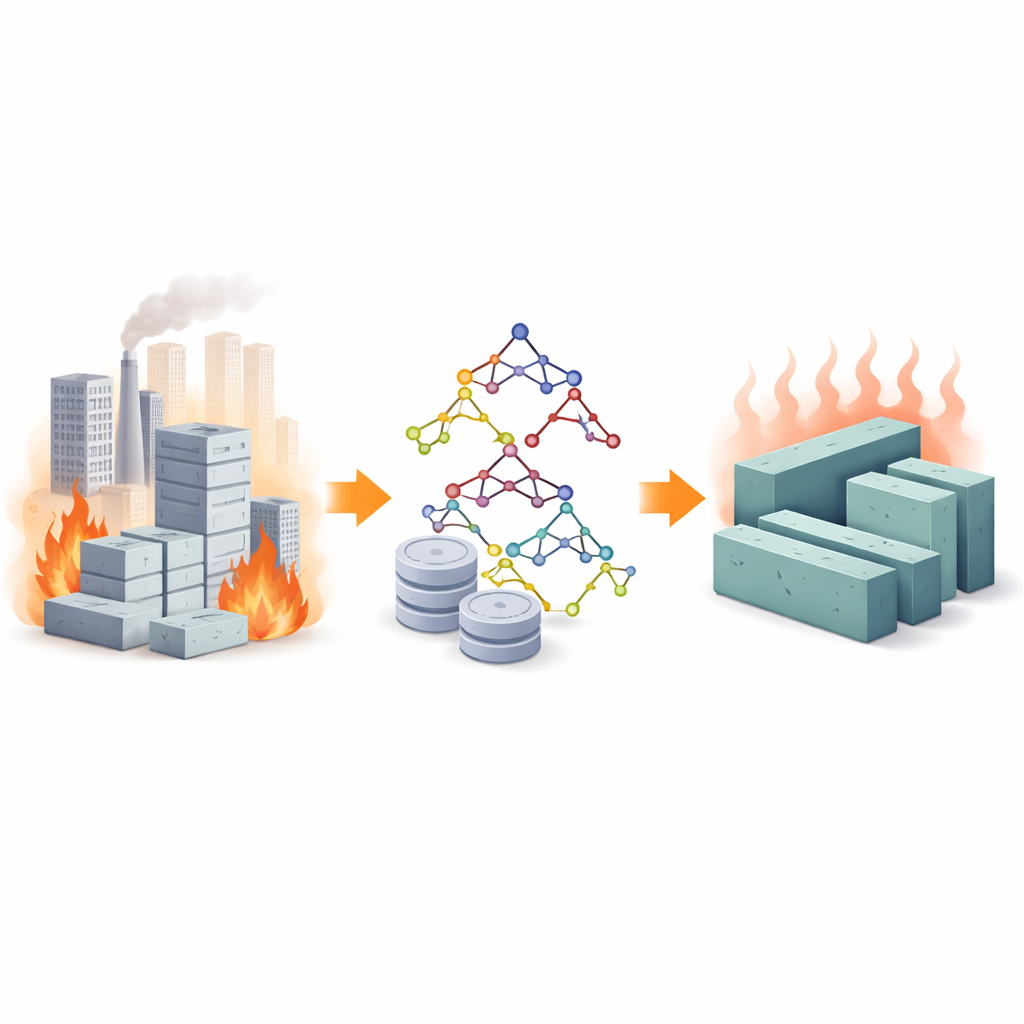
The researchers assembled a detailed dataset of 371 concrete cubes made from fly ash and slag, sometimes partially replaced by waste glass powder. Each cube’s recipe was recorded, along with how it was cured and the temperature—between typical room conditions and 1000 °C—to which it was later heated before testing. Instead of relying on simple equations, the team turned to five supervised machine learning methods. These algorithms look for patterns linking the inputs (mix proportions, curing temperature and time, and heating level) to the output: the remaining compressive strength of the concrete.
Which digital "forecaster" works best
The study compared a basic decision tree with more advanced "ensemble" methods that combine many simple models to obtain a more reliable prediction. These included bagging, AdaBoost, random forest, and a technique called Extreme Gradient Boosting. The authors used careful cross-validation, training the models on some mix designs and testing them on entirely different ones to mimic real-world use. Among all contenders, the gradient boosting model came out ahead. It reproduced test results with a very high level of agreement and the lowest average error, closely followed by random forest. In contrast, a simple linear approach could not capture the curved, non-linear way strength changes with composition and temperature.
Discovering what really matters inside the mix
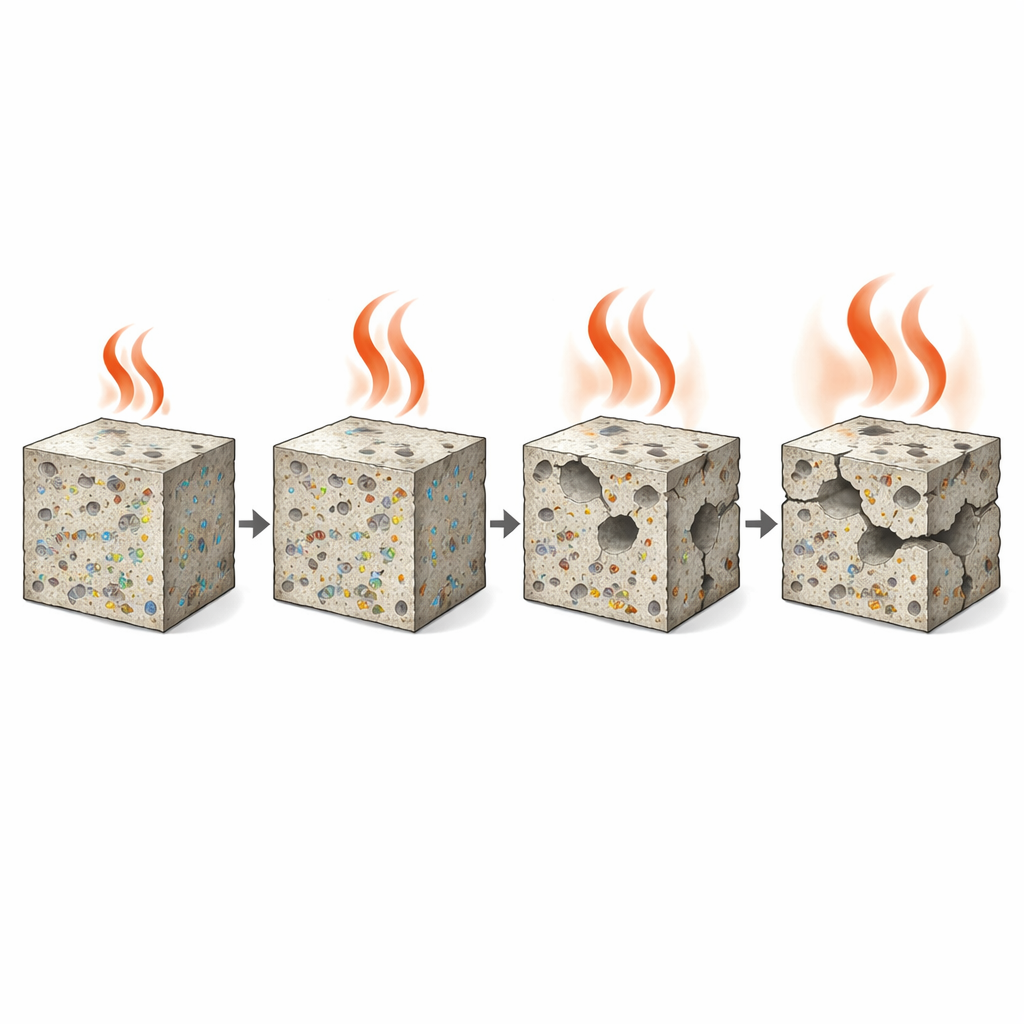
Beyond raw accuracy, the researchers wanted to know which ingredients and processing steps truly drive performance in the heat. They examined correlations and used interpretability tools that show how much each input variable shifts the model’s predictions. Curing temperature, curing duration, and the concentration of the alkaline activator emerged as the dominant factors controlling how much strength the concrete keeps after heating. Variables like the amount of coarse aggregate or small changes in water content played a lesser role. The analysis also reflected known physical processes: moderate curing helps form a dense binding network, but excessive heat or alkali content can make the hardened material more brittle and prone to cracking as temperatures later climb toward 1000 °C.
From test lab to design tool
In simple terms, this work turns a scattered set of furnace tests into a practical design aid. The ensemble models act like fast, trained advisers that can estimate how a proposed green concrete recipe will behave in a severe fire, without casting and heating hundreds of new samples. By highlighting which variables matter most, they also guide engineers toward smarter choices in curing and chemical dosage. The approach does not replace careful testing or building codes, and it still needs to be broadened to other materials and conditions. But it offers a powerful step toward designing safer, more fire-resilient, and more sustainable concrete structures using far fewer trial-and-error experiments.
Citation: Deepti, Y., Kumar, S., Bandyopadhyay, A. et al. Assessment of thermally induced strength loss in alkali-activated concrete through ensemble regression models. Sci Rep 16, 14475 (2026). https://doi.org/10.1038/s41598-026-44193-1
Keywords: alkali-activated concrete, fire-resistant materials, machine learning, compressive strength, sustainable construction