Clear Sky Science · en
Evolution of tripartite entanglement in three-qubit quantum gravity-induced entanglement of masses (QGEM) with quantum decoherence
Why tiny weights and ghostly links matter
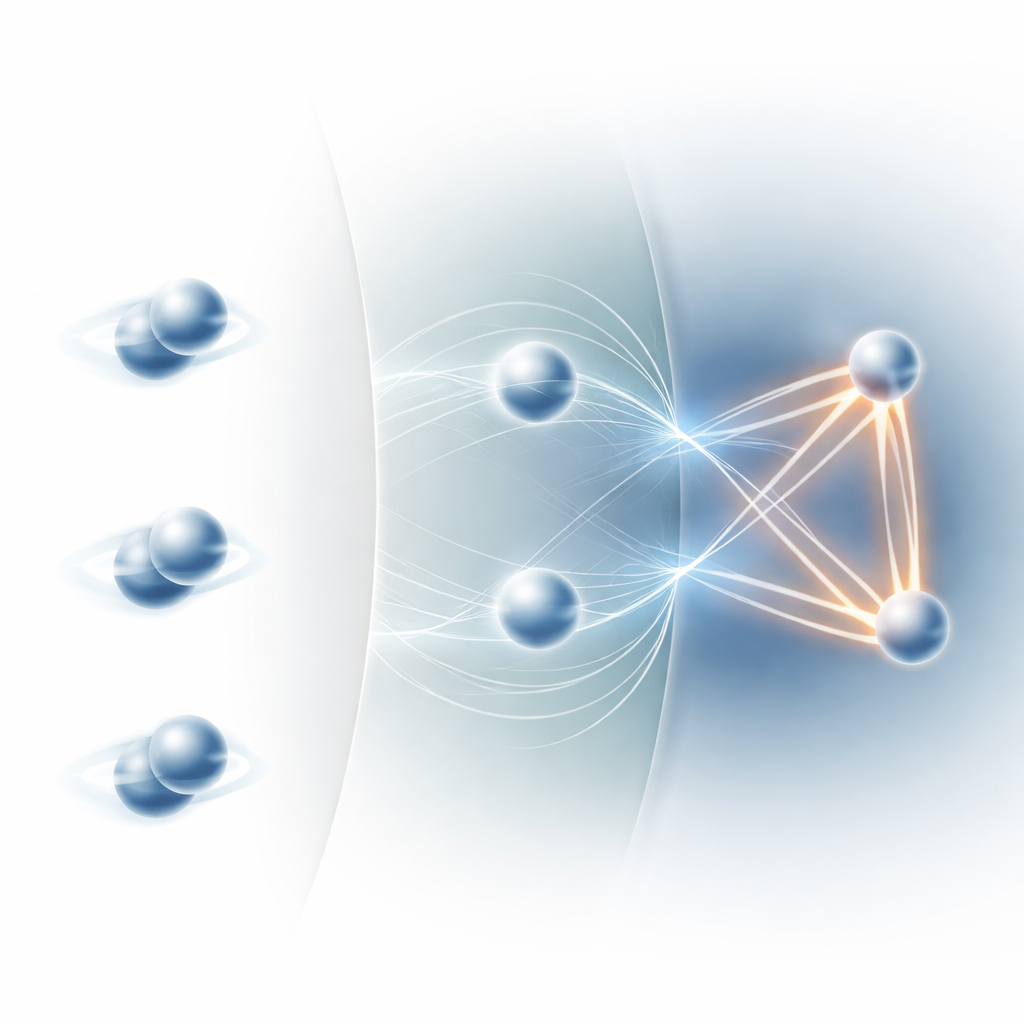
Imagine proving that gravity itself obeys the rules of quantum mechanics—not by peering into black holes, but by delicately juggling a few tiny beads of matter in the lab. This study explores how three ultra-small masses can become linked in a deeply quantum way, all through gravity alone, even while the surrounding environment constantly tries to scramble their fragile connections. Understanding when this three-way link survives offers a new route to testing whether gravity is truly quantum, and what future experiments must overcome to show it.
From everyday gravity to quantum links
Gravity is famously the weakest of the fundamental forces, yet it shapes the universe on the largest scales. Whether gravity is also a fully quantum field, like light or electromagnetism, remains one of the biggest open questions in physics. A recent experimental idea called quantum gravity-induced entanglement of masses (QGEM) tries to answer this without needing a complete theory of quantum gravity. The key idea is that if two or more tiny objects are placed in quantum superpositions of position, and gravity alone causes them to become entangled, then the gravitational field itself must have quantum properties. Otherwise, a purely classical gravitational field could not generate new entanglement between initially independent quantum systems.
Why three tiny objects are better than two
Earlier QGEM proposals considered just two small masses held in a superposition of being in two places at once, using magnetic fields to create and control these split paths. The new work focuses instead on three masses, each behaving like a quantum bit (a “qubit”) with two possible positions. When all three are allowed to interact gravitationally, the system can generate not just pairwise entanglement, but a stronger form called genuine tripartite entanglement, where all three particles share a single inseparable quantum state. The authors analyze three spatial layouts for the three masses—parallel, linear, and star-shaped—and show how the gravitational phases picked up in each arrangement determine whether the final state is separable, weakly entangled, or of the highly nonclassical “GHZ-type” class, in which all three qubits act as one collective unit.
How the noisy world tries to break quantum ties
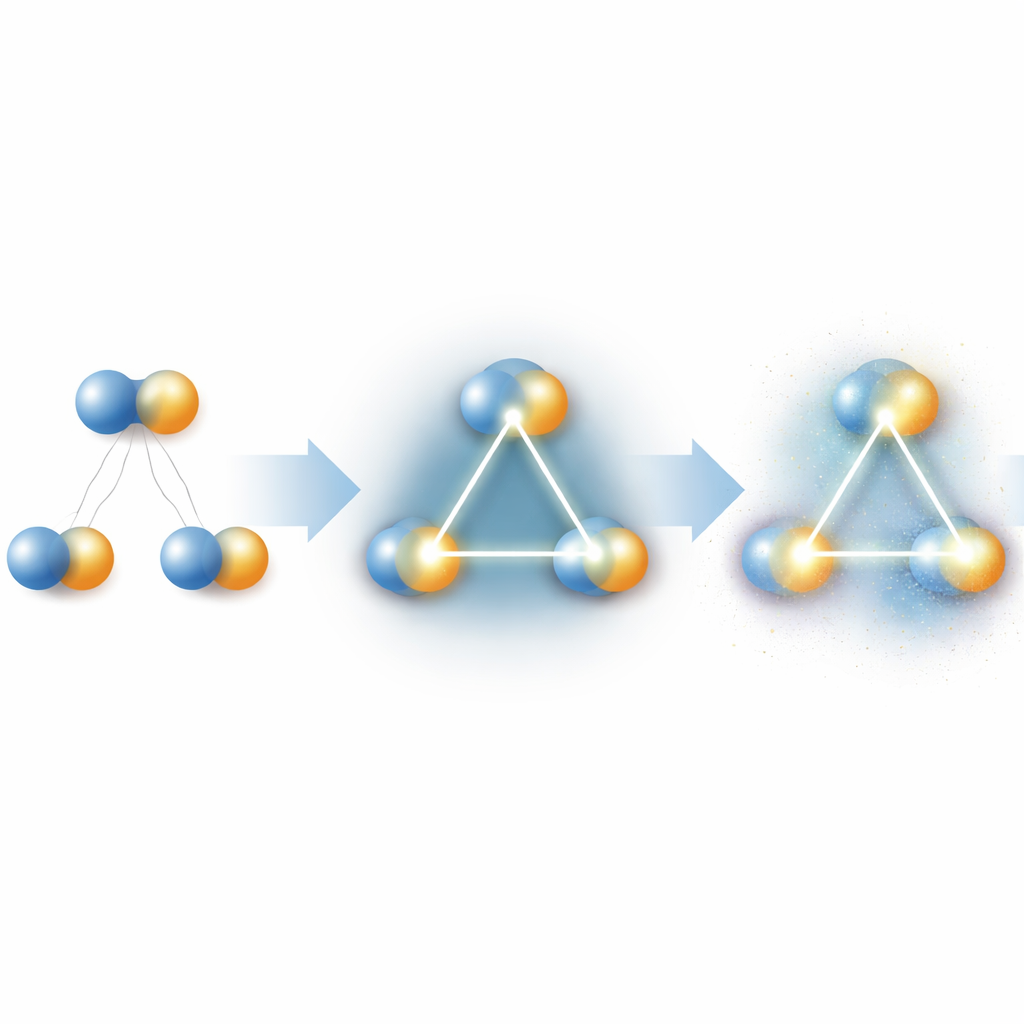
In any real experiment, the surrounding world—stray fields, background gas, vibrations—acts as a constant source of noise, a process known as decoherence. Decoherence causes the delicate quantum superpositions of the masses to gradually blur into ordinary mixtures, eroding entanglement over time. The authors model this process by assuming that environmental disturbances make different position states of each mass less and less distinguishable in a controlled, exponential way. They derive how this loss of coherence suppresses the off-diagonal elements of the system’s density matrix, steadily reducing the measurable entanglement and eventually turning the joint state into a completely mixed, uninformative one if one waits too long or if the noise is too strong.
Measuring three-way quantum links
To move beyond simply asking whether any two particles are entangled, the authors use tools that diagnose truly three-way quantum correlations. They study quantities like tripartite negativity and the three-tangle, which capture how entanglement is shared among all three qubits rather than just split into pairs. Crucially, they construct and apply a so-called entanglement witness tailored to detect genuine tripartite entanglement, even when the overall state is mixed by decoherence. By scanning over realistic experimental parameters—mass, separation, superposition size, interaction time, and decoherence rate—they identify where this witness would still signal a nonclassical three-way link, and where decoherence would completely hide it in practice.
What this means for future gravity tests
The study finds that three-particle QGEM setups can sustain detectable genuine tripartite entanglement under harsher noise conditions than simpler two-particle designs, especially when the superposition size and particle spacing are optimized. For realistic masses around 10⁻¹⁴ kilograms and separations of a few tens of micrometers, the authors show that quantum-gravity-induced three-way entanglement should be visible as long as decoherence rates remain below roughly a few thousandths to a tenth of a hertz, depending on geometry. In plain terms, if future experiments can keep the tiny test masses clean, quiet, and close enough together, gravity itself could forge unmistakably quantum links among three objects at once—a striking hint that spacetime, at its core, is governed by quantum rules.
Citation: Carmona Rufo, P.G., Mazumdar, A. & Sabín Lestayo, C. Evolution of tripartite entanglement in three-qubit quantum gravity-induced entanglement of masses (QGEM) with quantum decoherence. Sci Rep 16, 14440 (2026). https://doi.org/10.1038/s41598-026-44184-2
Keywords: quantum gravity, entanglement, decoherence, nanoparticle interferometry, tripartite entanglement