Clear Sky Science · en
Gravitational effects on the hydrogen bond network of water and ionic solutions revealed by near infrared spectroscopy under simulated microgravity
Why Space Changes Ordinary Water
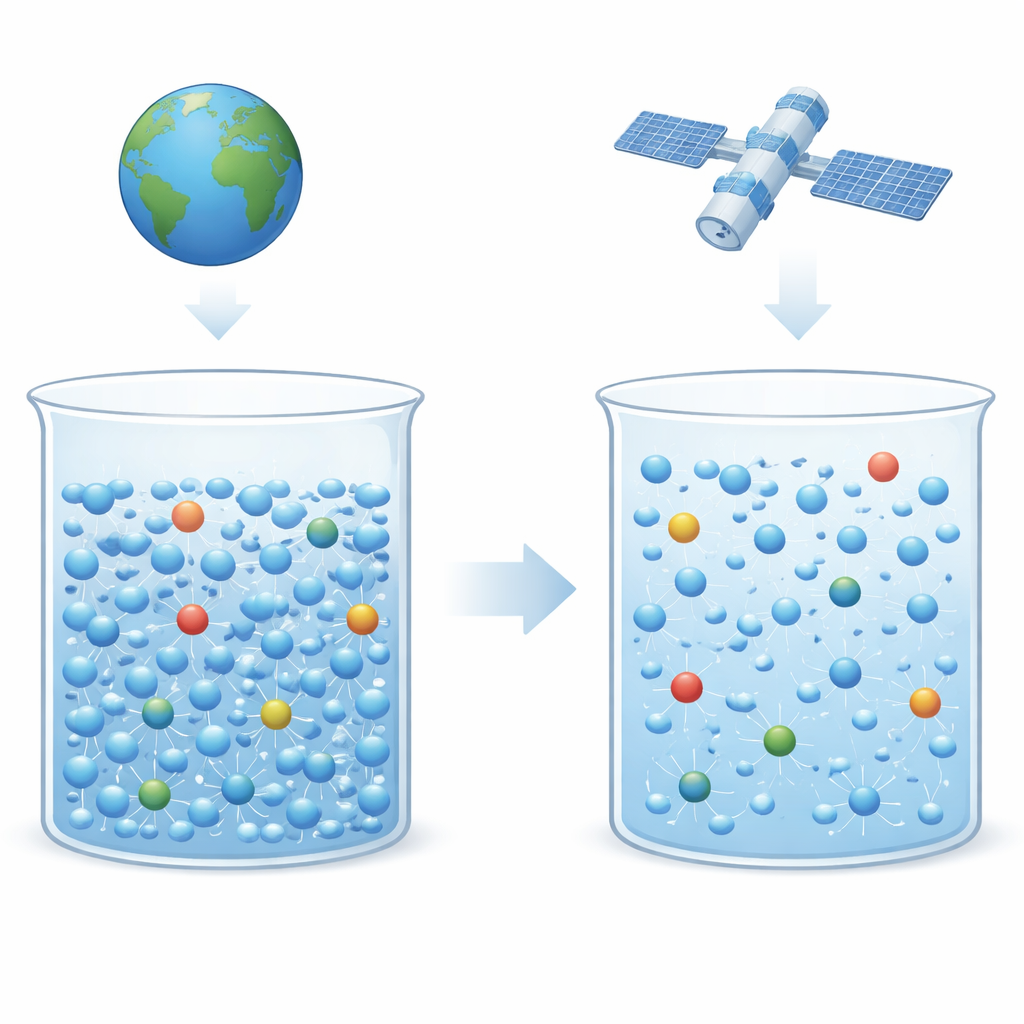
Water seems simple, but its behavior quietly underpins everything from how our cells work to how oceans circulate. This study asks a deceptively basic question with big implications for space travel: does water itself behave differently when gravity is nearly absent, as it is in orbit? By carefully watching how water absorbs near‑infrared light under simulated microgravity, the researchers show that the subtle bonds linking water molecules loosen in low gravity—and that dissolved salts can either cushion or amplify this effect. These tiny shifts could matter for biology and human health during long stays in space.
The Hidden Architecture Inside Liquid Water
Liquid water is held together by a shifting, three‑dimensional web of connections called hydrogen bonds. Each water molecule can briefly clasp its neighbors, forming and breaking links trillions of times per second. This restless network explains many of water’s odd traits, such as its unusually high boiling point and the fact that it is densest just above freezing. When these connections are tighter and more extensive, water behaves differently than when they are weaker and looser. The authors set out to see whether simply changing gravity—from Earth‑like conditions to microgravity—can nudge this invisible architecture in a consistent way.
Using Light to Listen to Water
To probe the internal structure of water without disturbing it, the team used near‑infrared spectroscopy, a technique that shines gentle light through a sample and records which colors are absorbed. Tiny shifts in these absorption bands reveal changes in how strongly water molecules are linked. The researchers focused on the band around 1450 nanometers, which reflects a mix of stretching motions in the water molecule. First, they carefully mapped how this band moves as temperature changes, because warmth is known to break hydrogen bonds. This calibration step allowed them to later separate the effects of heat from the effects of gravity in their experiments.
Spinning Away Gravity in the Lab
To mimic microgravity without leaving Earth, the group placed a compact near‑infrared spectrometer on a special rotating device called a three‑dimensional clinostat. By slowly spinning water samples around two axes, the pull of gravity is averaged out over time, creating an effective gravity of less than one‑tenth of Earth’s. The system recorded spectra of ultrapure water and of water containing common sodium salts, while sensors tracked temperature and residual acceleration. Careful data analysis was then used to pick out spectral patterns linked specifically to gravity changes, separating them from those caused by small temperature drifts.
How Gravity and Salts Reshape Water’s Network
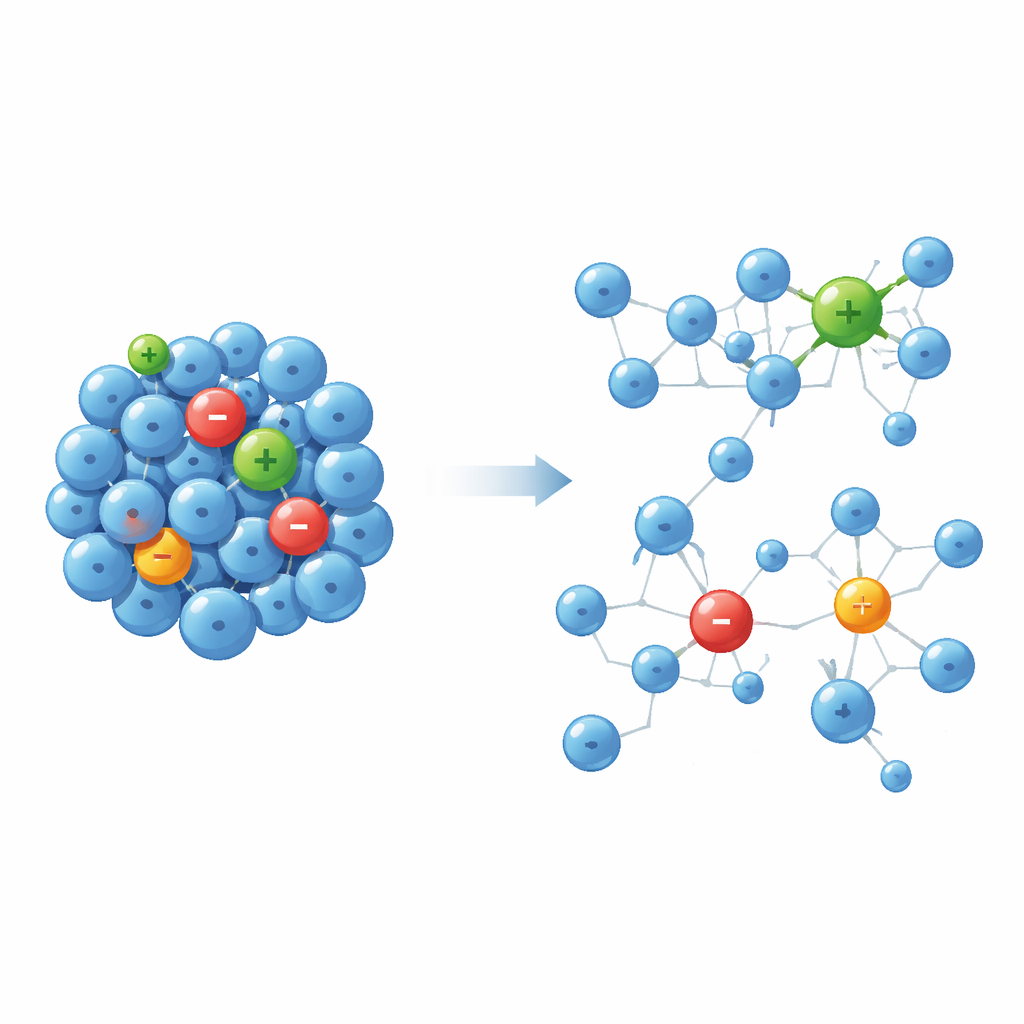
The results showed a clear trend: under simulated microgravity, the hydrogen‑bond network of water became slightly weaker. This appeared as a shift in the absorption band toward shorter wavelengths, a sign of more loosely connected water molecules. The effect was modest—smaller than what would be caused by warming the sample by about two degrees Celsius—but it was consistent. When salts were added, the story grew more nuanced. Some negatively charged ions, known as “structure‑making” in classical chemistry, normally strengthen water’s network; others, called “structure‑breaking,” tend to disrupt it. In microgravity, the weakening of the network was easier to detect in solutions with disrupting ions, where water molecules were already more free, and harder to see in solutions with strengthening ions, which lock water into a tighter arrangement.
What This Means for Life Beyond Earth
Although the measured changes in water’s internal bonding are small, living systems depend on finely tuned arrangements of water and ions around proteins, membranes, and DNA. Slight shifts in how tightly water molecules cling to one another can influence reaction rates, folding of biomolecules, and transport of nutrients and waste. This work suggests that in microgravity, water and dissolved salts form a subtly different microscopic environment than on Earth. As humans plan longer journeys and possible settlement in space, understanding these basic shifts in water’s behavior will be crucial for predicting how our bodies—and other life forms—adapt when the familiar pull of gravity is gone.
Citation: Ishigaki, M., Koizumi, K., Asano, K. et al. Gravitational effects on the hydrogen bond network of water and ionic solutions revealed by near infrared spectroscopy under simulated microgravity. Sci Rep 16, 13497 (2026). https://doi.org/10.1038/s41598-026-44169-1
Keywords: microgravity, hydrogen bonding, near infrared spectroscopy, ionic solutions, space biology