Clear Sky Science · en
Deformation characteristics of weakly cemented overburden in Western mining areas in China
Why shifting ground above coal mines matters
When coal is mined deep underground, the rocks above do not stay still. In western China, these overlying layers are unusually soft and easily broken, which makes the ground more likely to sink and can threaten precious underground water. This study looks at how those weak rocks deform as mining progresses in the Yili No. 4 coal mine, and shows how understanding their behavior can help keep both miners and regional water supplies safer. 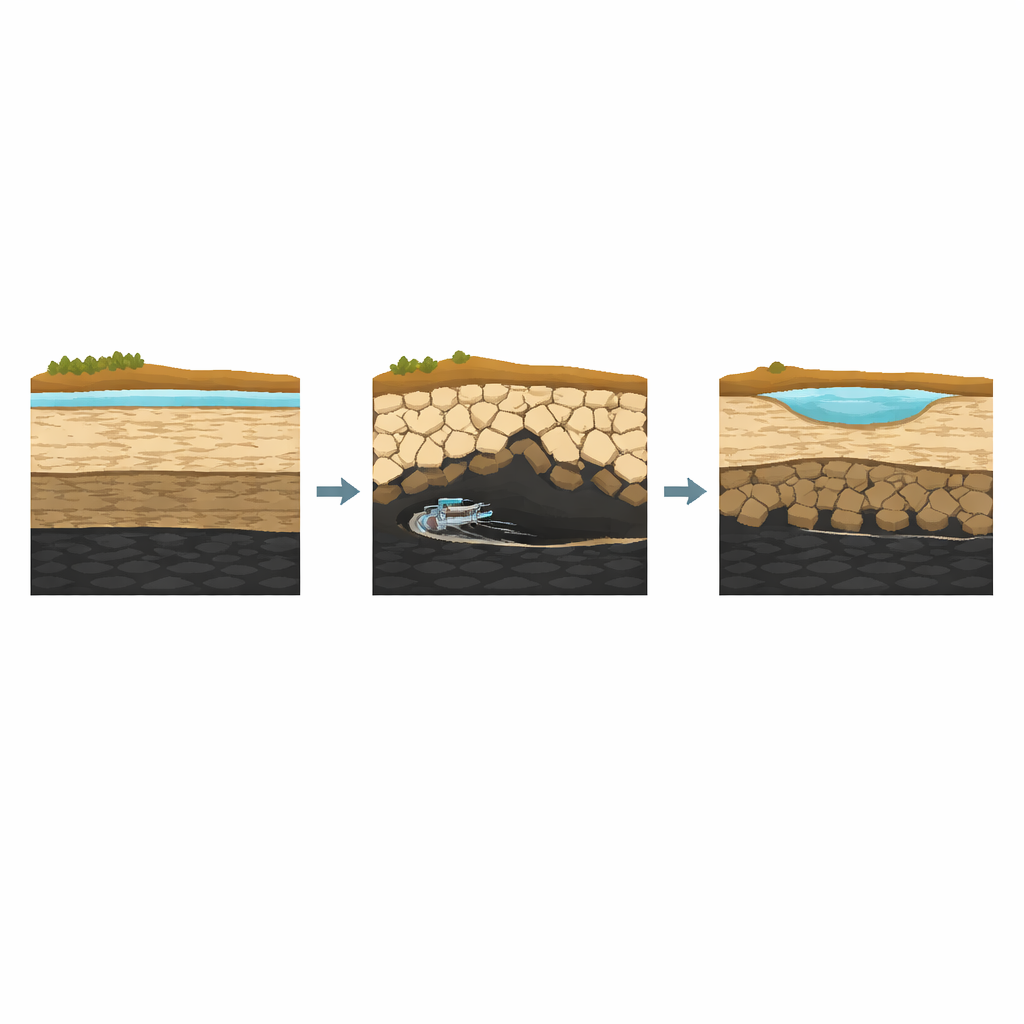
Soft rocks that crumble and soak up water
The overlying rocks above the studied coal seam are mainly dark mudstones and siltstones. Laboratory tests show that they are relatively weak even when dry, and become far weaker when soaked with water. Their compressive strength drops sharply after saturation, and they are prone to cracking, peeling along bedding planes, and breaking apart. Unlike many eastern Chinese coalfields, this area lacks thick, strong rock layers that can act like protective beams. Instead, the rock column is more like a stack of damp, weak biscuits: once disturbed, it deforms quickly and is slow to recover. This combination of low strength and high water sensitivity makes the region especially vulnerable to large ground movements and water-related hazards during mining.
Simulating how the ground sinks and breaks
To see how the rock layers respond as the coal face advances, the researchers built a three-dimensional computer model using FLAC3D, a numerical program widely used in rock engineering. They represented hundreds of meters of layered rock above a 10-meter-thick mined-out seam and simulated mining in steps as the working face moved forward. As coal was removed, the model showed a distinctive pattern of vertical movement: first a stage of steadily increasing subsidence, then a plateau where further advance mainly expanded the affected area sideways rather than upward. The maximum downward movement of the overlying rocks reached about two meters once the face had advanced roughly 260 meters, forming a characteristic arch-shaped sinking zone above the mined-out void.
Three stacked zones: collapse, fractures, and gentle bending
Within the model, the overburden naturally separated into three zones. Closest to the mined seam was a caving zone where the rock broke into blocks and fell, filling part of the void. Above that lay a water-conducting fracture zone, where layers were still largely in place but cut by numerous interconnected cracks and separations. Higher still, the rock bent and sagged more gently without losing its overall integrity. As mining progressed, the caving and fracture zones grew taller until they stabilized once the face reached about 260 meters of advance. At that point, the caving zone was roughly 30 meters high, while the fractured zone extended to about 52 meters above the seam—still just below a major water-bearing layer, an important safety margin for preventing sudden water inflow. 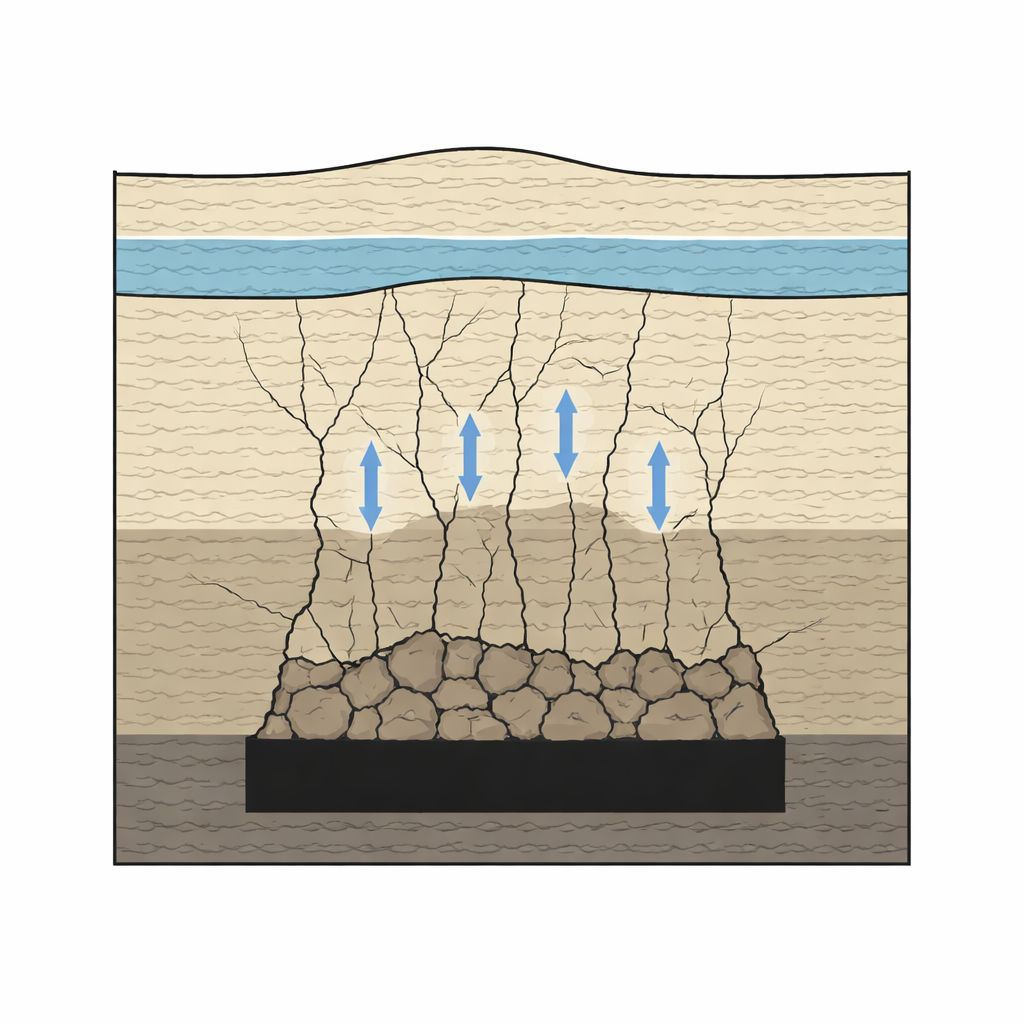
Listening to the rocks with underground “radar”
To check whether the simulations matched reality, the team used a high-precision transient electromagnetic method, a geophysical technique that tracks changes in the electrical properties of rock as it cracks and dries out. They installed a large, fixed loop on the surface and repeatedly measured how resistivity changed above the advancing coal face. Zones of collapsed rock and open fractures showed up as clear increases in resistivity. By examining how these anomalies thickened over time, they could estimate the real heights of the caving and fracture zones. The field data indicated that the fracture zone rose to about 45–50 meters above the seam for a mining height of 9.5 meters, closely aligning with the 52-meter prediction from the model.
Practical rules for safer mining and water protection
By combining detailed simulations with sensitive field measurements, the study provides simple design rules for mining in weak, water-sensitive rocks. It shows that in this setting, the fractured zone above a mined seam grows to about five times the mining height. That means any protective coal pillar left beneath an aquifer must be at least as tall as the maximum fracture height—in this case, more than 52 meters—to keep the water-bearing layer isolated from mining-induced cracks. The work also highlights how much more aggressively the ground deforms in western weakly cemented rocks compared with similar seams in the east, underlining the need for tailored support and water-protection strategies in these fragile terrains.
Citation: Zhang, G., Zhang, H., Li, G. et al. Deformation characteristics of weakly cemented overburden in Western mining areas in China. Sci Rep 16, 14211 (2026). https://doi.org/10.1038/s41598-026-44166-4
Keywords: coal mining, ground subsidence, rock fractures, groundwater protection, geophysical monitoring