Clear Sky Science · en
Fault diagnosis method of rolling-element bearings via FBEWT and EIRVM
Why hidden bearing problems matter
From train wheels to factory conveyors and wind turbines, countless machines rely on rolling-element bearings—small metal rings packed with steel balls or rollers that keep shafts spinning smoothly. When these parts begin to crack or wear, the early warning signs are often tiny vibrations buried in noise. Missing those clues can lead to sudden breakdowns, costly repairs, or even safety incidents. This paper presents a new way to listen to those faint signals and spot trouble in bearings earlier and more reliably, even when the data are messy and the machines are working under changing loads.
A smarter way to read vibration patterns
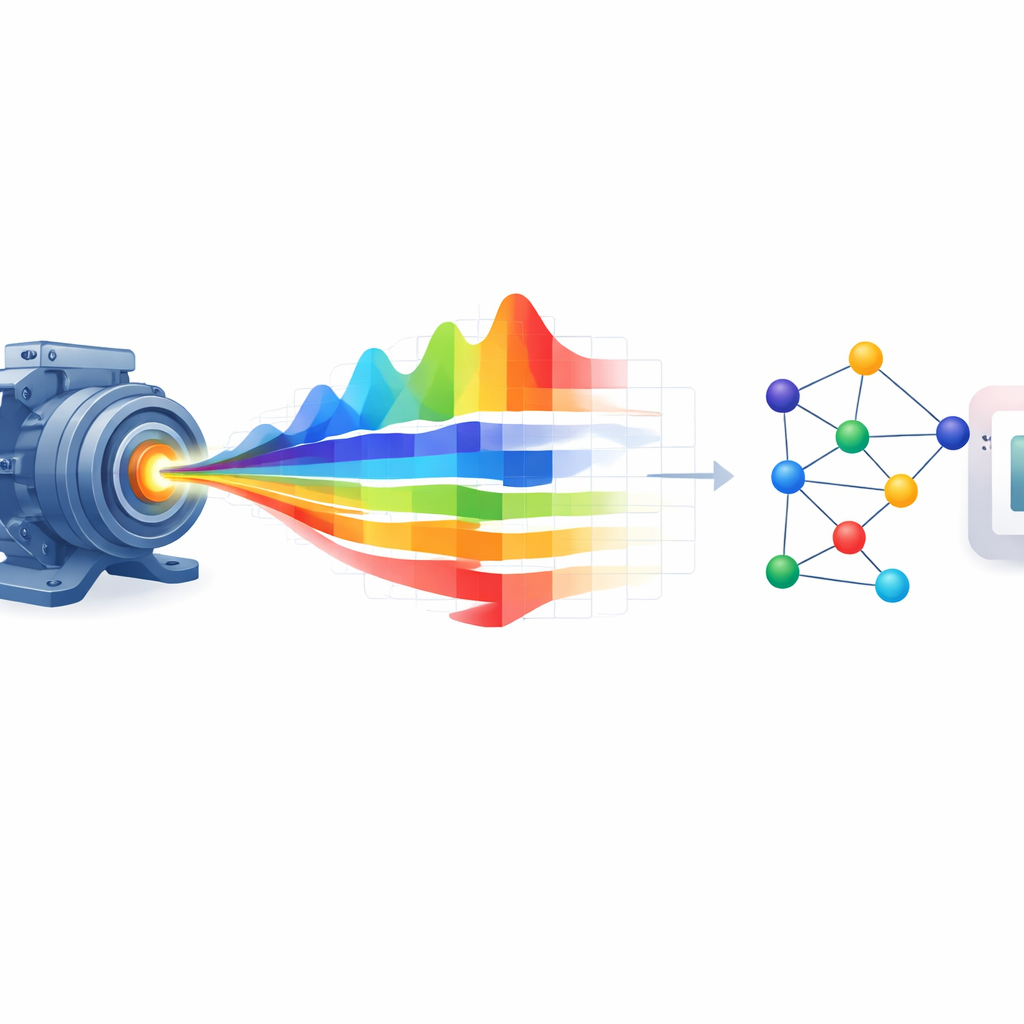
The authors focus on how to turn raw vibration data into clear pictures of a bearing’s behavior, and then how to teach a computer to read those pictures. Instead of relying on fixed recipes for signal analysis, they introduce a method called Fourier–Bessel empirical wavelet transform (FBEWT). In simple terms, FBEWT reshapes the vibration record into a time–frequency image—a kind of heat map that shows which vibration tones are active at each moment. By using special mathematical waveforms (Bessel functions) and adapting itself to the data, FBEWT separates overlapping vibration components that older methods tend to mix together. The result is a sharper, cleaner image where fault-related patterns stand out more distinctly from the background.
Turning images into telltale textures
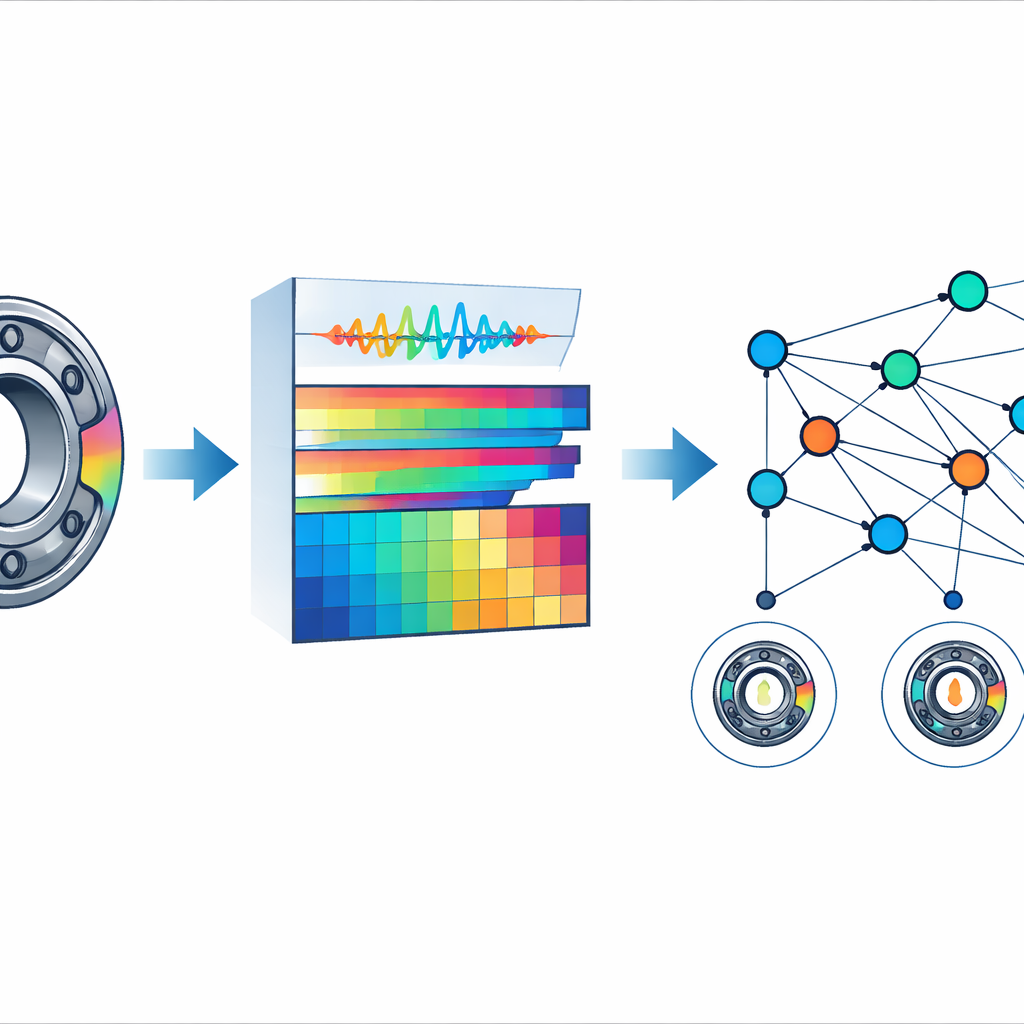
Once the vibration data are converted into time–frequency images, the next step is to extract compact numerical fingerprints that a classifier can handle. The researchers do this by treating each image like a textured photograph and measuring how pixel brightnesses co-occur across the image. These so‑called texture measures capture features such as contrast, smoothness, and regularity that reflect the repeating shock patterns created by damaged bearing surfaces. Compared with simple statistics like average or variance, these texture descriptors preserve more of the subtle, localized structure associated with cracks on the inner race, outer race, or rolling elements.
An agile, lean learning machine
To decide which health state a bearing is in, the paper upgrades a probabilistic model known as a Relevance Vector Machine (RVM). The enhanced incremental RVM (EIRVM) learns which training examples are truly informative and keeps only a small subset, called relevance vectors, reducing both memory use and computation. Crucially, it can update itself as new data arrive instead of retraining from scratch, a practical requirement for online monitoring in industry. To fine‑tune its most sensitive setting—the width of the kernel that measures similarity between examples—the authors enlist a meta‑heuristic search procedure inspired by the hunting behavior of grey wolves, augmented with a dash of chaos theory (CGWO). This clever search strategy explores the space of possible settings efficiently, avoiding premature convergence on second‑best choices.
Putting the method to the test
The proposed FBEWT–EIRVM pipeline is evaluated on several widely used bearing fault datasets from laboratory test rigs, as well as on real measurements from an operating industrial installation. In each case, the method must distinguish healthy bearings from those with defects on the inner race, outer race, or balls, and it must do so under different loads and with added artificial noise. Across all scenarios, the new approach consistently delivers higher classification accuracy than competing techniques, including traditional empirical wavelet analysis paired with standard RVMs, and even a modern deep‑learning combination of convolutional and recurrent neural networks. Notably, its performance remains almost unchanged when strong noise is injected into the data, indicating a robust resistance to interference.
What this means for everyday machines
For a non‑specialist, the message is that this study offers a more reliable stethoscope for rotating machinery. By producing clearer pictures of how bearings vibrate and coupling them to a compact, self‑updating learning algorithm, the FBEWT–EIRVM framework can detect early‑stage faults with high confidence, even when signals are weak or noisy. In practical terms, this means maintenance teams can catch problems sooner, schedule repairs more intelligently, and reduce both downtime and risk in critical equipment ranging from transport systems to power plants.
Citation: Zheng, Q., Li, Y., Chen, Y. et al. Fault diagnosis method of rolling-element bearings via FBEWT and EIRVM. Sci Rep 16, 14532 (2026). https://doi.org/10.1038/s41598-026-44164-6
Keywords: bearing fault diagnosis, vibration analysis, machine health monitoring, time–frequency imaging, intelligent maintenance