Clear Sky Science · en
A distributed socio-hydrological framework for integrating perception and groundwater dynamics in farmers’ crop choice modeling
Why farmers and groundwater are linked
In many dry regions, underground water is the hidden engine of food production. This study looks at how farmers' crop choices and their views about shrinking groundwater supplies influence each other over time. By combining computer models of water flow underground with virtual farmers who think, learn, and react, the research shows why some policies protect aquifers while others push struggling farmers toward risky over‑pumping.
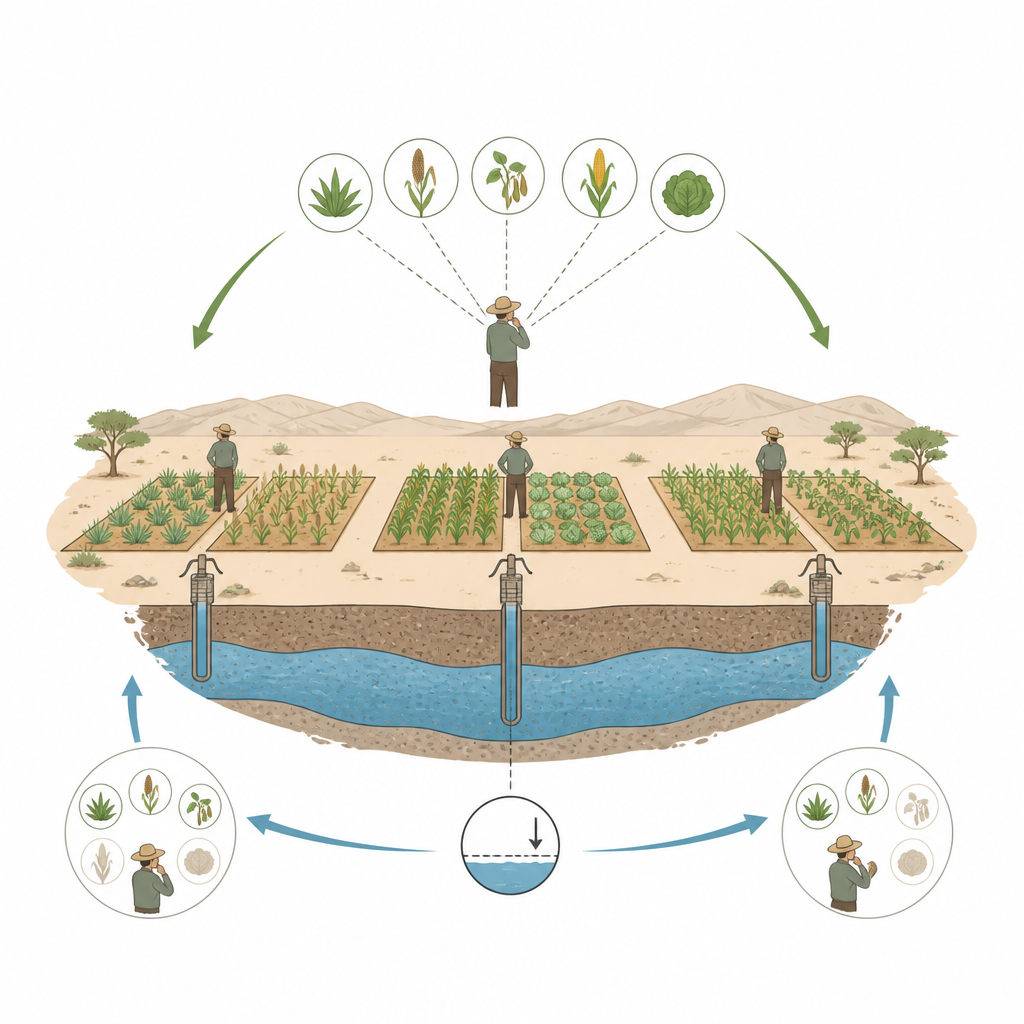
A shared resource under stress
The work focuses on the Isfahan‑Borkhar aquifer in central Iran, where more than 70 percent of groundwater is used for agriculture and repeated droughts have driven water levels steadily downward. Like many shared resources, this aquifer must serve thousands of individual users, each with different needs and constraints. The authors argue that it is not enough to track water levels and crop profits. Lasting management must also account for how farmers perceive water scarcity, how much they trust authorities, and how dependent they are on farming for their livelihood.
Virtual farmers with human motives
To capture this social side, the researchers build an agent‑based model in which each irrigation well is represented by a digital farmer. These agents differ in age, education, income security, trust in officials, and sensitivity to land subsidence. Drawing on the Theory of Planned Behavior, each farmer's tendency to save water depends on three elements: personal attitude (such as welfare level and experience), social pressure (including groundwater status and awareness of damage), and perceived control (such as age and reliance on agriculture). Based on their overall inclination to save water, farmers fall into four behavior types: profit‑driven, imitating, balance‑oriented, and water‑conserving, with some becoming non‑compliant when restrictions make farming unprofitable.
Coupling minds with the aquifer
The social model is tightly linked to a detailed groundwater simulator known as MODFLOW. Each year, virtual farmers choose crops such as wheat, barley, or corn, calculate expected profits and water needs, and decide how much to pump. Those pumping rates feed into the groundwater model, which updates water levels across thousands of grid cells. New water depths then shape how farmers feel about scarcity in the next year. This two‑way loop reveals complex patterns: in parts of the aquifer where water is still relatively shallow, many farmers are willing to conserve modestly and can keep both income and water levels stable. In severely depleted zones, some farmers cut back sharply because pumping is costly, while others secretly over‑pump to survive, worsening the decline.
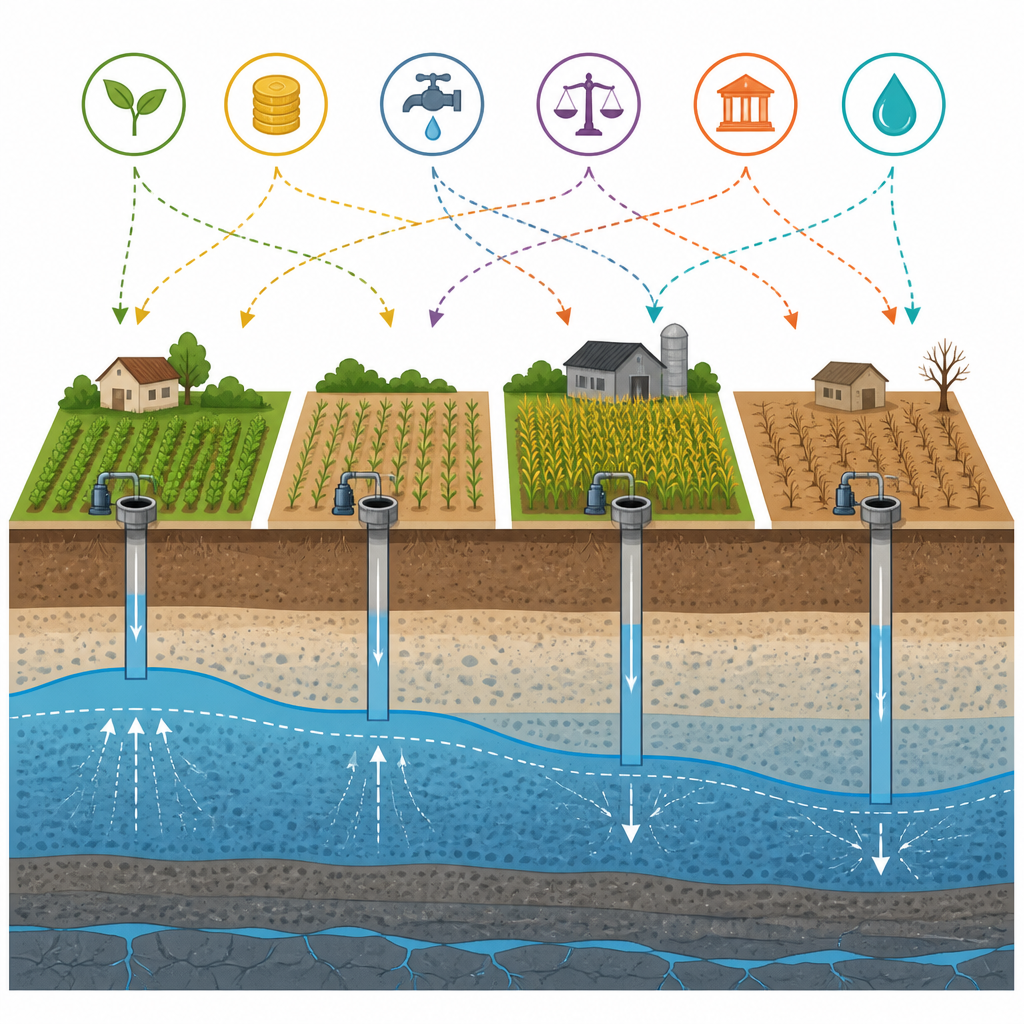
Testing incentives, penalties, and water trading
After calibrating the model against real well records and observed crop areas, the authors test three policy scenarios. Raising the prices of water‑saving crops encourages farmers to switch toward them, increasing profits by 88 percent, cutting farm water use by 16 percent, and lifting the average water table by just over a meter. Fining high‑water‑use crops reduces consumption slightly more and improves the water table by 1.15 meters, but trims farmers' income by about 5 percent, which could fuel resistance and rule‑breaking. A simple water market, in which some farmers sell part of their water rights to industry, delivers the largest recovery in groundwater levels, about 1.66 meters, while still modestly increasing profits overall.
What this means for people and water
The study shows that the fate of an aquifer is not set only by climate and pumps, but also by hopes, fears, and pocketbooks of the people who depend on it. Where farmers are poor, highly dependent on agriculture, and distrustful of authorities, harsh limits can backfire and lead to illegal pumping. By contrast, well‑designed price incentives and carefully managed water markets can align farmer welfare with aquifer health. The modeling framework, which links human behavior and groundwater at fine detail, offers a tool that can be adapted to other regions to explore which mixes of rewards, rules, and support are most likely to keep both farms and underground water reserves alive.
Citation: Soleimanzadeh, Z., Ahmadi, A. A distributed socio-hydrological framework for integrating perception and groundwater dynamics in farmers’ crop choice modeling. Sci Rep 16, 15376 (2026). https://doi.org/10.1038/s41598-026-44157-5
Keywords: groundwater, farmers, crop choice, agent based model, water policy