Clear Sky Science · en
Dynamic evaluation of waterfowl habitat quality based on an integrated multi-indicator framework and habitat function enhancement strategies in Xianghai Nature Reserve
Why these wetlands matter to birds and people
Across the globe, wetlands that shelter ducks, cranes, herons, and shorebirds are shrinking or breaking apart. The Xianghai Nature Reserve in northeast China is one such wetland, and it plays a vital role as a stopover and breeding site along major bird migration routes. This study asks a practical question with wide relevance: how can we track the changing quality of bird habitat in a single wetland over time and use that information to guide smarter protection and restoration?
Looking at the wetland as a living system
Instead of focusing on just one factor, such as water level or plant cover, the researchers treated the wetland as an interconnected system. They combined satellite images, hydrological modeling, and field bird counts from 2014 to 2023 in Xianghai. From satellites they measured how water surfaces were connected across the landscape, how green and dense the vegetation was, and how deep the water was in different places. In the field, they watched waterbirds at 34 sites, recording how many species and individuals were present, from geese and ducks to herons and sandpipers. Together these pieces formed a picture of how water, plants, and birds respond to each other through wet and dry years.
Building a single score for habitat quality
To make sense of this large amount of information, the team created a Habitat Quality Index, or HQI. They first converted each ingredient into a common 0 to 1 scale, where higher values mean better conditions for waterbirds. These ingredients were hydrological connectivity (how well water patches link up), vegetation cover, water depth, and the diversity of bird species. Using a blend of statistical methods and expert judgment, they assigned weights to each ingredient, with connectivity receiving the strongest influence. The HQI was then calculated for every pixel across the reserve, producing yearly maps of habitat quality that range from very poor to excellent.
What changed over a decade
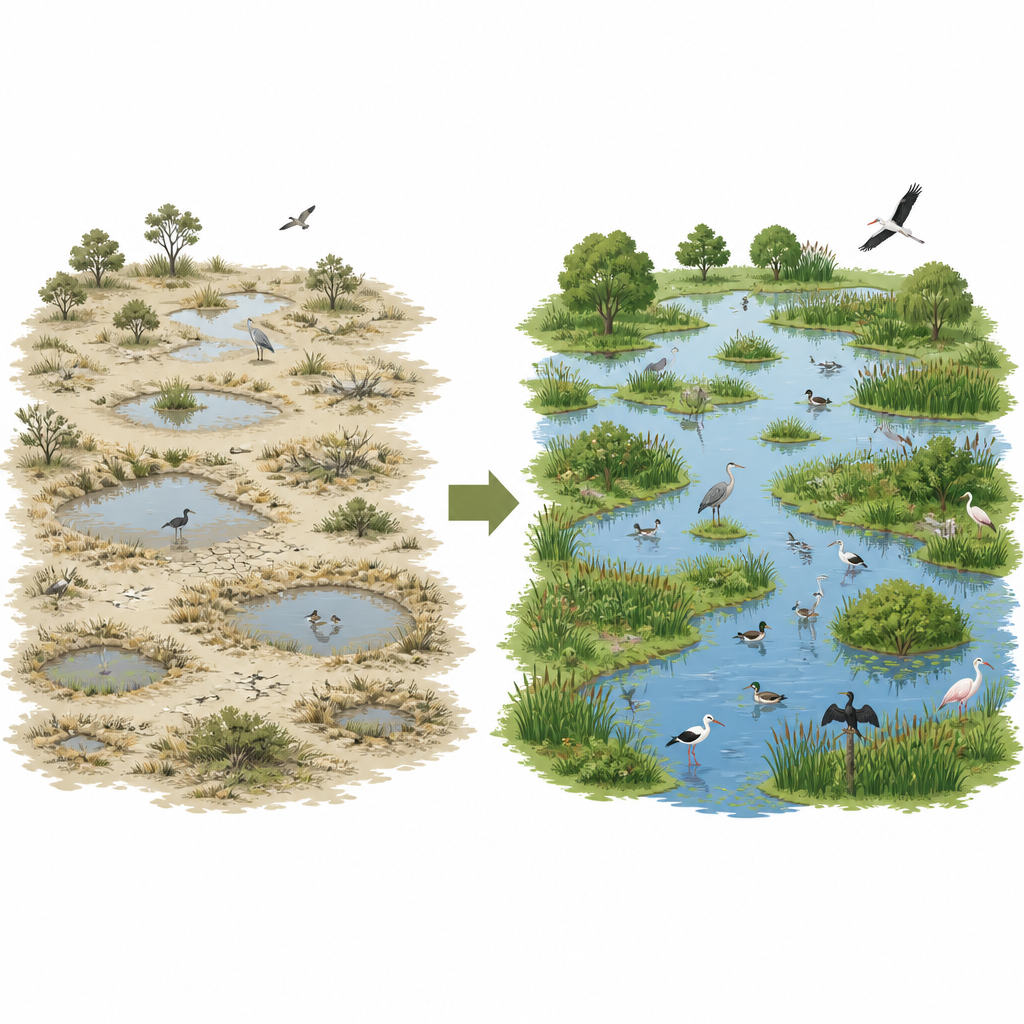
The HQI maps show that Xianghai’s bird habitat first declined, then recovered. From 2014 to 2019, low rainfall and shrinking water bodies broke up connections between ponds and lakes. Water became shallower and more scattered, plants did not thrive in many areas, and the diversity of waterbirds fell, reaching a low point in 2019. High-quality habitat patches were small, isolated, and mostly confined to the wetland core. Starting around 2020, a combination of better rainfall and deliberate water releases into the reserve helped reconnect channels and deepen key areas. Vegetation along lake edges rebounded, bird diversity increased, and high-quality habitat patches grew larger and more continuous through 2023.
Where the best bird habitat is found
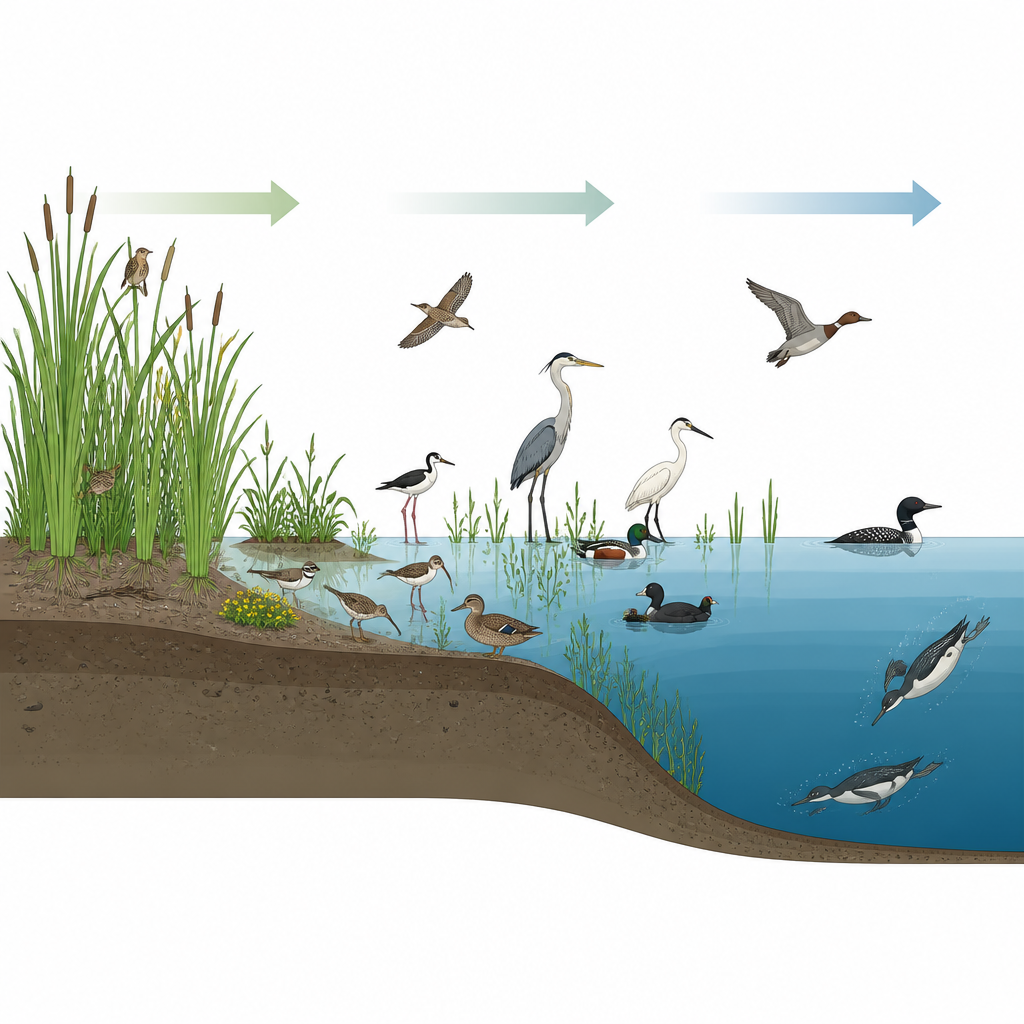
Across all years, the richest bird habitats clustered in the central parts of the reserve and around the main lakes, where water stays connected, depths are moderate, and a mix of open water, mudflats, and low vegetation provides both food and shelter. Outer zones near farmland and roads tended to score lower, reflecting weaker water links, more extreme water levels, and heavier human disturbance. The study also revealed that very dense vegetation away from open water can actually reduce habitat quality for many waterbirds, which prefer a mosaic of shallow water, sparse plants, and bare ground for feeding and resting.
Guiding smarter protection and repair
By distilling complex wetland processes into the HQI, the researchers were able to divide Xianghai into zones that call for different actions. Core areas with high HQI should be shielded from interference so natural processes can continue. Surrounding zones with moderate scores are prime targets for repair, such as restoring water flow paths and replanting native wetland plants. Edge zones with low HQI, where farms, roads, and towns exert strong pressure, require stricter control of human activities and the creation of buffer strips. For a layperson, the main message is clear: keeping water flowing in connected, moderately deep channels is the key to healthy wetlands and thriving bird life, and a clear, data-driven index can help managers see where that effort will matter most.
Citation: Wu, C., Yan, Y. & Liu, J. Dynamic evaluation of waterfowl habitat quality based on an integrated multi-indicator framework and habitat function enhancement strategies in Xianghai Nature Reserve. Sci Rep 16, 15394 (2026). https://doi.org/10.1038/s41598-026-44152-w
Keywords: wetland habitat, waterbird diversity, hydrological connectivity, vegetation cover, habitat restoration