Clear Sky Science · en
Experimental and machine learning evaluation of crumb rubber concrete strength at elevated temperatures
Turning Old Tires into Safer Buildings
Mountains of worn out car tires are piling up around the world, taking up space in landfills and posing fire risks. One promising idea is to grind these tires into small crumbs and mix them into concrete, creating buildings and roads that reuse waste instead of natural sand. This study explores how such crumb rubber concrete behaves when it gets very hot, such as during a fire, and shows how modern computer tools can help engineers predict its strength without testing every recipe in the lab. 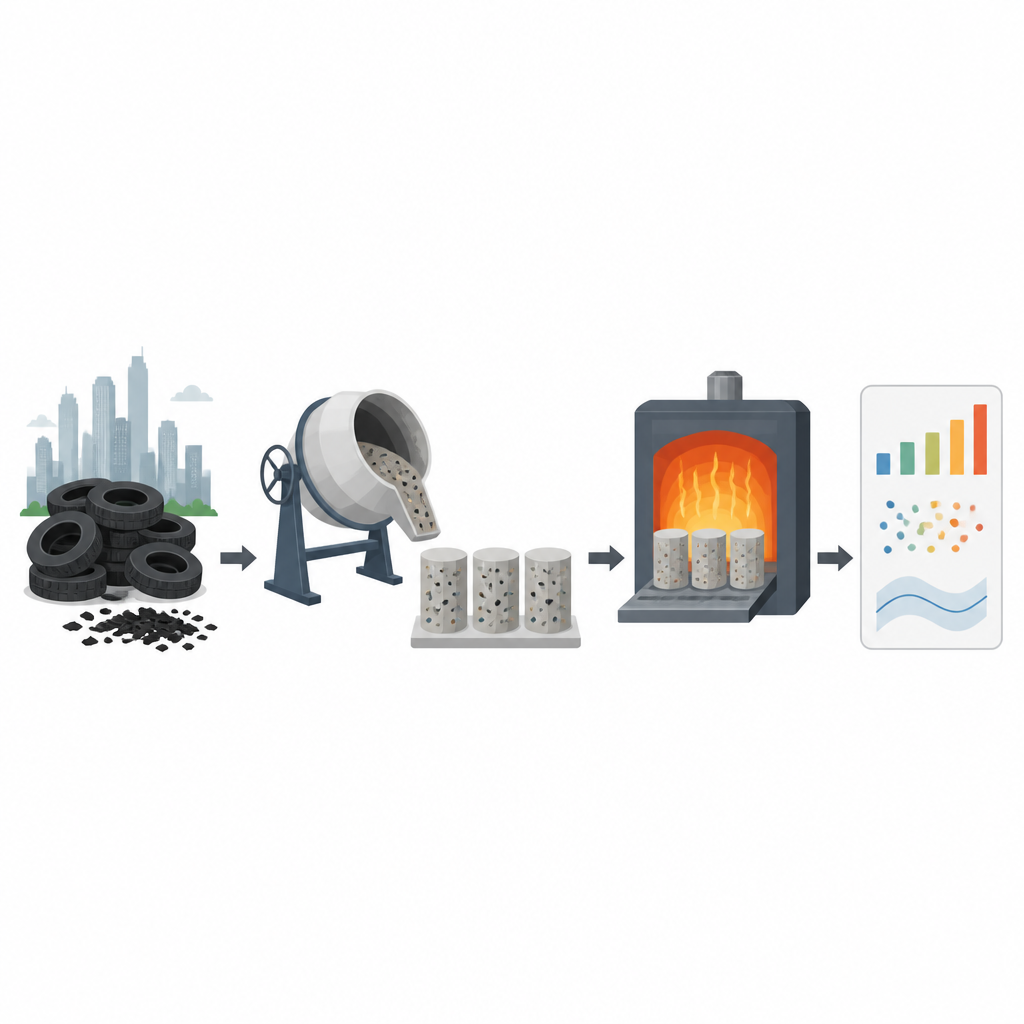
From Waste Piles to Concrete Mix
The researchers start by looking at why tire rubber in concrete is attractive and tricky at the same time. Rubber particles can make concrete lighter, better at absorbing impacts, and more resistant to sudden breakage. However, they also weaken the material because rubber does not bond well with the hardened cement paste. This weak bond, plus extra air pockets around the rubber, tends to reduce both how much load the concrete can carry and how well it holds together in tension. Earlier studies tested many rubber mixes, but there was still no clear and reliable way to predict how these mixes would perform under different temperatures and curing conditions.
Heating Rubber Concrete in the Lab
To tackle this problem, the team made several concrete mixes in which fine sand was partly replaced by crumb rubber at levels of 10, 20, and 30 percent. They cast cylindrical samples, let them harden, then exposed them to different temperatures up to 200 degrees Celsius before crushing and splitting them to measure compressive and tensile strength. As expected, adding more rubber reduced strength at room temperature, because the concrete became less dense and the rubber particles formed weaker links in the internal skeleton. Heating made things worse in most cases: as the rubber began to decompose and expand, it created more tiny voids and microcracks, further eroding strength, especially in mixes with the highest rubber content. 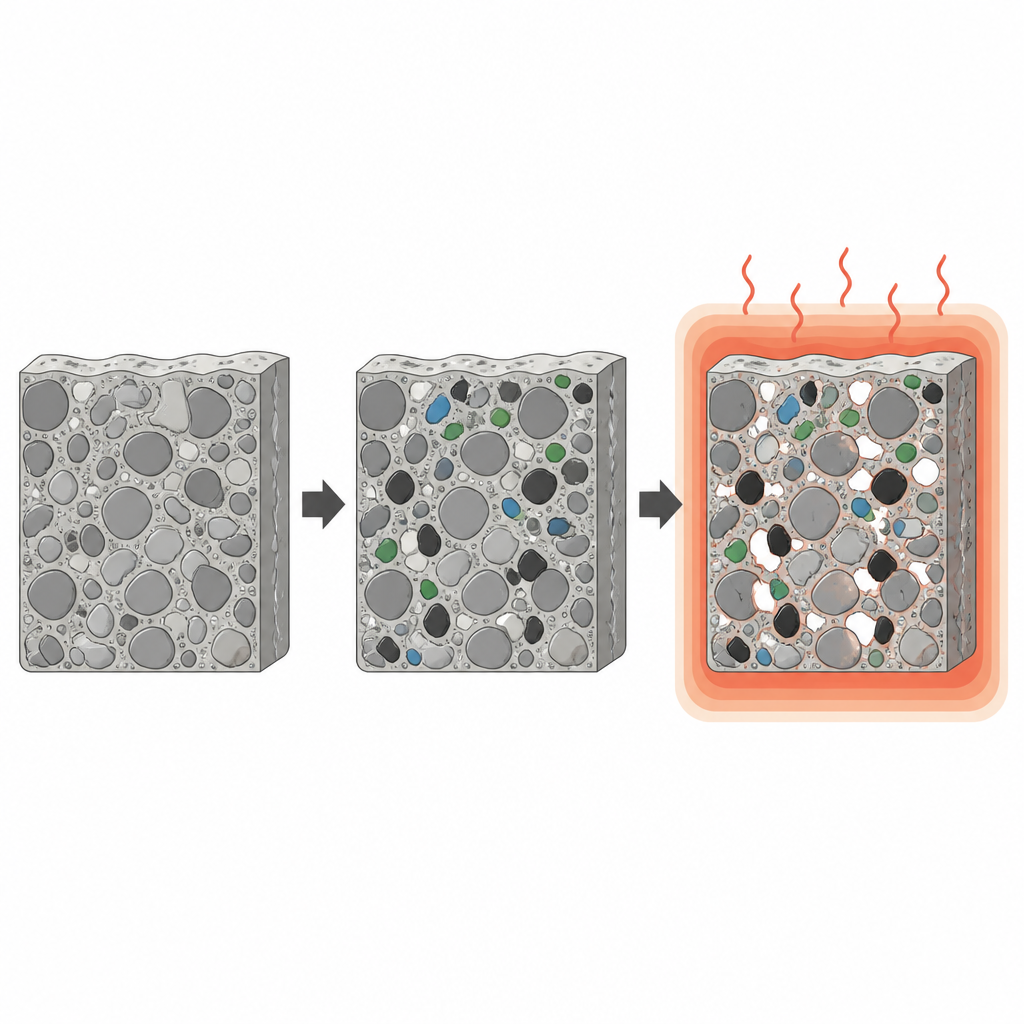
Teaching Computers to Predict Strength
Instead of relying only on new tests, the researchers also assembled a large database of more than a thousand rubber concrete mixes reported in earlier studies. For each mix they recorded ingredients such as cement, supplementary powders, rubber content, water level, curing temperature, and age, along with measured compressive and tensile strength. They then trained nine different machine learning models to learn the connection between the recipe and the resulting strength. Sophisticated approaches such as XGBoost, Light Gradient Boosting, and a type of neural network called a multilayer perceptron produced the most accurate predictions, with results closely matching real test values for both compression and tension.
Seeing Which Ingredients Matter Most
To make sense of these digital predictions, the team used an interpretability method that assigns each input a share of responsibility for the final answer. This revealed that how much fine aggregate is replaced by rubber, the amount of water relative to cement, and the age of the concrete are the strongest drivers of compressive and tensile strength. Fine rubber replacement especially stood out, confirming that changing the tiny particles inside the mix has a big effect on how the material behaves. Other additives such as silica fume were helpful but less dominant, while curing temperature within the studied range played a smaller role than expected in the combined database.
What This Means for Greener Construction
For non specialists, the key message is that using shredded tires in concrete can help cut waste but will usually lower strength, particularly when the material is exposed to high heat. The study shows that this loss can be managed if engineers know exactly how much strength to expect for a given mix and temperature. By blending careful lab testing with powerful computer models, the authors provide a tool that can quickly estimate how crumb rubber concrete will perform, guiding safer designs and smarter use of recycled materials in buildings that must face both everyday loads and potential fires.
Citation: Alameri, M., Alsulami, B.T. Experimental and machine learning evaluation of crumb rubber concrete strength at elevated temperatures. Sci Rep 16, 15616 (2026). https://doi.org/10.1038/s41598-026-44147-7
Keywords: crumb rubber concrete, waste tire recycling, elevated temperature, machine learning models, concrete strength