Clear Sky Science · en
Foggy water surface target detection model based on joint optimization
Why clearer views on the water matter
Ships, ferries, and small unmanned boats increasingly rely on cameras and artificial intelligence to spot other vessels and obstacles. But in fog or haze, cameras see a world that looks washed out and blurry, especially on open water where waves, glare, and distance already make objects hard to see. This study explores a smarter way to clean up foggy images and detect tiny boats more reliably, with the aim of making navigation safer in poor visibility.
Fog, small boats, and a tough vision problem
On a clear day, modern object detection systems can usually find cars, people, and boats in an image with high accuracy. In foggy scenes, however, contrast drops, edges soften, and colors fade, so small targets almost vanish into the background. Standard deep learning detectors that work well on sharp images often miss these faint outlines, particularly when drones or shore cameras are watching wide areas and each boat occupies only a few pixels. Existing approaches either retrain detection models directly on hazy images, chain a separate dehazing step before detection, or bundle several tasks together in one shared network. Each strategy helps, but none fully overcomes the combined challenges of haze and tiny targets on the water.
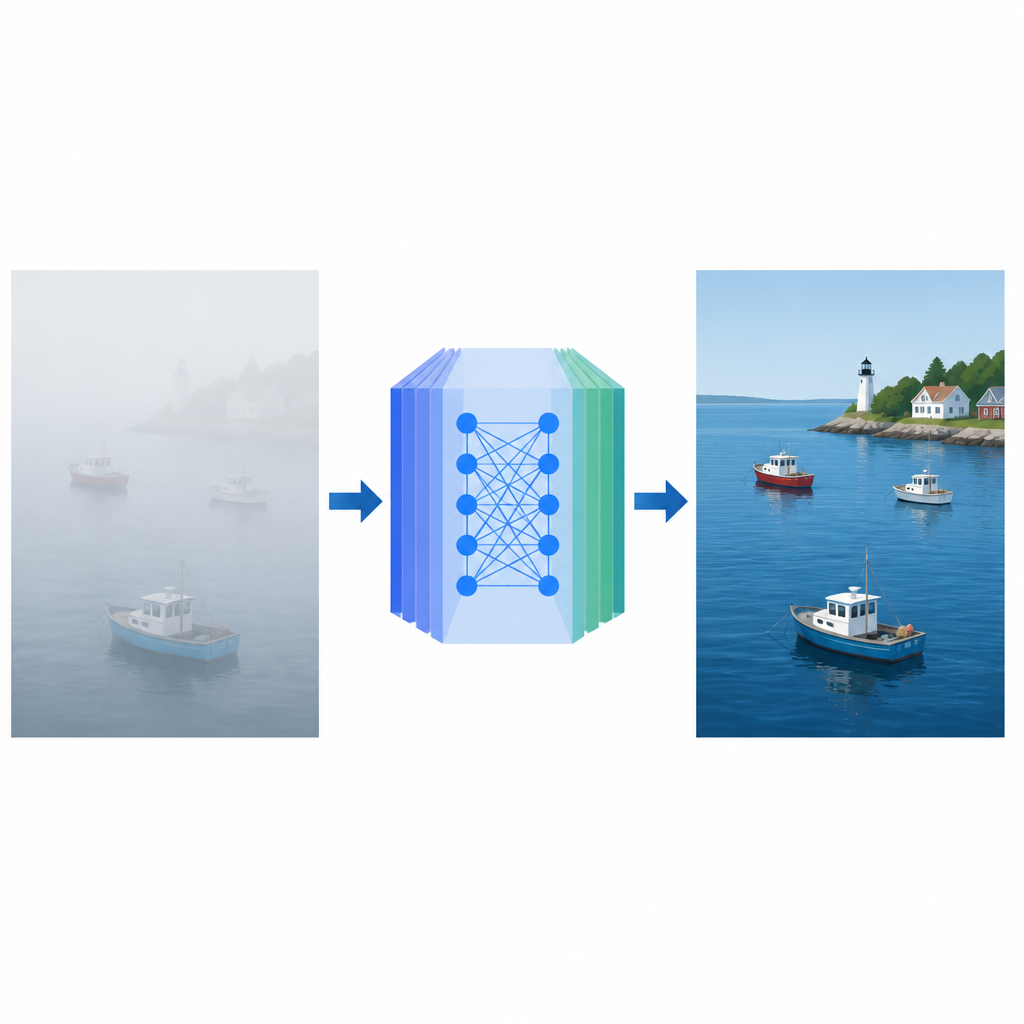
A joint system that learns to see through haze
The authors propose a joint system called DTDJO that tackles the problem from two angles at once. First, a specialized dehazing network takes the raw foggy image and tries to restore clearer structure and contrast, focusing on preserving fine details that might belong to small boats. Second, an improved detection network examines the cleaned image to find and classify targets. Instead of training these two parts separately, the system is optimized end to end, so learning to remove haze is guided by the ultimate goal of detecting objects correctly. This joint training encourages the dehazing step to highlight features that matter most for detection, rather than just producing the prettiest image.
Paying attention to tiny details
To make the dehazing part more effective, the researchers redesign how the network pays attention to image features. They introduce a multi scale module that looks at patterns of different sizes while also tracking where important structures lie across the image. This helps the system bring back sharp edges and subtle textures that belong to small, distant targets. They also refine the way information from early and deeper layers is combined, so that fine pixel details and higher level patterns support each other instead of competing. To keep the method practical, they replace heavier mathematical blocks with lighter ones that need fewer calculations, speeding up processing without sacrificing quality.
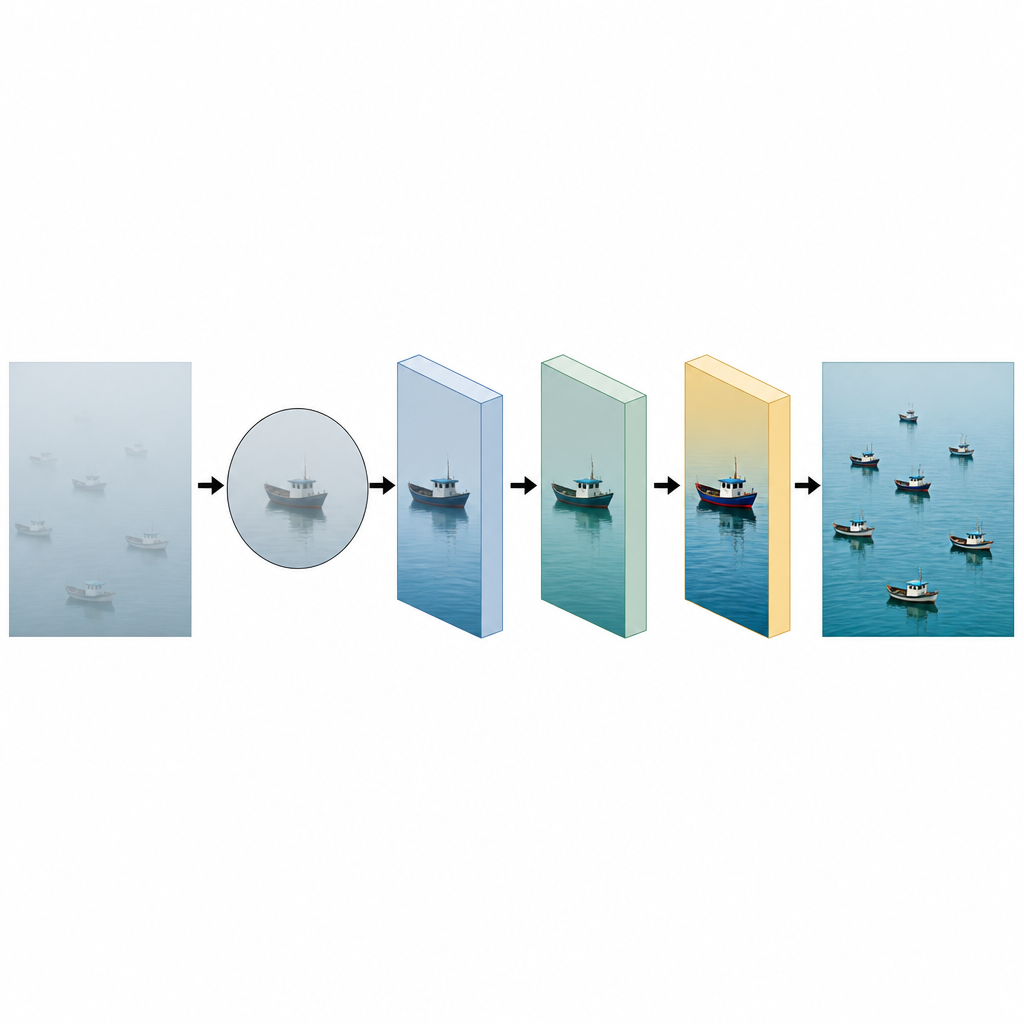
Helping the detector focus on small boats
Improving the cleaned image is only half the story. The detection part of DTDJO is based on a modern one stage detector, but the authors add a mixed attention module that strengthens useful signals and suppresses cluttered background. This module combines information about which image channels are most informative with where, in space, the most relevant regions lie. In foggy water scenes, that means emphasizing the faint shapes of boats and reducing the influence of waves, reflections, and sky. The team also builds new training sets by taking popular detection benchmarks and inserting realistic haze using a physical scattering model, allowing them to test the system on both general scenes and water specific imagery.
Measured gains in hazy real world scenes
When tested on the new foggy drone and mixed water scene datasets, DTDJO consistently outperforms both standard detectors and other haze aware methods. It detects more small and distant objects, misses fewer boats, and is better at separating overlapping targets that partially hide one another. Compared with a strong baseline detector, the joint system raises average detection accuracy by a few percentage points on both datasets, which represents a substantial gain in such challenging conditions. At the same time, its design keeps the computing cost well below that of some heavier multi task models, making it more suitable for real time use.
Clearer paths for safer navigation
In simple terms, this work shows that training an image cleaning step and an object detector together can help cameras spot small boats more reliably in fog. By learning which parts of a hazy image are truly important for finding targets, the system clears just enough of the view and guides the detector to focus on the right details. While the study centers on water surfaces and drone or shore based cameras, the same idea could support safer navigation and surveillance in many low visibility settings, from coastal harbors to rivers and ports.
Citation: Zhang, H., Wang, H. Foggy water surface target detection model based on joint optimization. Sci Rep 16, 15693 (2026). https://doi.org/10.1038/s41598-026-44144-w
Keywords: foggy object detection, water surface imaging, image dehazing, small boat detection, maritime computer vision