Clear Sky Science · en
Quantum-inspired NSGA-II for multi-objective optimization of electric vehicle charging stations
Why smarter charging stations matter
As electric cars become more common, cities face a puzzle: where should charging stations go so that drivers can plug in easily, power companies can keep the lights on, and costs don’t explode? Put in too few chargers and drivers wait in line. Build too many in the wrong places and expensive equipment sits idle while the grid is pushed to its limits. This paper introduces a new planning method that borrows ideas from quantum physics to design charging networks that are cheaper, fairer, and kinder to the power grid.
Juggling cost, convenience, and the power grid
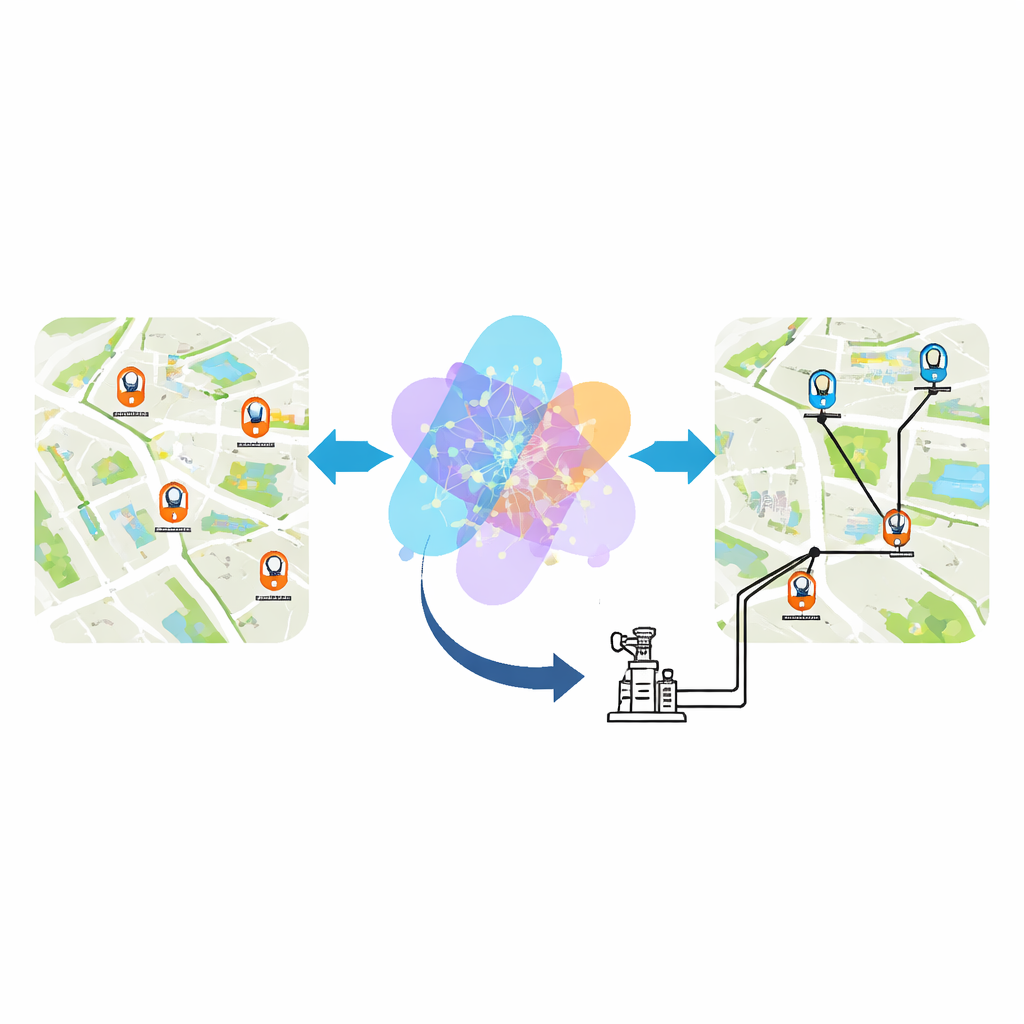
Designing a charging network is not just a matter of sprinkling plugs on a map. Operators must weigh at least three competing goals at once: keeping installation and running costs low, giving drivers good access across a city, and avoiding dangerous strain on the electricity network. Traditional planning tools often focus on one goal at a time or struggle when the problem becomes large and messy, as it does in real cities where traffic, prices, and solar power output all fluctuate. The authors frame charging-station planning as a truly multi-goal problem and seek whole sets of trade-off solutions, rather than a single “best” answer.
Borrowing tricks from the quantum world
To search this tangled landscape of possibilities, the researchers build on an evolutionary optimization method known as NSGA-II and enhance it with “quantum-inspired” ideas. Instead of treating each decision—whether to place a charger at a candidate site—as a fixed yes or no, the algorithm represents it as a qubit, a tiny mathematical object that can encode probabilities of both choices at once. Special update rules, inspired by how quantum states rotate and become linked (entangled), let the method explore many combinations efficiently while still homing in on promising patterns. In practical terms, this means it can keep a diverse set of options on the table while steadily improving them.
Capturing real-world linkages in cities and grids
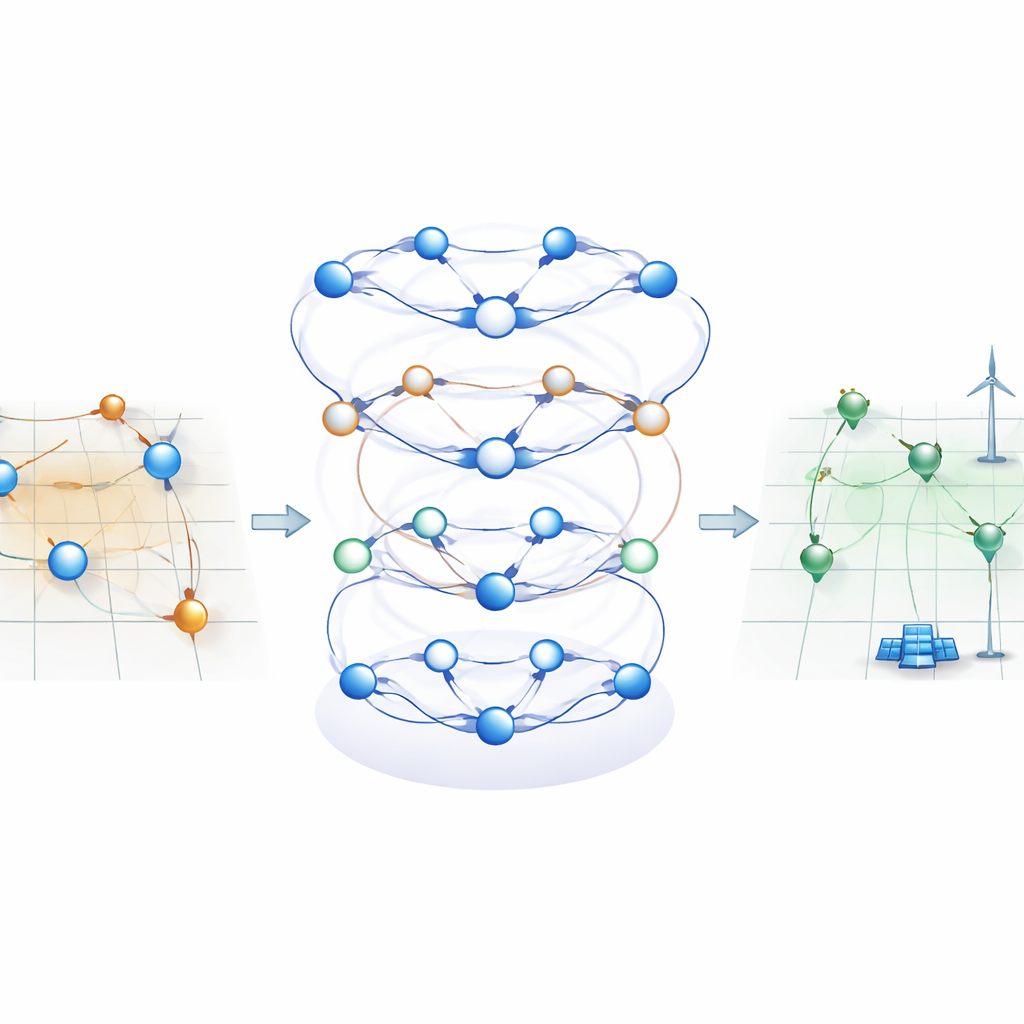
A key innovation is the way the method ties together related decisions. Installing a large station in one neighborhood can reduce the need for stations nearby and also reshape how electricity flows through local power lines. The algorithm mimics this interdependence by “entangling” certain decision pairs so that changing one tends to change the other. It also adjusts its search steps based on how much better or worse a new candidate solution is, taking big leaps when the gain is clear and smaller nudges when it is not. On top of this, a focused local search fine-tunes the most promising layouts by adding, removing, or swapping individual stations while continually checking that budgets and grid safety limits remain intact.
Testing on real charging data and a standard grid
Rather than relying only on small toy examples, the authors test their approach on three large collections of actual charging sessions from Palo Alto, Boulder, and a multi-region dataset of more than 70,000 events, alongside a widely used model of a 33-bus distribution network. Across these cases, the quantum-inspired method consistently finds station layouts that cut total installation costs by roughly a third compared with a classical NSGA-II baseline, while also expanding the share of demand that can be served and making power flows more even. It achieves better coverage of trade-off options, converges more reliably toward high-quality solutions, and keeps voltages in the grid within safe limits, all with only a modest increase in computing time.
What this means for future electric mobility
In plain terms, the study shows that smarter math can turn today’s messy charging build-out into a more orderly, efficient system. By exploring many possible layouts at once and preserving those that strike different balances between cost, access, and grid health, the quantum-inspired method gives planners a rich “menu” of choices instead of a single rigid plan. Cities and utilities could use such tools to decide how many stations to build, where to place them, and how to coordinate them with rooftop solar and batteries, all while keeping drivers moving and the grid stable. As electric vehicles spread and charging demands grow more complex, approaches like this offer a path to scaling up infrastructure without overbuilding or overloading the wires that power our daily lives.
Citation: Kumar, L., Solanki, S., Jhariya, M.K. et al. Quantum-inspired NSGA-II for multi-objective optimization of electric vehicle charging stations. Sci Rep 16, 14666 (2026). https://doi.org/10.1038/s41598-026-44141-z
Keywords: electric vehicle charging, charging station planning, power grid stability, multi-objective optimization, quantum-inspired algorithms