Clear Sky Science · en
Microfluidic investigation of synergistic mechanisms of microsphere-microbial compound system for enhanced oil recovery
Why squeezing more oil from old wells matters
Much of the world’s easy-to-reach oil has already been pumped, leaving behind stubborn pockets trapped in tiny rock pores underground. As fields age, they often produce mostly water with only a trickle of oil, yet a large share of the original oil still sits in place. This study explores a new way to coax more of that leftover oil out using a teamwork approach between man-made particles and living microbes—promising a cleaner, more efficient way to extend the life of existing reservoirs without drilling as many new wells.
A teamwork approach in the rock’s hidden channels
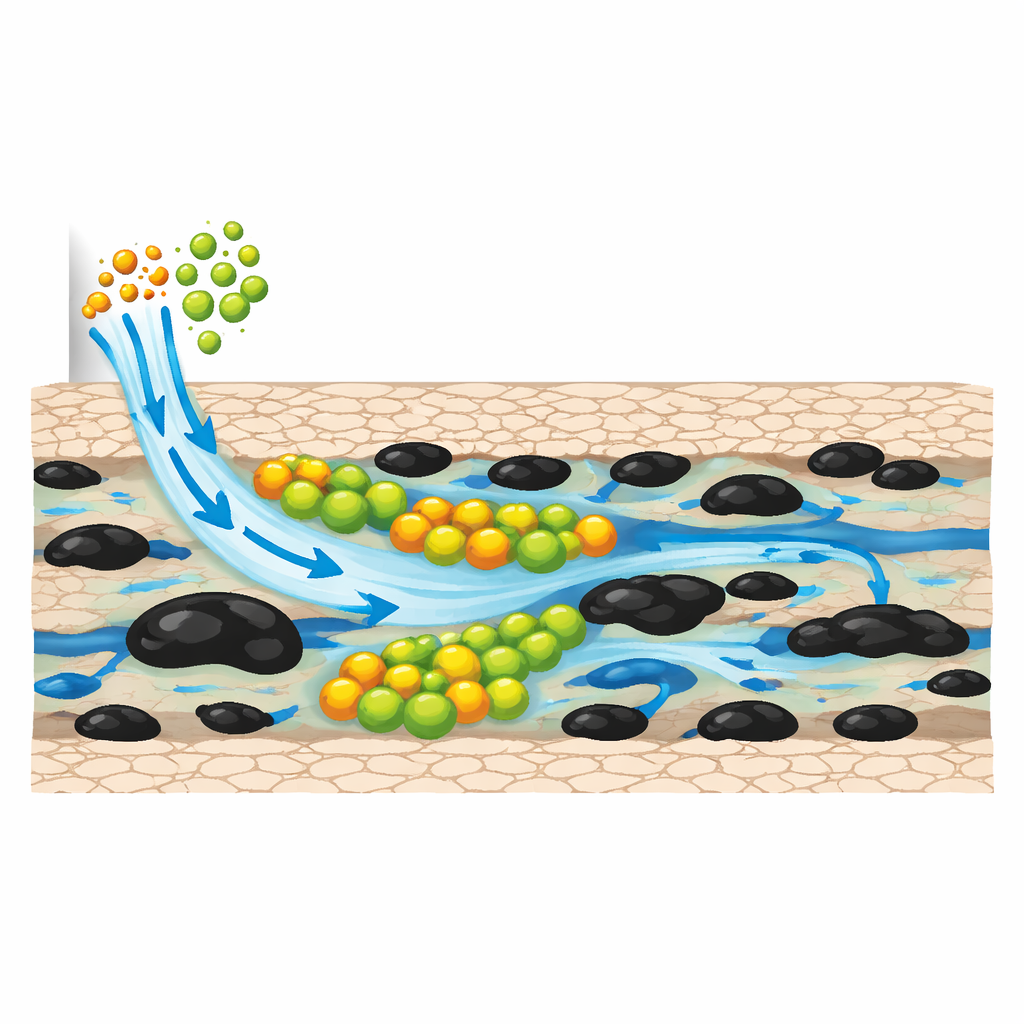
Traditional methods to flush out trapped oil rely on chemicals like polymers and surfactants, which thicken water or alter how it wets the rock. These methods can struggle in real reservoirs, where flow tends to rush through a few “highways” and bypass large areas. Two newer ideas—injecting soft microspheres and using oil-loving microbes—each help in different ways but also have weaknesses. Microspheres can swell and block the biggest channels, pushing water into tighter regions, yet their chemical action is short-lived. Microbes can slowly release natural detergents that loosen oil, but they spread unevenly and do little to correct the channeling problem. The researchers set out to see whether combining them into a single “compound system” could do better than either alone.
Watching oil and water move through a glass rock
To test this hybrid strategy, the team built glass chips etched with a maze of pores copied from a real rock sample. They filled the miniature rock with model oil, then mimicked how an oilfield is operated: first flooding with water until almost only water flowed out, and then injecting one of three agents—microspheres alone, microbes alone, or the combined mixture—followed by more water. High-resolution microscopes allowed them to watch in real time how oil blobs broke up, shifted, or stayed put in different parts of the pore network. Computer analysis of the images turned the colored patches of oil and water into numbers, revealing how much oil remained in the main flow paths versus the side zones.
How tiny partners change the way oil sticks and flows
Pictures taken during and after injection showed that the compound mixture changed the rock’s surface behavior more strongly than either ingredient alone. At first, surfactants wrapped inside the microspheres leaked out, making the rock less oil-wet and helping detach oil films from the pore walls. Over a quiet “shut-in” period with no flow, the microbes then produced their own surfactants, further loosening oil that had been only partially mobilized before. Measurements of the apparent contact angle—how sharply an oil droplet meets the rock surface—confirmed that both microbes and the combined system made oil easier to dislodge, whereas microspheres by themselves barely affected this property once injection stopped.
Building long-lasting plugs that redirect water
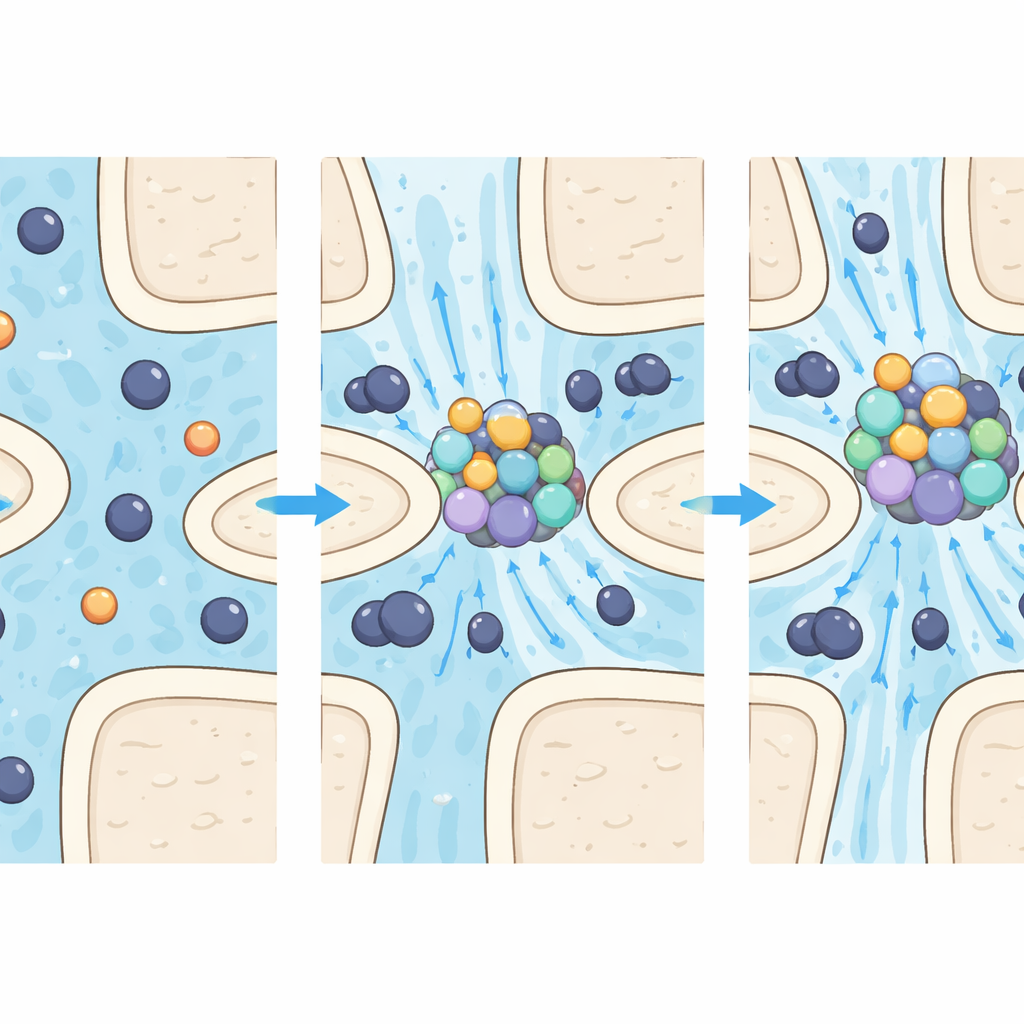
Beyond loosening oil, the compound system excelled at steering water toward previously neglected corners of the rock. The researchers seeded the flowing water with fluorescent tracer particles and used a technique called micro–particle image velocimetry to map speeds in the pores. They found that, compared with single agents, the compound mixture made flow speeds in the main channels and side areas more similar, indicating that water was no longer racing through just a few paths. Microscopy revealed why: microbes and polymer microspheres stuck together to form small clusters that lodged in the widest channels, acting as flexible skeletons for microbial attachment. These clusters resisted being torn apart by shear forces and maintained partial blockages even when clean water was later pushed through, keeping more flow directed into side pores where oil remained.
More oil from less chemical, and what it means
When the dust settled, the combined microsphere–microbe system recovered about 7% more oil than microbes alone and about 5% more than microspheres alone—even though it used only half as much microsphere material as the single-microsphere flood. In simple terms, the two ingredients provided a relay: microspheres led the first charge by quickly changing how oil and water interact and by reshaping the flow paths, and then microbes took over during the resting period, steadily generating natural surfactants that kept prying oil loose. The study suggests that carefully designed partnerships between engineered particles and native microorganisms could help tap significant extra oil from mature, mid- to low-permeability reservoirs while limiting chemical use. Future work in three-dimensional models and real fields will be needed to fine-tune these systems, but the pore-scale experiments offer a clear window into how this unlikely duo can work together underground.
Citation: Li, H., Zhu, W., Song, Z. et al. Microfluidic investigation of synergistic mechanisms of microsphere-microbial compound system for enhanced oil recovery. Sci Rep 16, 14253 (2026). https://doi.org/10.1038/s41598-026-44131-1
Keywords: enhanced oil recovery, microfluidics, microspheres, microbial flooding, porous media flow