Clear Sky Science · en
Analysis of the correlation between lower limb muscle synergy characteristics and landing load during single-leg landing in humans
Why one-legged landings matter
Every time an athlete comes down from a jump on a single leg, their joints briefly face forces several times their body weight. How well the leg muscles share and absorb that impact can mean the difference between a safe landing and a torn ligament. This study asks a deceptively simple question: not just how strong the muscles are, but how well they work together as a team when the foot hits the ground.
How the leg’s “team play” was measured
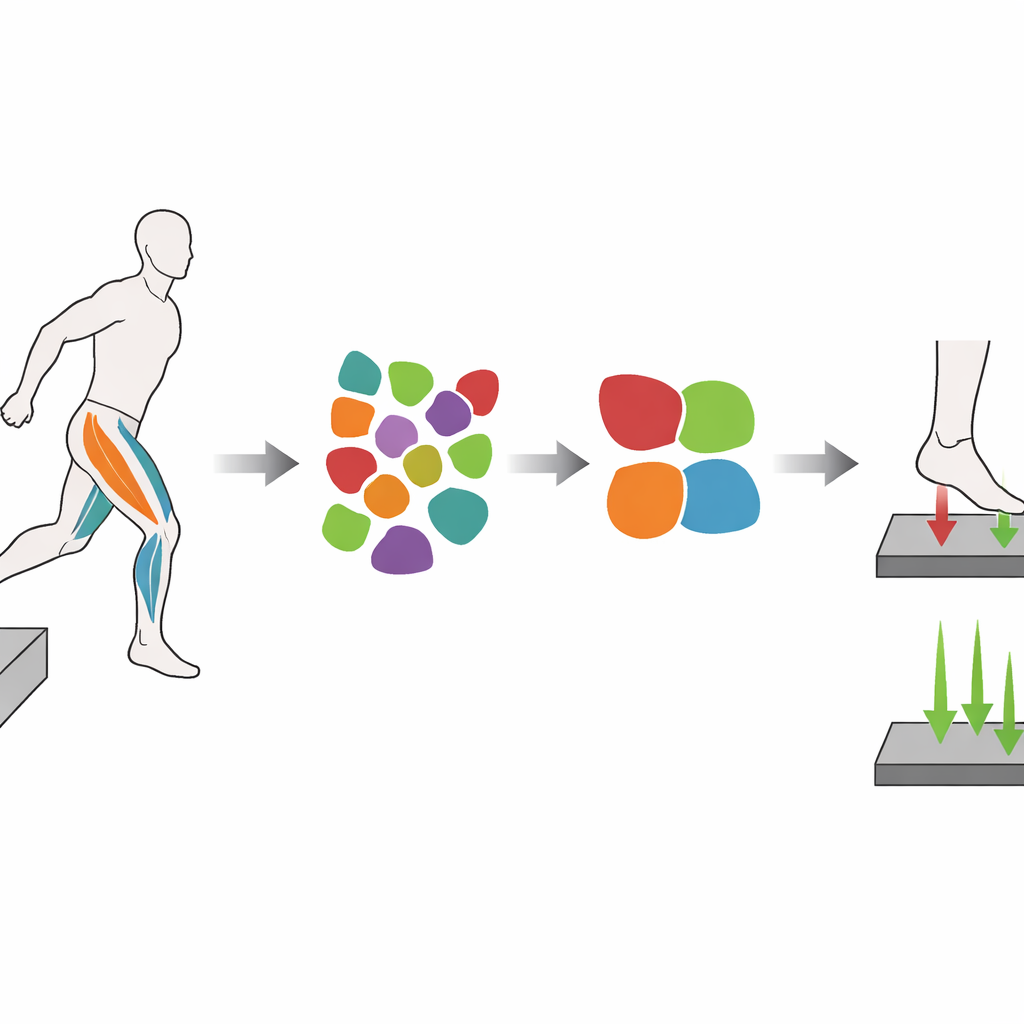
Researchers in China recruited 21 young male basketball and volleyball players and had them drop from a 30-centimeter platform, landing on one leg on a force plate. While they landed, sensors on seven key muscles—from the front and back of the thigh to the calf and shin—recorded the tiny electrical signals that accompany muscle activity. Using a mathematical method called non-negative matrix factorization, the team grouped these signals into “synergies”: recurring patterns showing which muscles tend to switch on together and when. At the same time, they measured how hard the athletes hit the ground, how quickly the force rose, and how stiff the leg behaved overall.
Three main patterns of muscle teamwork
The analysis revealed three distinct muscle synergies that consistently appeared across athletes. One pattern mainly involved the big muscles at the front of the thigh that straighten the knee, and it dominated the later “buffering” part of the landing when the body sinks down to absorb force. A second pattern coordinated other thigh muscles, while a third pattern was driven mostly by the calf and shin muscles and was most active right after the foot first touched down. Importantly, athletes who recruited more of these synergies during landing tended to experience lower peak impact forces. In other words, when more coordinated muscle groups joined the effort, the load on any one joint or tissue was reduced.
Timing: not just who works, but when
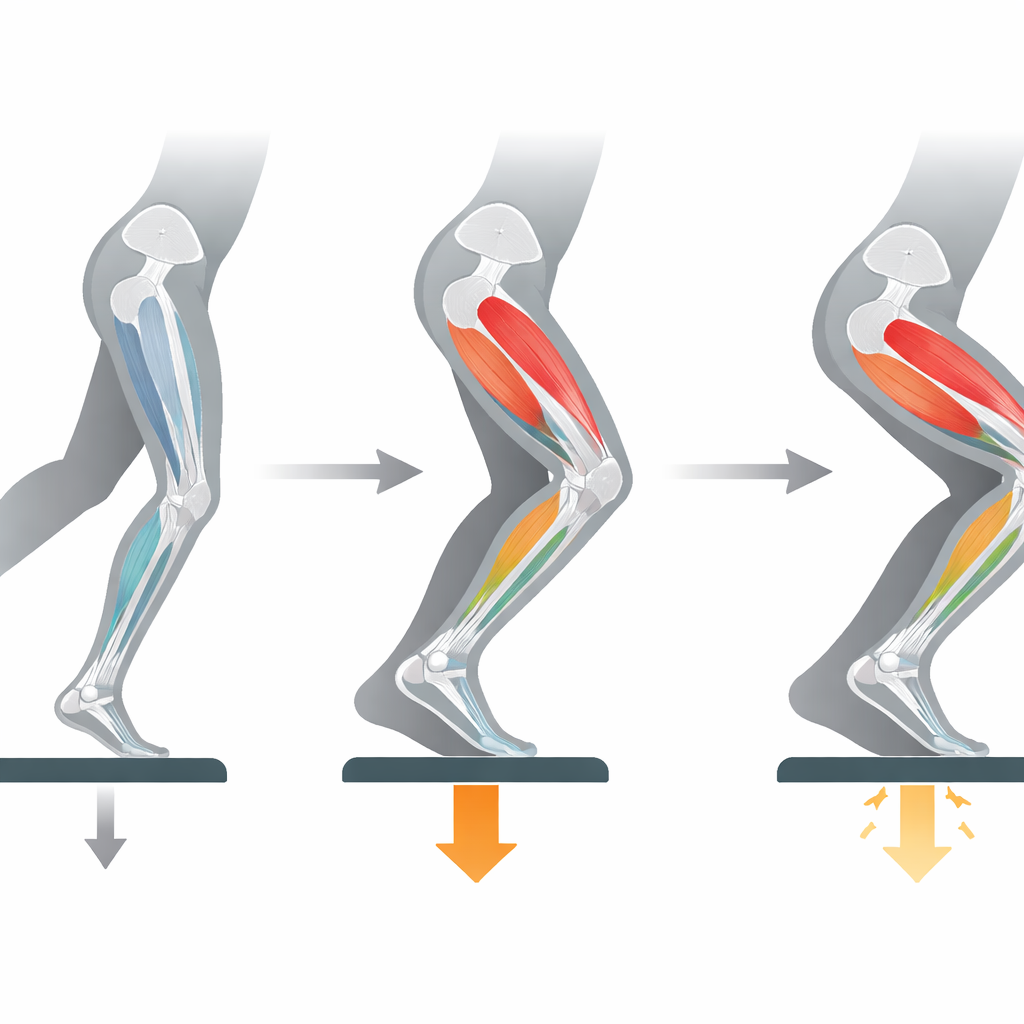
Beyond the number of patterns, the timing of their peak activity also mattered. When the “buffering” synergy led by the front-thigh muscles reached its peak earlier, the leg behaved less stiffly, allowing the knee to bend more and spread the impact over a longer time. This is generally considered safer for the joint. Meanwhile, when the calf-and-shin synergy reached its peak more quickly during the first instant of contact, peak impact forces tended to be lower. Rapid ramp-up of these lower-leg muscles seems to help create a pre-tensed, spring-like system that can store and release energy, sparing bones and ligaments from sharp jolts.
Which muscles pull extra weight
The study also examined how heavily individual muscles contributed within each synergy. A stronger role for the rectus femoris—a major front-thigh muscle that helps control knee bending—was linked to lower peak forces and less leg stiffness, suggesting that well-trained, well-timed eccentric (lengthening) strength in this muscle improves cushioning. The semitendinosus, a hamstring muscle at the back of the thigh, also showed a protective role: greater involvement of this muscle related to a slower rise in impact forces, hinting at better sharing of load and improved knee stability. In contrast, when the tibialis anterior, a shin muscle that pulls the foot upward, played too dominant a role in the early-impact synergy, peak impact forces tended to rise, possibly because the ankle stiffened too soon and shifted more shock up the chain.
What this means for training and injury prevention
For coaches, therapists, and athletes, these findings suggest that safer landings depend less on any single “star” muscle and more on balanced, well-timed teamwork across the leg. Encouraging more diverse muscle recruitment patterns, training the front-thigh and hamstring muscles to control bending under load, and practicing quick yet not excessive activation of the calf and shin muscles could all help soften landings. At the same time, avoiding over-reliance on the shin muscle that lifts the foot may prevent the ankle from becoming too rigid too early. Overall, smarter neuromuscular training that targets how muscles coordinate—not just how strong they are—may reduce landing loads and lower the risk of knee and ankle injuries.
Citation: Bi, C., Wei, M. & Yang, F. Analysis of the correlation between lower limb muscle synergy characteristics and landing load during single-leg landing in humans. Sci Rep 16, 13232 (2026). https://doi.org/10.1038/s41598-026-44108-0
Keywords: single-leg landing, muscle synergy, sports injury prevention, landing biomechanics, neuromuscular control