Clear Sky Science · en
A scaling up of flattening silver particles using dry ball milling by DEM simulation
Why making tiny silver flakes matters
From solar panels on rooftops to the chips inside smartphones, many modern devices rely on pastes and adhesives filled with tiny bits of metal to carry electricity and heat. Flat, flake‑shaped silver particles are especially prized because their broad faces touch each other easily, creating smooth, low‑resistance paths for current and efficient heat removal. But silver is expensive, and methods that work in a laboratory do not automatically scale up to factory‑size equipment. This study tackles a practical question: how can manufacturers reliably scale up a silver‑flattening process from small test mills to large industrial mills without wasting material or running endless trial‑and‑error experiments?
From rough grains to flat flakes
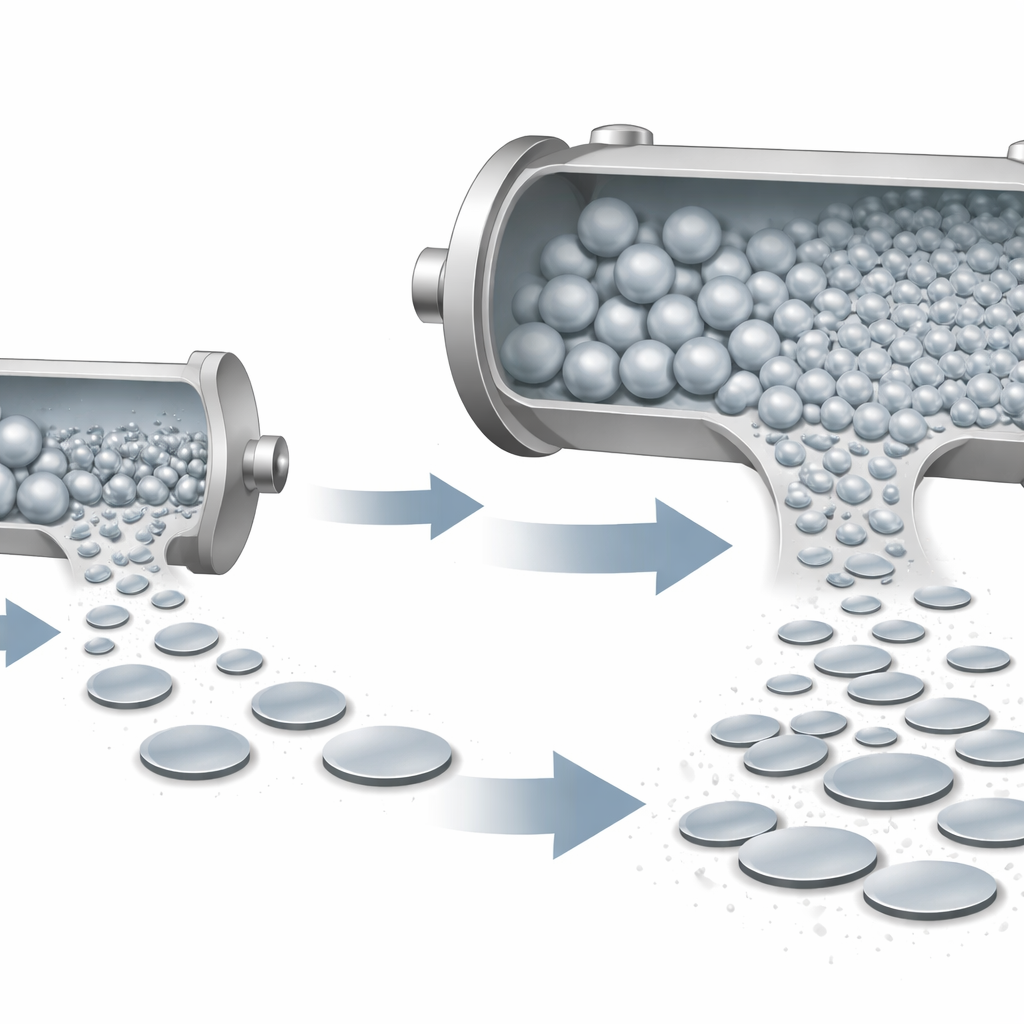
The researchers focus on a common industrial technique called ball milling, in which metal particles are shaken together with hard steel balls inside a vibrating container. When a silver grain is squeezed between two balls, or between a ball and a wall, it can be flattened into a thin flake. The team works with “dry vibration mills” of two sizes: a small 3.2‑liter test mill and a much larger 70‑liter mill closer to industrial use. Their starting material is irregularly shaped silver particles a few micrometers across, coated with a lubricant so they do not stick together too strongly. As milling proceeds, the particles are repeatedly squashed, their thickness shrinks, and their overall surface area increases.
Measuring how flat the silver becomes
To track how well the process is working, the authors use a simple measurable quantity: specific surface area, the amount of surface per gram of silver. Because flatter flakes expose more surface than lumpy grains, the surface area rises as the particles are flattened. They define a “normalized” surface area by dividing the current value by the starting value, and observe how this ratio grows with milling time in the small mill at different shaking speeds. Electron microscope images confirm that higher speeds yield more and thinner flakes. Mathematically, the surface‑area increase follows a straight‑line trend with time, allowing the researchers to define a single “flattening rate constant” that summarizes how quickly a given set of conditions turns grains into flakes.
Simulating billions of tiny impacts
Simply copying operating settings from the small mill to the large one does not work because the pattern of ball collisions changes with size, wall area, and fill level. To bridge this gap, the authors turn to a numerical technique known as the discrete element method. In their computer model, each steel ball is represented as an individual object obeying Newton’s laws. The program tracks how balls move, bump into each other, and hit the container walls, calculating the energy involved in every collision. From this, the team computes a “specific impact energy”: the collision energy per unit mass of silver inside the mill. They separate this energy into a normal part, from head‑on squeezing motions, and a shear part, from sliding motions along the surface.
Linking collision energy to flattening
With both the experimental flattening rate and the simulated impact energy in hand for the small mill, the researchers look for a simple relationship between them. They find that the flattening rate increases in direct proportion to the specific impact energy, whether they consider the normal component, the shear component, or the total. This straight‑line link provides a prediction factor: once the specific impact energy is known for any mill, the expected growth in surface area over time can be calculated. They then simulate ball motion in the large mill under several vibration speeds, carefully tuning the model so that the overall flow of balls matches what is seen in real‑world tests. Using the prediction factor from the small mill and the simulated energy in the large mill, they forecast how the normalized surface area should evolve with milling time.
Head‑on hits matter most
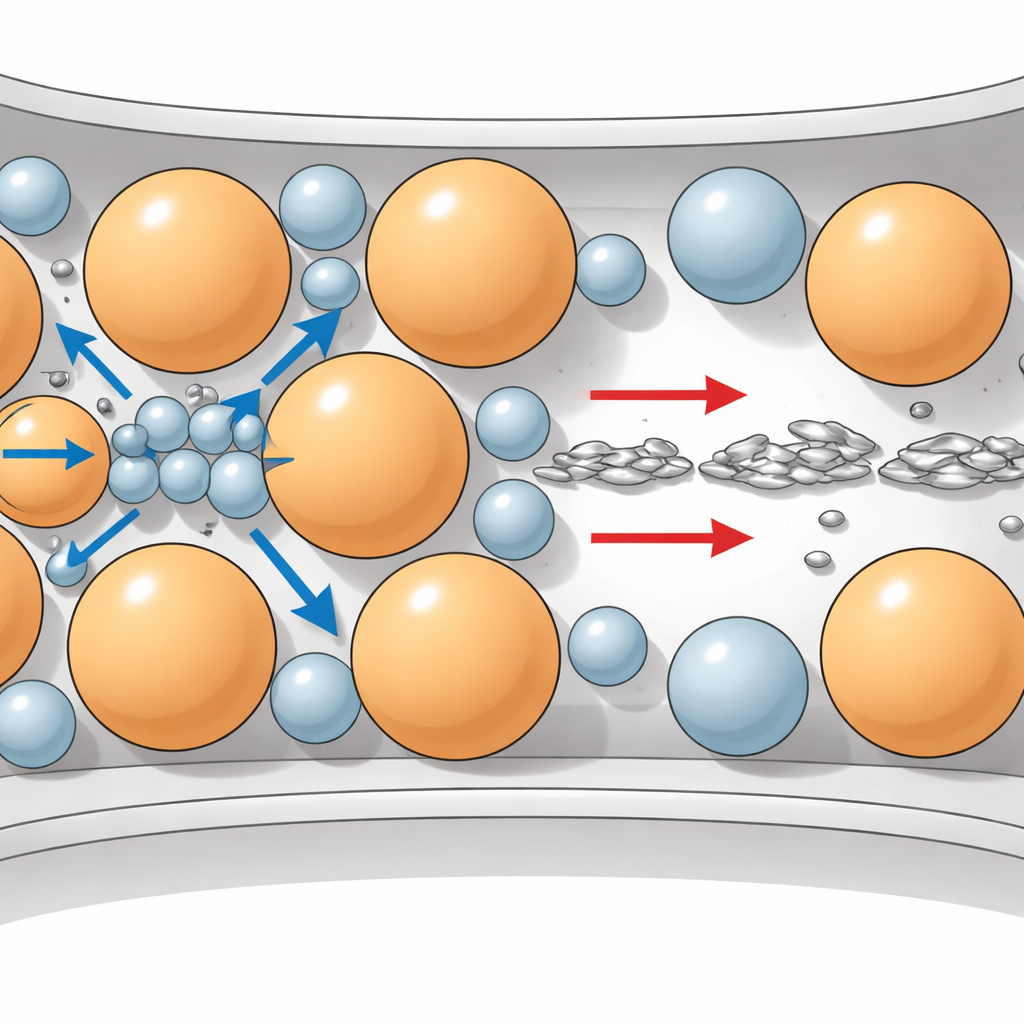
Finally, the team compares their predictions with measurements from actual large‑scale flattening experiments. The agreement is best—errors of only a few percent—when they use only the normal component of the impact energy, associated with direct squeezing between balls and walls. Predictions based on shear or total energy are noticeably less accurate. This indicates that head‑on compression, rather than sliding, is the main driver of turning silver grains into flakes. For industry, the message is straightforward: by using computer simulations to estimate the normal impact energy in a proposed mill design, engineers can predict how fast silver particles will flatten and scale up from laboratory tests to production equipment with far fewer costly trials. The approach may also extend to other metals and mill types, offering a general blueprint for designing efficient particle‑flattening processes.
Citation: Kojima, T., Kushimoto, K., Oka, D. et al. A scaling up of flattening silver particles using dry ball milling by DEM simulation. Sci Rep 16, 14082 (2026). https://doi.org/10.1038/s41598-026-44107-1
Keywords: silver flakes, ball milling, particle flattening, DEM simulation, scale-up