Clear Sky Science · en
Automated multi-class ECG arrhythmia detection using VMD and multi-task optimization
Why this matters for everyday hearts
Heart rhythm problems can be silent, sudden, and dangerous, yet the first warning sign is often a simple electrocardiogram printout. This study explores how computers can quickly read those electrical heart traces to spot several serious rhythm disturbances at once, aiming to support doctors with faster and more reliable decisions.
Watching the heartbeat as a signal
An electrocardiogram, or ECG, is a recording of the tiny electrical pulses that make the heart squeeze in a steady pattern. In a healthy person, these waves follow a regular shape, but in conditions such as atrial fibrillation, ventricular fibrillation, and ventricular tachycardia, the pattern becomes irregular, too fast, or chaotic. Reading these rhythms by eye is time consuming and prone to human error, especially when thousands of heartbeats must be checked. Automated analysis can help by turning each heartbeat into numbers that a computer can compare and classify.
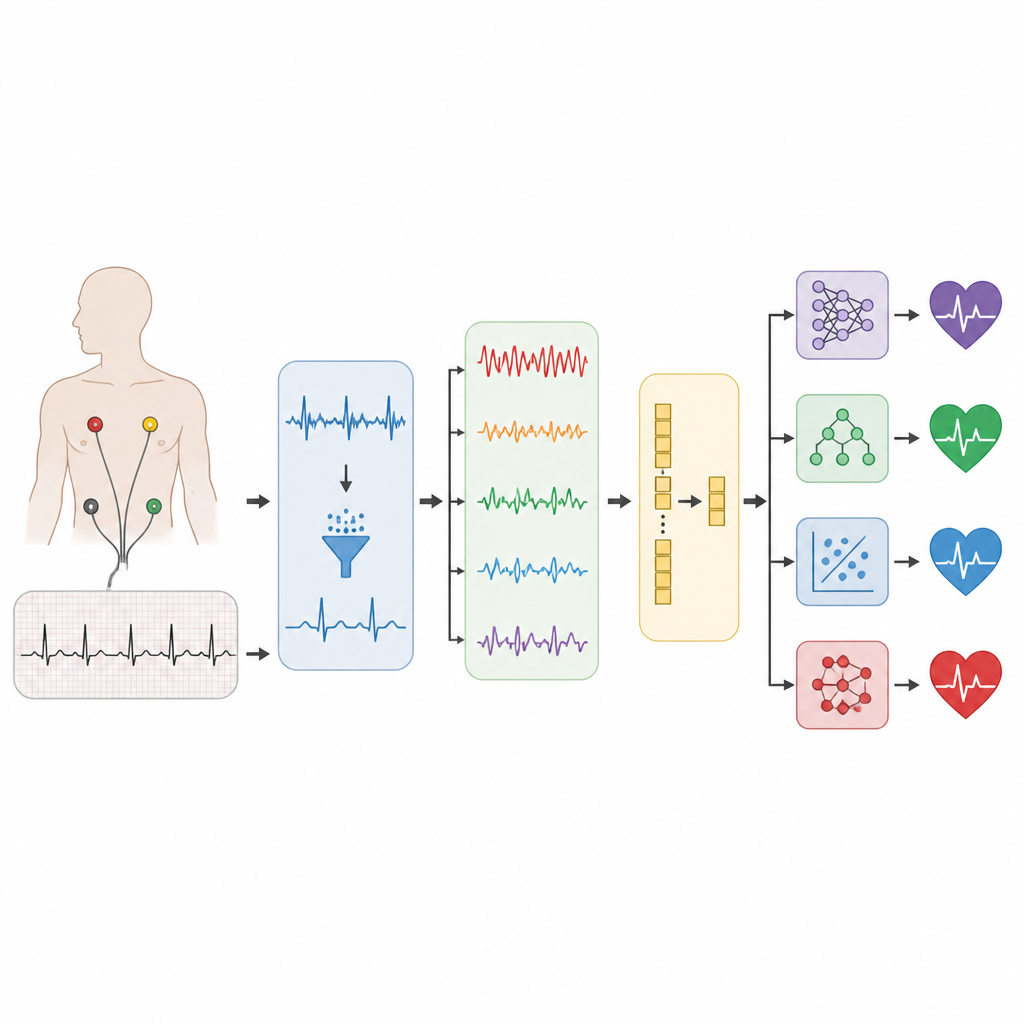
Turning messy traces into meaningful patterns
The researchers built a step by step pipeline that starts with raw ECG recordings from several well known public databases. First, they clean the signals to remove noise and artifacts so that only the true heart activity remains. Next, they break each ECG into several simpler components using a mathematical method that separates low and high frequency content. From these components, the system measures many properties, such as how energetic, irregular, or skewed the waves are. These numerical descriptions capture subtle differences between normal rhythm and dangerous arrhythmias that may not be obvious to the naked eye.
Letting an algorithm choose what really matters
Because hundreds of measurements can be extracted from every heartbeat, not all of them are equally useful. Too many inputs can slow down programs and even confuse learning algorithms. To tackle this, the authors use a swarm inspired search method that behaves like a group of virtual birds exploring different combinations of features together. This method tries to keep accuracy high while trimming away unnecessary measurements. After this search, only about one third of the original features are kept, forming a compact description of each heartbeat that is easier and faster for computers to handle.
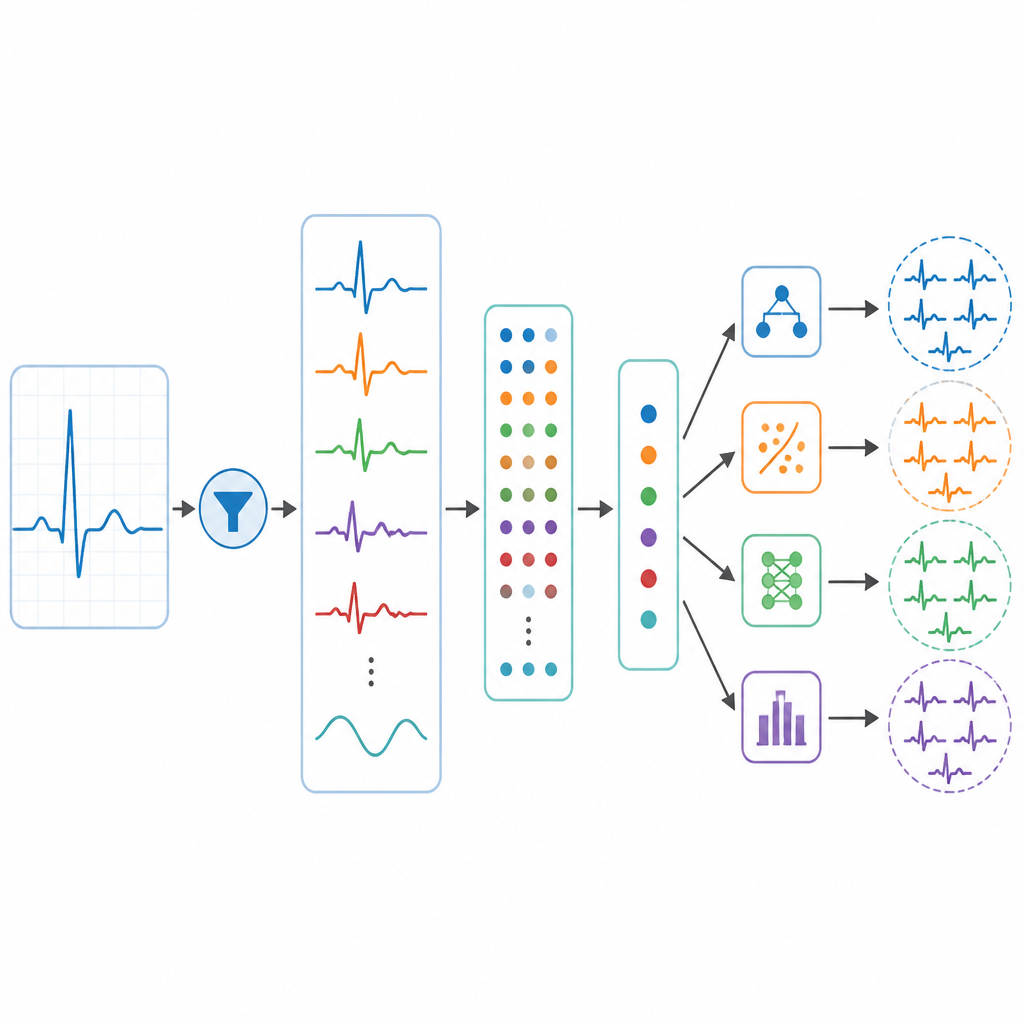
Putting many learning models to the test
With these streamlined features, the team trains and evaluates several state of the art machine learning models. These include tree based methods that build many decision rules and combine them, as well as boosting approaches that focus on harder to classify beats. They compare performance before and after feature selection, looking not only at overall accuracy but also at how often each type of rhythm is correctly recognized. After optimization, several models reach around 99 percent accuracy while taking far less time to run. The system shows strong results across all four rhythm classes, as confirmed by confusion matrices and receiver operating characteristic curves.
What this means for future heart care
In simple terms, this work shows that carefully cleaning ECG signals, breaking them into meaningful pieces, and letting a smart search method pick the best measurements can give computers a very sharp eye for heart rhythm problems. While it still needs testing on broader and more varied patient groups, the approach could form the basis of fast automatic screening tools that flag dangerous rhythms for doctors, helping them focus attention where it is needed most.
Citation: Krishna, Y.M., Vasavi, K.P., Chaitanya, M.K. et al. Automated multi-class ECG arrhythmia detection using VMD and multi-task optimization. Sci Rep 16, 15435 (2026). https://doi.org/10.1038/s41598-026-44103-5
Keywords: ECG, cardiac arrhythmia, machine learning, feature selection, heart rhythm