Clear Sky Science · en
A framework for a national cancer imaging repository in Nigeria
Why this matters for cancer care in Nigeria
Cancer is claiming more lives in Nigeria every year, in part because many people are diagnosed late and advanced imaging tools are scarce. This article explains how building a shared, national storehouse of cancer scans could help doctors, researchers, and computers work together to spot tumors earlier, tailor treatments to Nigerians, and ease pressure on overstretched specialists.
The growing cancer burden and data gap
Cancer now causes around one in six deaths worldwide, and low and middle income countries account for most of these losses. Nigeria, Africa’s most populous nation, faces rising cases and some of the highest death rates, worsened by late diagnosis, too few cancer centers, and limited imaging equipment. While the country runs cancer registries that track who gets which cancers, these systems mainly collect summary statistics and do not store the underlying X rays, CT scans, or ultrasound images that could power modern data driven tools.
How smart computers could help
Artificial intelligence has shown that it can read medical images quickly and, in some tasks, match expert performance. For cancers of the breast, lung, and other organs, computer programs can highlight suspicious spots, help map tumors before surgery or radiation, and track small changes over time. But to work safely, these systems must be trained on many thousands of images from the same kinds of patients they will later serve. Today, Nigerian researchers mostly rely on foreign image banks built from European or North American patients, even though tumor patterns and body features often differ across populations. This mismatch can quietly reduce accuracy for African patients and deepen existing health gaps.
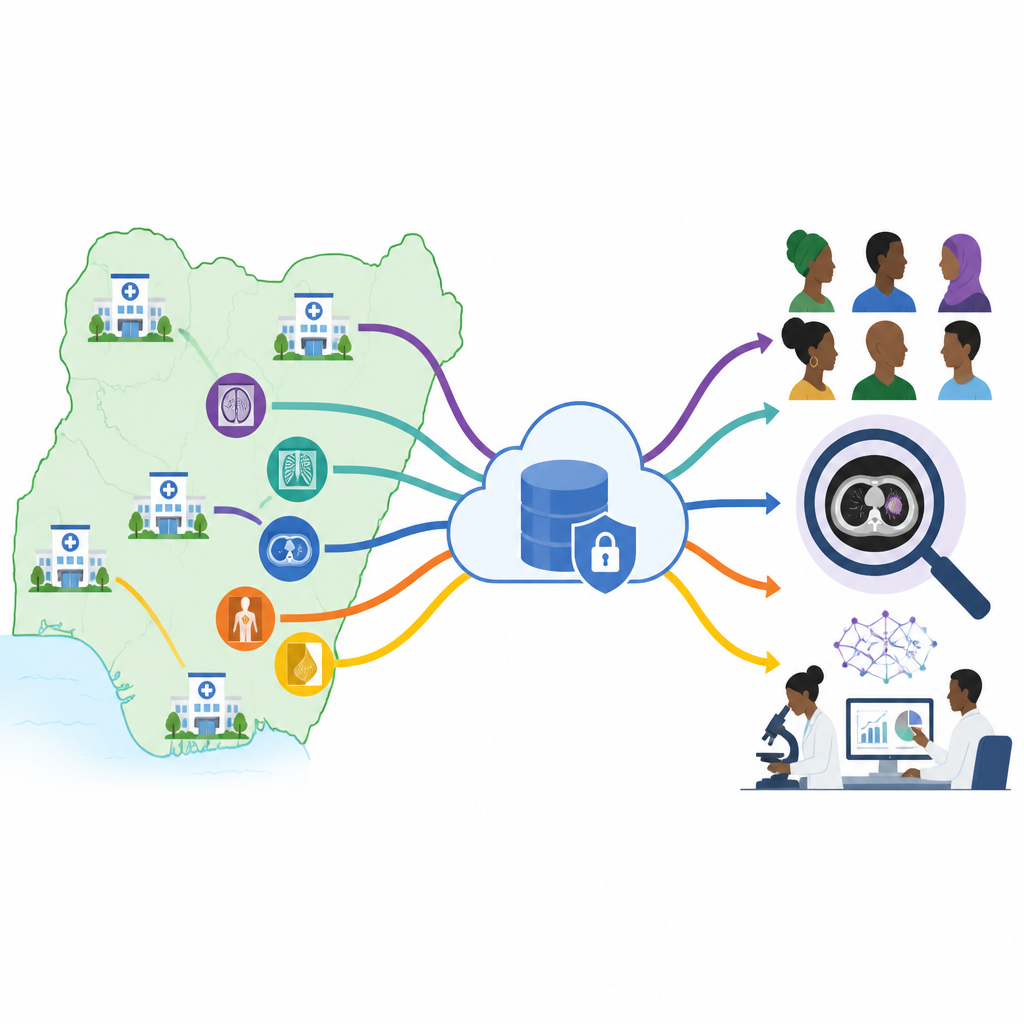
A national shared home for cancer images
The authors propose a National Cancer Imaging Repository for Nigeria, starting with twelve major hospitals spread across all six geopolitical zones. These centers already provide cancer care and have basic digital imaging systems. The plan calls for national rules that spell out how images are captured, cleaned, labeled, and shared, along with strict safeguards for privacy and security. All scans would be stripped of names and other identifiers, checked for quality, converted into common formats, and then stored in a secure cloud system that can grow as more hospitals join.
Inside the six step system
The framework is organized as six connected layers, each with clear jobs. At the front end, hospital systems supply scans and basic notes. A transfer layer moves these images through encrypted links to the central platform. A processing layer then validates and standardizes the pictures, removes any remaining personal details, and supports helpful tools such as automated marking of likely tumor regions. Next, a storage layer keeps the images and linked clinical information in cloud databases with backup and recovery. On top of this, an access and security layer controls who can log in and what they can see, using role based permissions and full audit trails. Finally, a user interface layer offers web tools that let approved doctors and researchers search, view, and download suitable data without touching the raw servers.
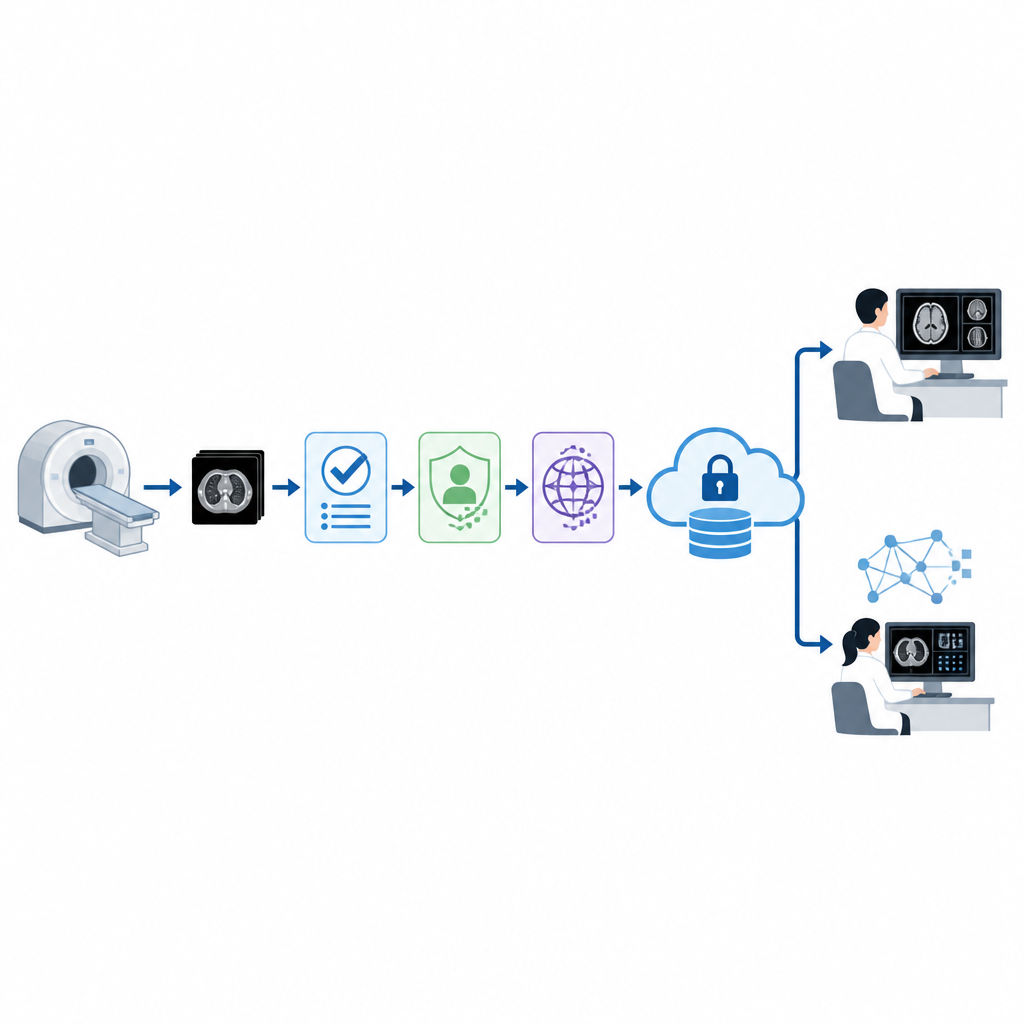
Building capacity and matching global standards
To make the system work in practice, the authors outline training programs for radiologists, data managers, and IT staff in all pilot hospitals, covering image handling, anonymization, and ethical rules. They also describe the hardware and software needed at each site, from imaging archives to secure internet links and graphics processors for future AI work. The proposed design is compared with The Cancer Imaging Archive, a leading international resource. The Nigerian plan follows similar rules for formats, privacy, and governance while adapting to local limits in funding, equipment, and workforce.
What this could mean for patients
The study does not yet deliver new AI tools or clinical results, but it lays the groundwork for them. If implemented, the repository would give Nigerian researchers access to rich, well organized sets of local cancer images for the first time. Over time, this could support computer systems tuned to Nigerian patients, make training easier for new specialists, and give health planners clearer insight into national cancer patterns. In simple terms, the article argues that carefully pooling and protecting cancer scans is a crucial step toward earlier detection, better treatment decisions, and fairer cancer care across Nigeria.
Citation: Adegoke-Elijah, A., Macauley, O., Jimoh, K.O. et al. A framework for a national cancer imaging repository in Nigeria. Sci Rep 16, 15945 (2026). https://doi.org/10.1038/s41598-026-44098-z
Keywords: cancer imaging, data repository, artificial intelligence, Nigeria, medical images