Clear Sky Science · en
Analytical investigation of soliton dynamics in the Fokas–Lenells equation with generalized self-phase modulation and nonlinear dispersion
Light Pulses That Refuse to Spread Out
Modern communication, medical imaging, and precision sensing all rely on tiny flashes of laser light racing through glass fibers. Normally, these light pulses spread and distort as they travel, which limits how much information we can send and how clearly we can see. This paper explores special pulse shapes, called optical solitons, that can travel long distances without changing their form—even when several strong nonlinear effects are at play inside the fiber.
Why Special Light Pulses Matter
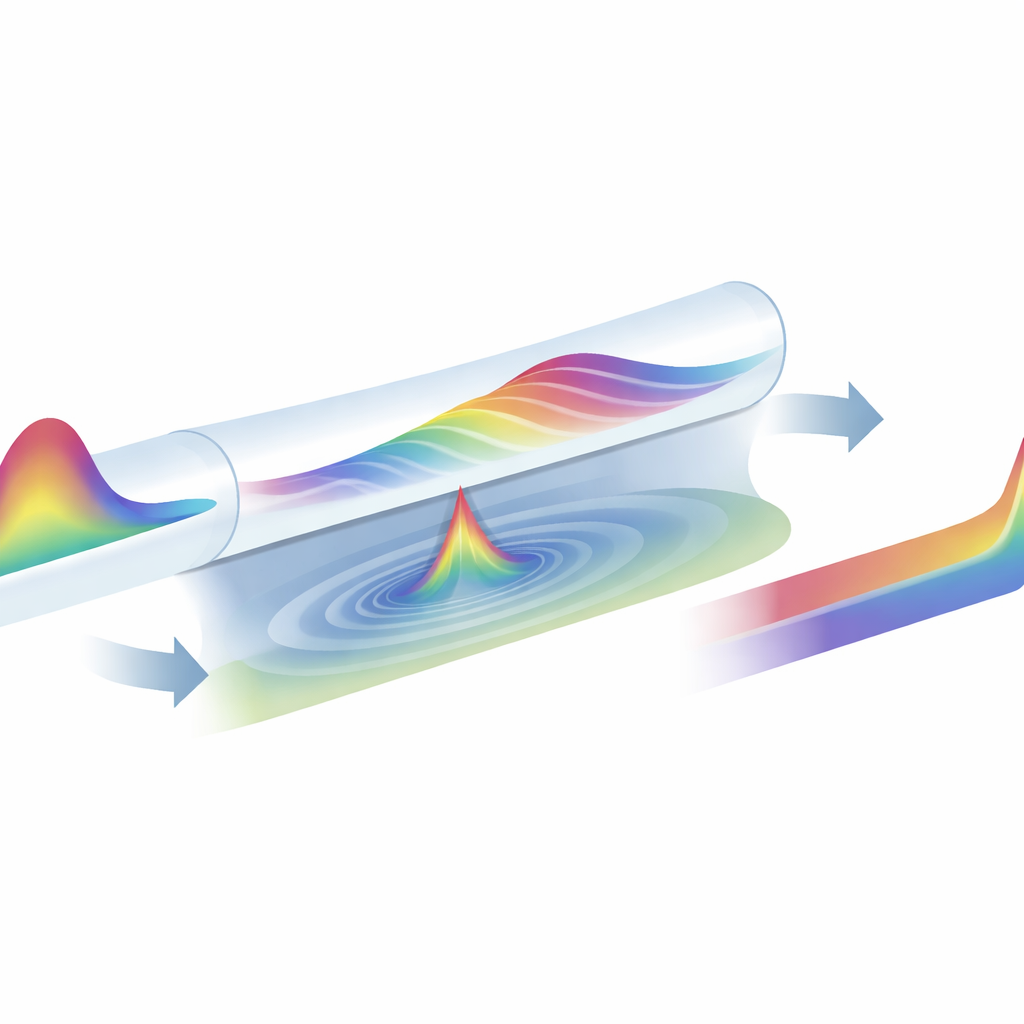
When a short laser pulse moves through an optical fiber, two main effects compete. Dispersion tends to stretch the pulse in time, smearing it out, while the material’s response to intense light can reshape the pulse in the opposite direction. Under the right conditions, these influences cancel, and a stable, self-maintaining pulse known as a soliton appears. Such pulses are crucial for high‑capacity fiber‑optic links, ultrafast lasers, and broadband light sources that power technologies like supercontinuum generation and optical coherence tomography for medical imaging.
A Refined Model for Real Optical Fibers
The authors study solitons within a mathematical framework called the Fokas–Lenells equation, tailored to describe dispersive light pulses in realistic fibers. They enrich this model by adding two important ingredients. First, they use a generalized "quadratic–cubic" description of self‑phase modulation, which means the material’s refractive index responds to light intensity in a more flexible way than simple textbook formulas. Second, they include nonlinear chromatic dispersion, capturing how different colors of light spread in a way that also depends on intensity. Together, these ingredients mimic the complex environment that real high‑power pulses experience in modern photonic devices.
Mathematical Tools to Classify Soliton Shapes
To understand what kinds of solitons this enriched model can support, the researchers do not rely on brute‑force computer simulations. Instead, they use three analytical techniques that produce exact formulas for the pulse shapes. These are known as the modified extended tanh method, the extended simple equation method, and the exp(−φ(η))‑expansion method. Each method rewrites the original equation in a simpler form and then systematically builds possible wave profiles. By comparing all three on the same model, the team can map out a wide variety of stable and structured pulses that could appear in practice.
Families of Stable Light Structures
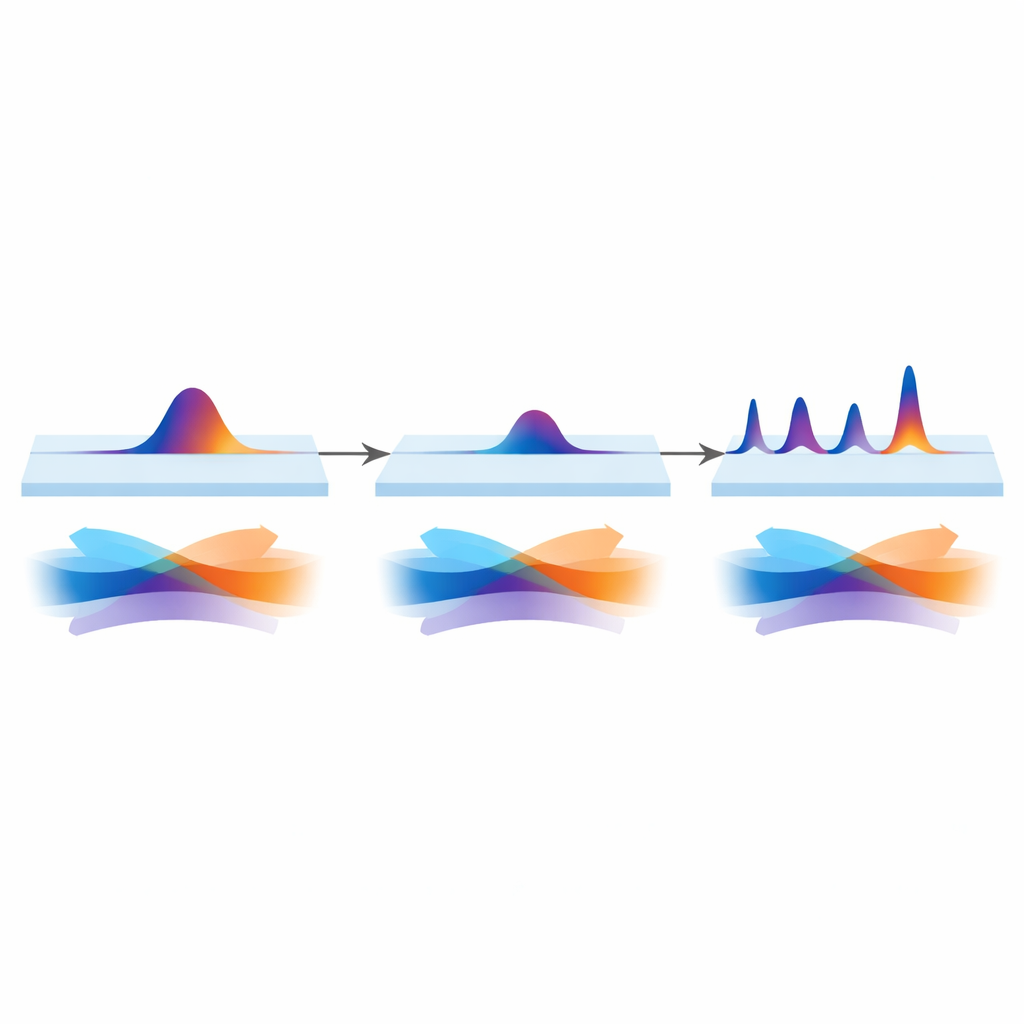
The analysis reveals a rich zoo of soliton types. There are dark solitons, which appear as localized dips in intensity riding on a continuous background of light. There are periodic solitons that form regular wave trains, and singular solitons whose intensity spikes sharply, concentrating energy in a very narrow region. The authors also identify hybrid forms such as dark‑singular and singular‑periodic solitons, where features like deep notches and sharp peaks coexist. By tuning parameters that control the strength of the nonlinear response and dispersion, the model predicts how the amplitude, width, and localization of these structures change, and under what conditions they remain stable.
Pictures That Reveal the Physics
To make these solutions more tangible, the researchers generate two‑ and three‑dimensional plots and contour maps of the real and imaginary parts of the wave field. These visualizations show how the soliton profiles evolve along the fiber and how they react when a key parameter governing the nonlinearity is varied. The graphics confirm that the analytical solutions truly behave like self‑maintaining pulses, and they highlight how different parameter choices transform one soliton type into another. This provides a practical guide for engineers who wish to design fibers or laser cavities that favor a desired pulse shape.
What This Means for Future Light Technologies
In simple terms, the paper offers a detailed recipe book for creating and controlling robust light pulses in complex optical media. By combining a more realistic model of how intense light interacts with a fiber and three powerful solution techniques, the authors show how to generate many distinct, stable pulse shapes and predict when they will occur. This deeper understanding can help improve long‑distance communications, enhance ultrafast laser performance, and refine optical signal processing, while also suggesting future work that includes randomness and higher‑dimensional effects to match real‑world devices even more closely.
Citation: Rehman, H.U., Khushi, K., Yildirim, Y. et al. Analytical investigation of soliton dynamics in the Fokas–Lenells equation with generalized self-phase modulation and nonlinear dispersion. Sci Rep 16, 13965 (2026). https://doi.org/10.1038/s41598-026-44097-0
Keywords: optical solitons, fiber optics, nonlinear dispersion, ultrafast lasers, self-phase modulation