Clear Sky Science · en
Vapor-phase (S)-methoprene alters cuticular hydrocarbons in the Argentine ant (Hymenoptera: Formicidae)
Why Tiny Invaders Matter
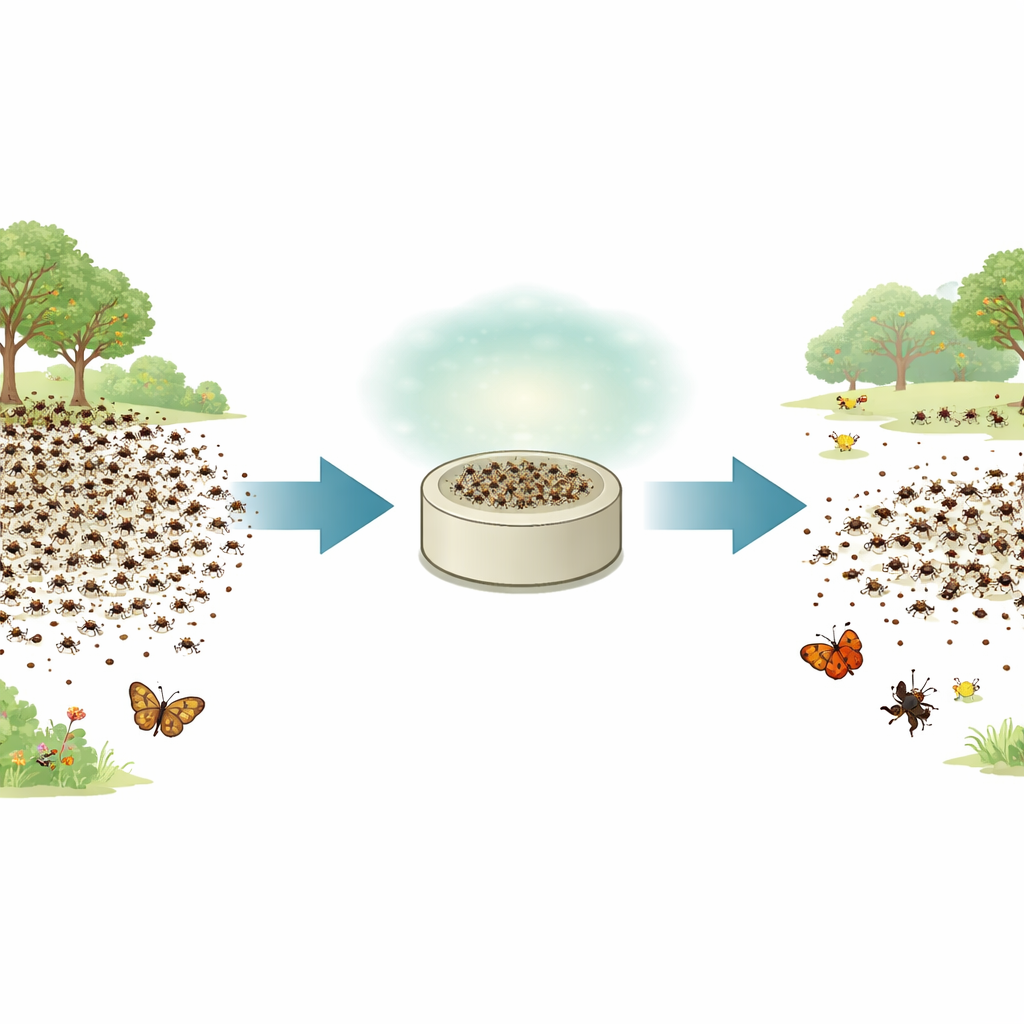
The Argentine ant is a tiny insect with an outsized impact. This invasive species has spread across much of the world, pushing out native ants, disturbing ecosystems, and bothering people in homes and farms. Most current control methods rely on traditional insecticides that can harm other wildlife and contaminate the environment. This study explores a more targeted approach: using a growth-regulating compound called methoprene, delivered as a vapor, to subtly disrupt the ants’ protective outer layer and possibly weaken their colonies over time.
A New Way to Target a Tough Pest
Argentine ants form huge cooperative “supercolonies” that are hard to eliminate with quick-kill sprays. Sprays mostly hit foraging workers and often leave queens and brood untouched, allowing colonies to rebound. Methoprene belongs to a class of compounds that mimic insects’ own developmental hormones. Rather than poisoning nerves, these compounds interfere with growth and reproduction and tend to be less toxic to other organisms. Earlier work showed that methoprene baits could increase worker and queen death in Argentine ants, but no one knew why. Meanwhile, studies in other insects hinted that such hormone mimics might also disturb lipids—fats that supply energy and form the waxy, water-resistant and communication-rich coating on the insect’s outer surface.
Looking at the Ants’ Protective Coat
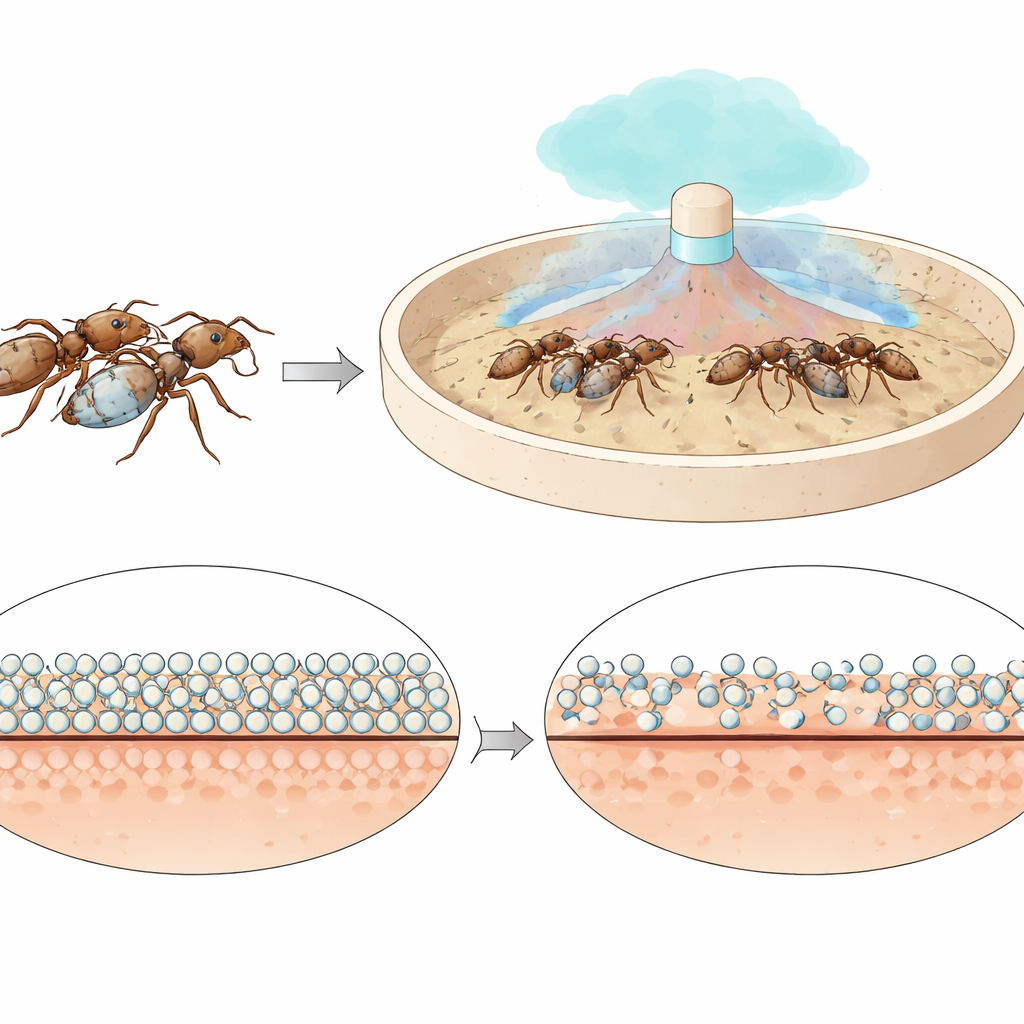
The researchers focused on that outer coating, made of molecules called cuticular hydrocarbons. These oily compounds help ants keep water in, fend off environmental stress, and recognize nestmates and queens by smell. To study how methoprene affects this coating, the team built special “vapor nests.” Small groups of Argentine ant workers, with or without queens, were placed in shallow containers whose lids held a tiny vial. A drop of methoprene on filter paper inside the vial slowly evaporated, bathing the ants in a controlled cloud of vapor for three weeks without forcing them to eat anything unusual. Control groups experienced the same setup but with clean filter paper instead of methoprene.
Measuring Invisible Changes
After 21 days, the scientists collected workers and queens that were still active and extracted their surface hydrocarbons using a solvent. They then ran these extracts through gas chromatography, a technique that separates and quantifies dozens of different compounds. By comparing treated and untreated ants, they could see not only whether the total amount of surface hydrocarbons changed, but also which specific types—simple straight chains, more complex branched forms, and molecules of different lengths—were most affected. They analyzed ants from two separate field sites and accounted for differences among collection batches to ensure that any patterns they saw truly reflected methoprene’s influence.
What Methoprene Did to the Ants
Methoprene exposure consistently reduced the overall quantity of surface hydrocarbons in both workers and queens by about 15 percent—a notable weakening of their waxy shield. The pattern of change depended on the role of the ant. In workers, the biggest drop occurred in straight-chain compounds, especially those of medium length. These molecules are thought to be particularly good at keeping water from escaping the body. In queens, the largest reductions were found in a subset of branched hydrocarbons that earlier studies have tied to queen fertility and signals workers use to assess and sometimes kill less-productive queens. Very long-chain compounds, which may be especially important for social recognition, stayed largely unchanged over the study period, hinting that some parts of the chemical “language” are more tightly controlled than others.
Why This Matters for Control and Conservation
By showing that methoprene vapor can thin and reshape the ants’ protective and communicative coating, this work suggests a possible explanation for earlier observations of increased worker and queen death in treated colonies. Weaker waterproofing could make Argentine ants more vulnerable to drying out, especially in hot, dry habitats where they already live near their water limits. Altered chemical signals on queens might disrupt reproduction or change how workers treat them, affecting colony growth from within. Together, these subtle shifts could make invasive populations easier to manage with less collateral damage than broad-spectrum insecticides, and they open the door to new strategies that exploit the ants’ own chemistry instead of relying solely on fast-acting poisons.
Citation: Moyneur, T., Giloni, K. & Choe, DH. Vapor-phase (S)-methoprene alters cuticular hydrocarbons in the Argentine ant (Hymenoptera: Formicidae). Sci Rep 16, 10781 (2026). https://doi.org/10.1038/s41598-026-44089-0
Keywords: Argentine ant, methoprene, cuticular hydrocarbons, invasive species control, insect growth regulator