Clear Sky Science · en
Internal conversion dominates the excited state dynamics and fluorescence efficiency of mono-substituted TPE-BODIPY dyes
Why glowing molecules matter
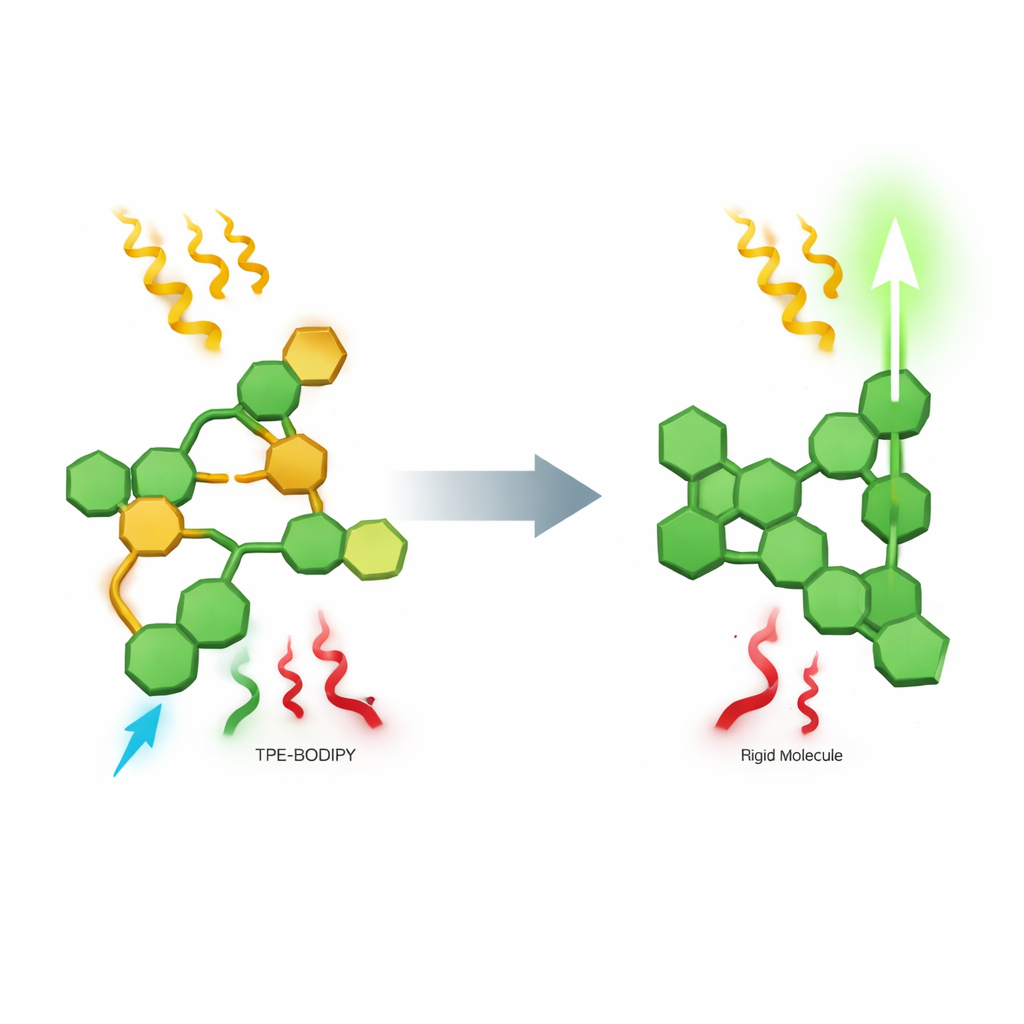
From brighter medical imaging agents to more efficient solar cells and display technologies, the ability of a molecule to absorb light and re‑emit it as color is big business. A popular family of glowing dyes, called BODIPY, is prized for its sharp colors and stability. Another well-known building block, tetraphenylethylene (TPE), can light up when its motion is restricted. This study brings these two together and asks a deceptively simple question: when you bolt TPE onto BODIPY, what really decides whether the excited molecule shines as light or quietly loses its energy as heat?
Building a family of light-up molecules
The authors designed a series of six closely related molecules, all based on the same BODIPY core with a single TPE “propeller” attached at one position. They then fine‑tuned this propeller by adding either electron‑donating groups (methoxy units) or an electron‑pulling group (dicyanovinyl), and by changing how these pieces are connected (para versus meta linkages). This systematic set lets them ask very targeted questions: Which pattern of donors and acceptors gives the brightest light? Which patterns quietly bleed energy away? By comparing these variations, the team could trace how small structural changes ripple through the electronic structure and motion of the molecule.
Using computation as a molecular movie camera
Instead of running many difficult experiments, the researchers used advanced quantum-chemistry tools, known as density functional theory and time‑dependent DFT, to simulate how each molecule behaves after it absorbs light. These calculations have been carefully benchmarked against existing experimental data and reproduce known emission colors and brightness with impressive accuracy. That validation is crucial: it means the simulations can be trusted like a slow-motion camera, revealing ultrafast events that are hard to capture in the lab. The team followed how the molecule relaxes into its first excited state, how likely it is to emit a photon, and how efficiently alternative “dark” pathways funnel energy away as tiny vibrations and heat.
Heat paths versus light paths
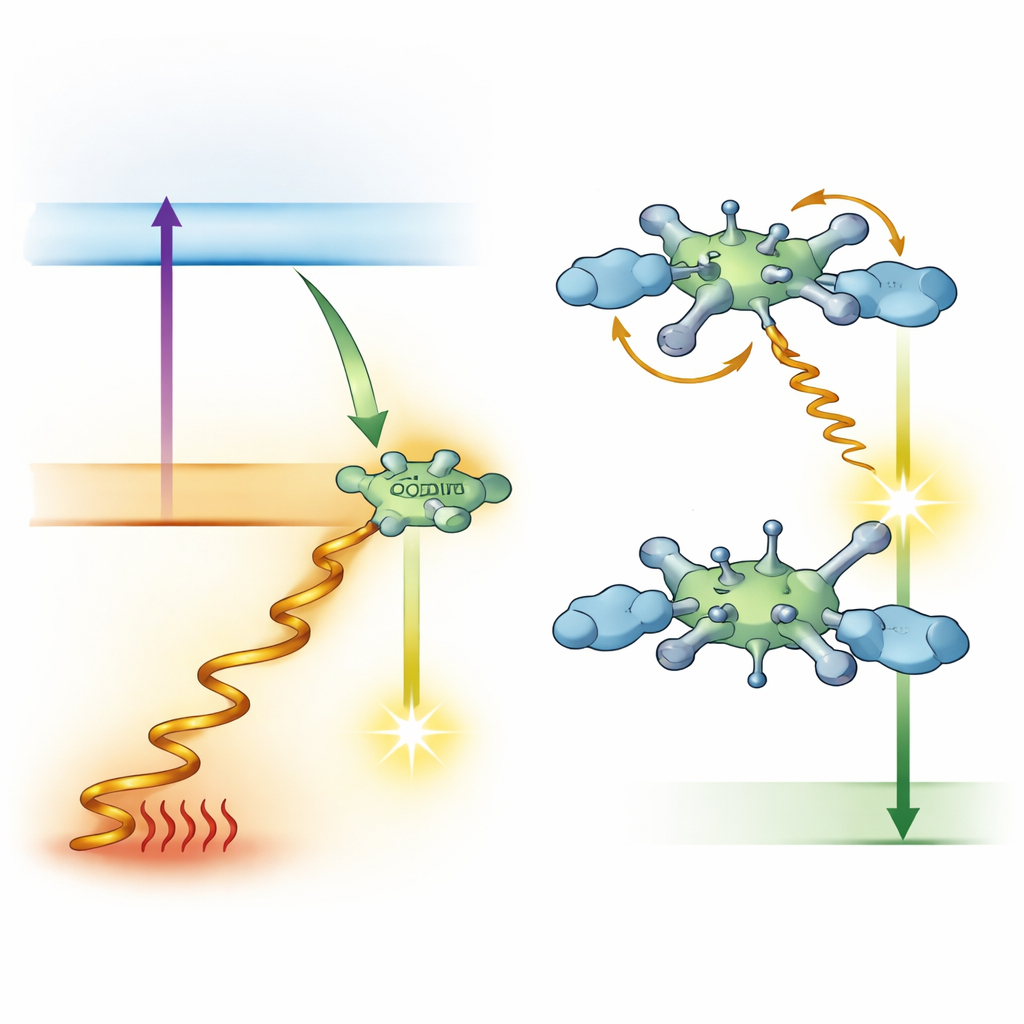
Once excited, a molecule has two main options. It can relax by emitting a photon (fluorescence), or it can dump its energy internally without light, a process called internal conversion. A more exotic third path, involving a twisting motion that leads to a crossing of energy surfaces (a conical intersection), is sometimes a very fast route to darkness in organic dyes. This study finds that, in this particular TPE–BODIPY family, that twisting route is blocked by high energy barriers: the molecule would have to distort too much to reach it, making this path too slow to matter. As a result, the real competition is almost entirely between shining and quietly warming up, and the key battleground is the relaxed excited state right after the molecule has settled from its initial jolt of light.
What makes some members glow and others go dark
By dissecting the internal conversion process in detail, the authors pinpoint two main culprits behind lost light: how strongly the ground and excited electronic states are coupled, and how much the molecule’s slow, floppy motions have to rearrange when the state changes. Strong coupling and large structural reorganization both accelerate the dark pathway. Among the six molecules, one stands out: the version with a single dicyanovinyl group and no methoxy donors has the highest predicted fluorescence efficiency, about 22%. It is not the brightest because it emits photons especially quickly; it wins because its internal conversion is unusually weak. In contrast, the worst performers, heavily decorated with donors or with less favorable linkage patterns, suffer from extremely fast internal conversion driven by big, low‑frequency distortions, so almost all their excitation energy becomes heat instead of light.
Design rules for brighter dyes
To a non-specialist, the take‑home message is clear: in this family of light‑emitting molecules, brightness is controlled less by how well they can emit light and more by how effectively they avoid losing energy internally. The authors show that simply strengthening light absorption or adding more donors is not enough; real gains come from designing molecules that minimize the coupling between their ground and excited states and that resist slow, large‑scale twisting and bending in the excited state. In practical terms, that means rigidifying the link between TPE and BODIPY and carefully choosing substituents so that internal conversion is suppressed. These insights provide a roadmap for chemists seeking brighter dyes for imaging, sensing, lighting, or solar-energy harvesting, and they highlight how detailed computer simulations can guide molecular design long before a new compound is ever made in the lab.
Citation: Cui, P., Yin, F. & Wang, Z. Internal conversion dominates the excited state dynamics and fluorescence efficiency of mono-substituted TPE-BODIPY dyes. Sci Rep 16, 13313 (2026). https://doi.org/10.1038/s41598-026-44085-4
Keywords: BODIPY dyes, fluorescence efficiency, internal conversion, molecular design, organic photophysics