Clear Sky Science · en
Stability enhancement via speed adaptation and efficiency improvement for induction machine
Why smoother, thriftier motors matter
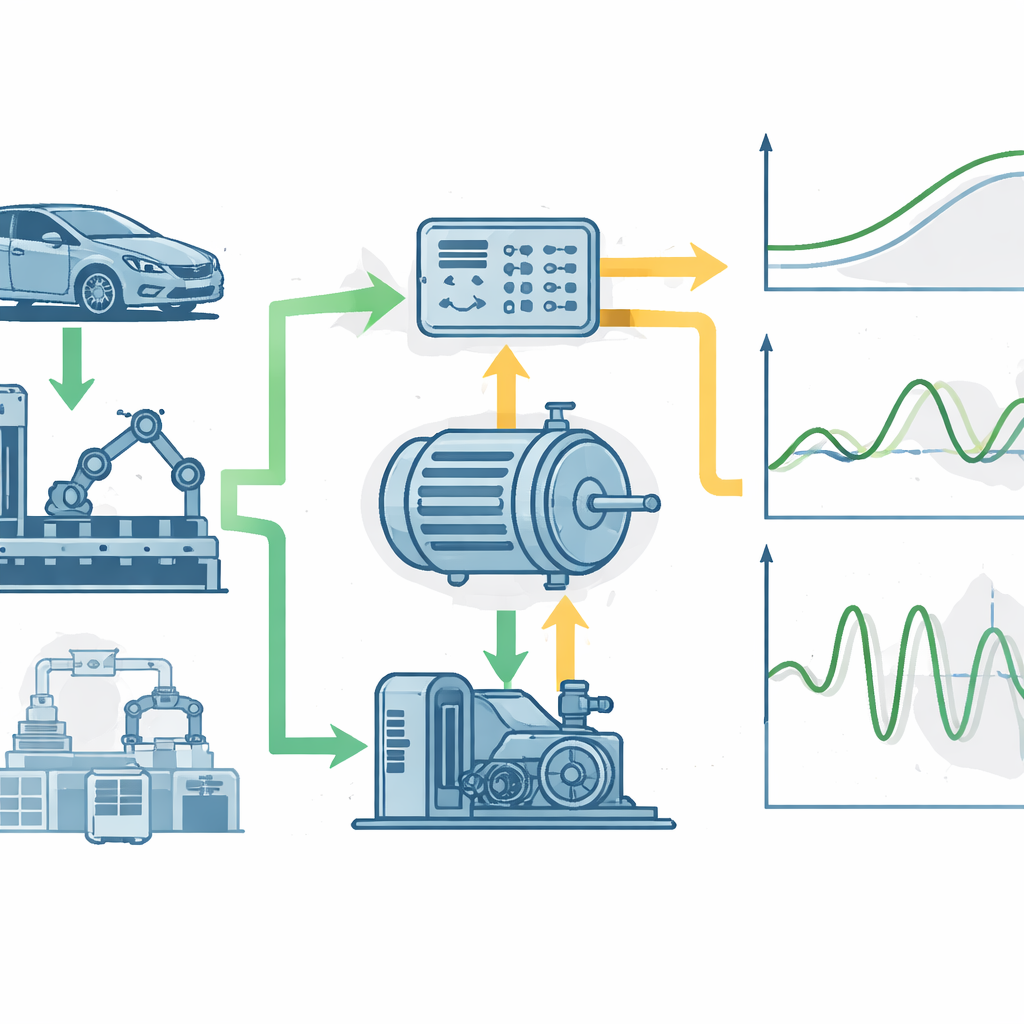
Electric motors are the hidden workhorses of modern life, driving everything from factory lines to electric cars. Two things matter most for these machines: they should run smoothly over a wide range of speeds, and they should waste as little energy as possible. This paper tackles both goals at once for a common workhorse called the induction motor, focusing on versions that measure only electrical signals and not mechanical speed. The authors present a new way to estimate motor speed and a new way to automatically trim energy waste, especially at low speeds and light loads where motors are often inefficient and unstable.
Keeping track of speed without extra hardware
Many high‑performance drives avoid using physical speed sensors because they add cost, size, and failure points. Instead, they infer speed from voltages and currents in the motor windings. However, at low and zero speed these "sensorless" methods can become unreliable and even unstable, especially when the motor is switching between driving and braking. The authors design a new mathematical observer—essentially a software twin of the motor—that introduces extra internal variables chosen so their behavior does not depend directly on hard‑to‑measure magnetic quantities. By carefully shaping the feedback in this observer using energy‑based stability proofs, they make the estimated speed track the true speed accurately even at very low speeds and during reversals.
Smarter control knobs for torque and magnetism
To command an induction motor, engineers usually work with two key ingredients: torque (how hard the motor pulls) and flux (how strongly it is magnetized). Traditional control schemes use several layered controllers to tune these ingredients, and one of them directly regulates the flux. The paper adopts a "multiscalar" viewpoint that re‑expresses the motor’s state in four higher‑level quantities: speed, torque, total flux, and a so‑called flux‑controlling variable, which combines current and flux into a single measure. The authors show that by targeting this combined variable instead of raw flux, they can remove one of the usual controllers, simplifying the structure while still steering the motor’s magnetism precisely. This provides a clean path for connecting the new observer to the power electronics that feed the motor.
Finding the sweet spot for power and losses
Running a motor with more magnetism than needed wastes energy in the copper windings and in the iron core. Past methods to minimize these losses either rely on heavy numerical optimization, pre‑computed tables, or detailed loss models that are very sensitive to uncertain parameters. In contrast, the authors introduce a new rule they call Maximum Active Power per Flux Controlling Variable (MAPPFCV). By analyzing how real power, torque, and their multiscalar variables relate, they derive a compact formula that tells the controller what the optimal value of the flux‑controlling variable should be for any given operating point. This formula is analytical, avoids iterative searching, and can be computed quickly on inexpensive microcontrollers, making it practical for large fleets of drives and for electric vehicles.

Proving stability and saving real energy
The authors verify the stability of their observer and control design using both mathematical tools and simulations. Small‑signal analysis and pole–zero plots show that the modified speed‑adaptation law keeps the system stable over a wide range of speeds, including demanding braking conditions, whereas a conventional design becomes unstable in the same region. Hardware tests on a 5.5 kilowatt laboratory motor confirm that the estimated speed closely follows actual speed, even during fast reversals and torque steps, with very small ripple in speed and torque. When the MAPPFCV‑based flux optimization is activated, the drive automatically reduces magnetization at light loads, cutting losses and boosting efficiency: gains of over 6 percent at low speed and more than 16 percent at high speed under light loads are reported, with smaller but still positive gains at higher loads.
What this means for everyday machines
Put simply, the paper shows how to make widely used induction motors both steadier and thriftier without adding extra sensors or heavy computation. By rethinking how speed is estimated and how magnetism is tuned in real time, the proposed approach keeps the motor stable from standstill to high speed and trims away avoidable losses, particularly in light‑load conditions that occur often in real applications. For electric vehicles and industrial drives, this translates into smoother operation, better use of battery or grid energy, and simpler controllers that are easier to implement in low‑cost hardware.
Citation: Wogi, L., Joy, S.I.I., Morawiec, M. et al. Stability enhancement via speed adaptation and efficiency improvement for induction machine. Sci Rep 16, 13516 (2026). https://doi.org/10.1038/s41598-026-44079-2
Keywords: induction motor, sensorless control, energy efficiency, flux optimization, electric vehicles