Clear Sky Science · en
Prediction-based attack detection and mitigation mechanism in power system
Why Hidden Cyber Attacks on Power Grids Matter
Modern power grids are no longer just wires and generators; they are tightly woven with computers, communication networks, and automated controls. This cyber-physical marriage brings great efficiency but also opens a new door for attackers. Instead of blowing up equipment, a skilled intruder can quietly change sensor readings so that control rooms make dangerous decisions while believing everything is normal. This paper explores a new way to spot such “invisible” attacks early and automatically push the grid back to safety before lights start to flicker or blackouts spread. 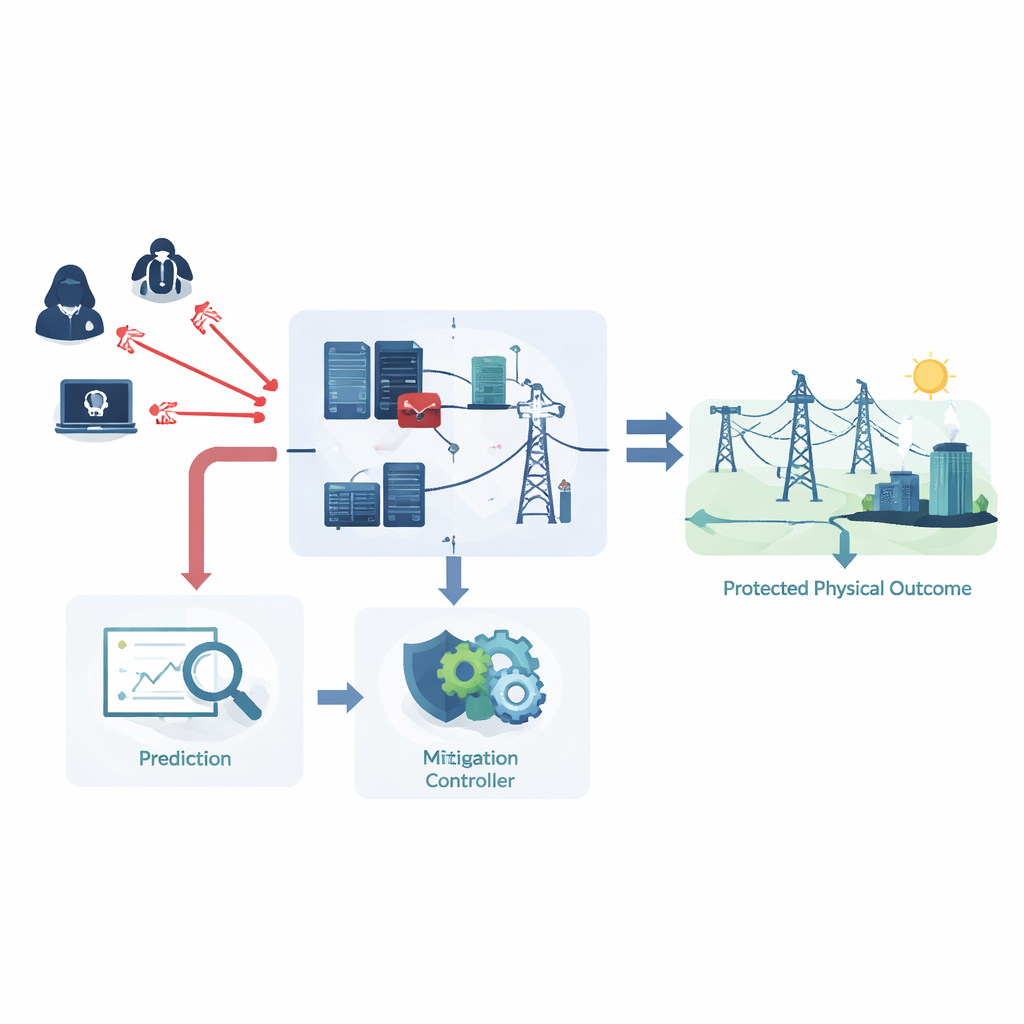
The New Face of Power Grid Threats
Today’s smart grids depend on vast streams of real-time data from sensors spread across power plants, substations, and transmission lines. Control centers use this data to estimate the current state of the grid and to decide how generators should respond. Classic security checks look for obvious mismatches between measured data and what the grid model predicts, flagging them as bad data. However, attackers who understand the grid’s structure can craft “false data injection” that changes the estimated state while keeping these mismatches within normal limits. In other words, the alarm never sounds, yet the control system may slowly drive the grid toward unsafe voltages, overloading lines or destabilizing generators.
Limits of Current Guardrails
Researchers have tried two main strategies to defend against such stealthy attacks. Data-driven methods use machine learning to find suspicious patterns in measurements, while model-based methods rely on the physics of the power system and preset thresholds. Machine learning approaches can adapt to complex behaviors but are often expensive to train and hard to trust in safety-critical settings because their performance is not guaranteed by theory. Model-based methods offer clearer guarantees but can be rigid and may miss cleverly designed attacks. Other advanced ideas, such as interval estimation or feasibility regions, improve detection but still mainly signal that “something is wrong” instead of actively steering the grid back to safety with proven stability.
A Loop That Predicts and Fights Back
The authors propose an integrated framework that does more than just raise a flag. First, they build a streamlined mathematical model of how generator angles and frequencies evolve, including how an attack would change sensor readings. On top of this model, they design an adaptive Kalman filter—a self-tuning estimator that constantly adjusts itself to real operating conditions. When even a tiny statistical anomaly appears in the incoming data, the filter not only estimates the current grid state but also teases out an estimate of the hidden attack signal and forecasts how that attack is likely to evolve over the next time step. This turns the problem from merely detecting damage after it is done into anticipating the attacker’s next move within the same ongoing incident.
Smart Control That Neutralizes the Threat
Once the attack signal is estimated and predicted, a specially designed feedback controller uses this information to counteract the malicious influence. It effectively injects corrective control actions that cancel out what the attacker is trying to achieve, nudging the system back toward its safe operating point. Crucially, the controller’s settings are not tuned by trial and error; they are computed by solving mathematical conditions called Linear Matrix Inequalities, which guarantee that, under the assumed attack conditions, the combined estimator–controller loop remains stable and the grid’s key variables converge back to normal. Extensive computer simulations on three standard test networks—from a simple 6-bus setup to a large 118-bus grid—show that this method recovers faster and with smaller overshoots than several recent benchmark techniques, even under high noise and parameter uncertainty. 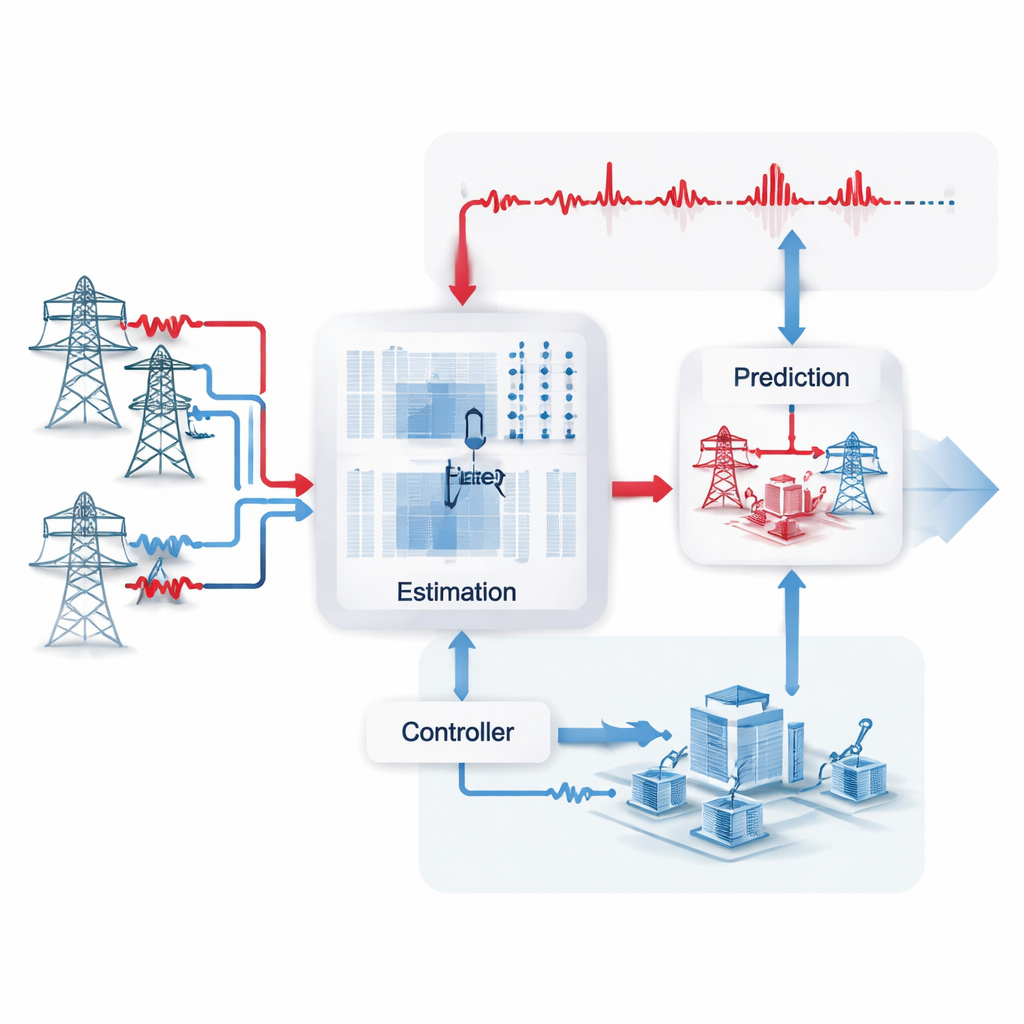
What This Means for Keeping the Lights On
For non-specialists, the key message is that this work moves grid security from a reactive stance to a more anticipatory one. The framework cannot magically foresee an attack before any trace appears in the data, but once the slightest statistical footprint is visible, it quickly reconstructs and predicts the attacker’s moves, then shapes control actions to blunt their impact. The result is a power system that can ride through deceptive data attacks with less disruption, shorter recovery times, and mathematically proven stability. As grids become ever more digital and interconnected, such proactive, theory-backed defenses will be essential to keeping electricity reliable in the face of increasingly sophisticated cyber threats.
Citation: Zhai, P., Zhang, M. & Wang, X. Prediction-based attack detection and mitigation mechanism in power system. Sci Rep 16, 13252 (2026). https://doi.org/10.1038/s41598-026-44076-5
Keywords: smart grid security, cyber-physical power system, false data injection, attack detection, adaptive control