Clear Sky Science · en
Convolutional neural networks using preoperative CT to predict short-term recurrence after incisional hernia repair
Why predicting surgical setbacks matters
When people undergo surgery to repair an abdominal wall hernia that formed in a previous incision, everyone hopes the fix will last. Yet in a noticeable minority of cases, the hernia comes back, often meaning more pain, more surgery, and more cost. Surgeons usually estimate this risk using experience and a handful of clinical factors, but those judgments are imperfect. This study explores whether a form of artificial intelligence, trained on routine preoperative CT scans, can help forecast which patients are most likely to experience a recurrence after incisional hernia repair.
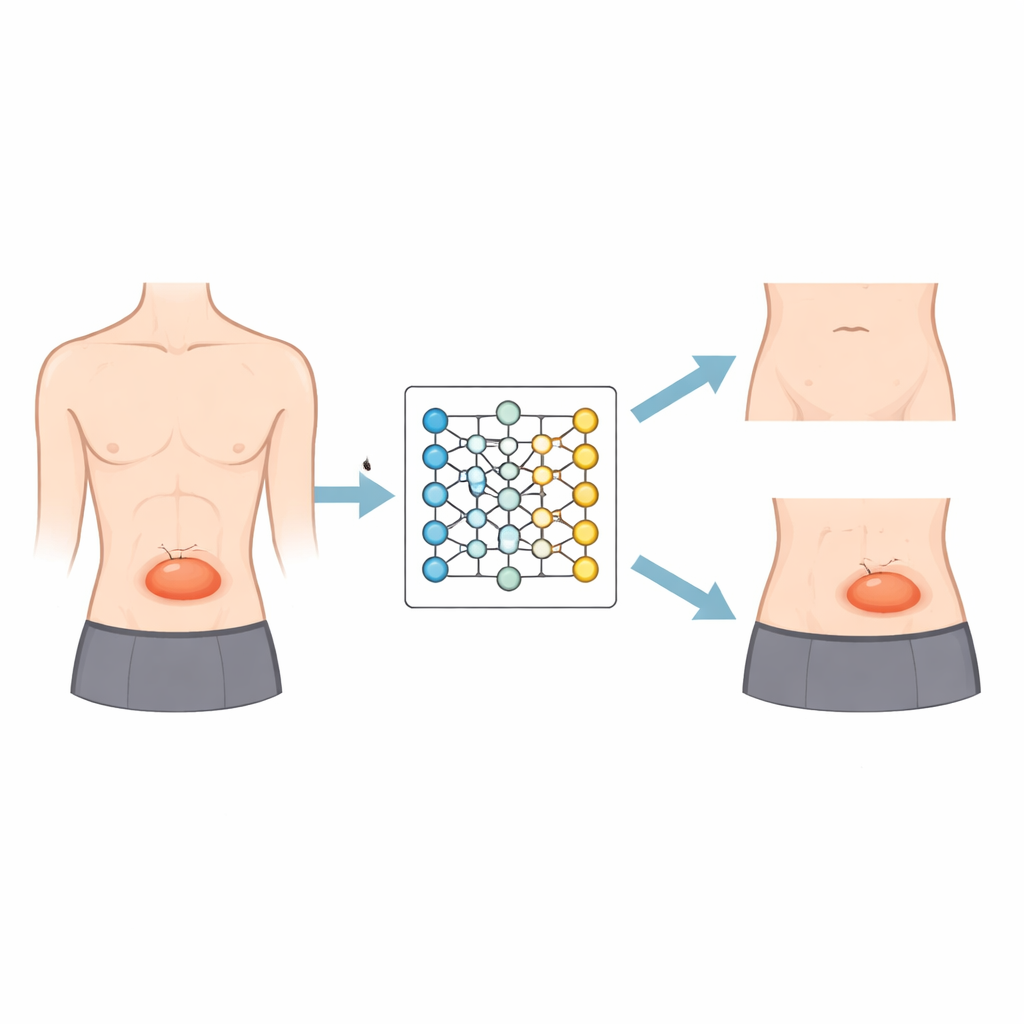
Turning routine scans into predictions
The researchers looked back at 528 patients who had surgery to repair an incisional hernia at a large hospital between 2016 and 2019. All had CT scans of the abdomen taken before their operation, capturing the size, location, and shape of the hernia and nearby tissues. The team extracted 44,380 individual image slices that showed the hernia region, removed all identifying information, standardized the images to a uniform format, and split them into a large training set and a smaller test set. Importantly, the computer models never “saw” the test images during training, allowing a fair check of how well the system would perform on new patients.
How the computer learns from images
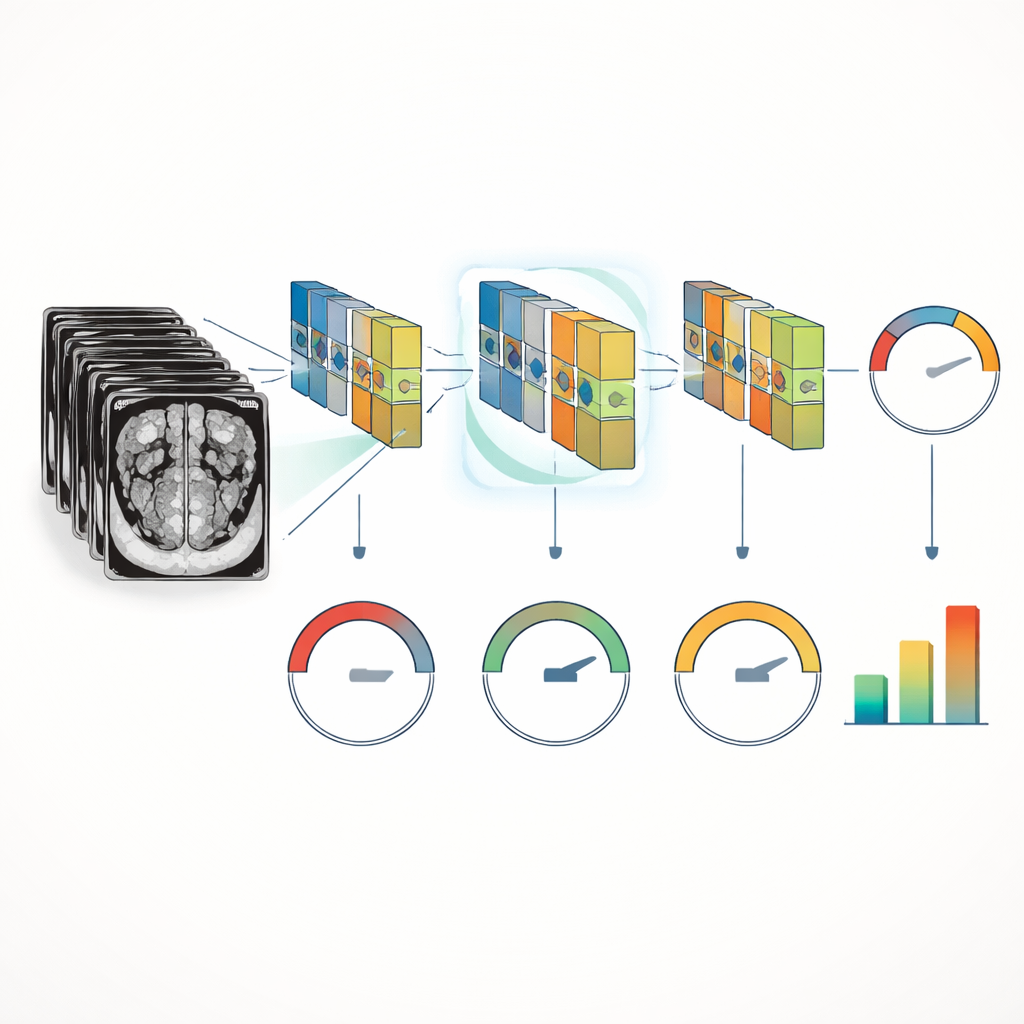
To analyze the scans, the authors used three popular deep-learning image models known as convolutional neural networks. These networks, originally developed for tasks such as recognizing everyday objects in photographs, excel at spotting patterns in complex images. During training, each CT slice was labeled according to whether the patient’s hernia later came back or not. The networks repeatedly compared their predictions with the true outcomes and adjusted their internal connections to reduce errors. For each patient, the model’s predictions from multiple slices were combined into a single estimate of recurrence risk.
Which model did best
The three models—ResNet-50, a deeper version called ResNet-152, and VGG16—did not perform equally. When tested on previously unseen images, ResNet-50 showed the strongest ability to distinguish patients who would experience recurrence from those who would not. Its performance, summarized by a standard metric called the area under the curve, was noticeably higher than that of the other two networks. Statistical analysis confirmed that these differences were unlikely to be due to chance. To gain insight into what the networks were “looking at,” the team also used a visualization method that highlights image regions most important for a prediction, revealing that areas around the hernia defect and abdominal wall carried the greatest weight.
What this could mean for patients and surgeons
If refined and validated across multiple hospitals, such image-based prediction tools could add an objective second opinion to the surgeon’s own assessment. A more accurate estimate of recurrence risk, calculated before the operation from a scan that is already part of standard care, could help guide decisions on timing of surgery, choice of surgical approach, type and size of mesh, and whether a patient might benefit from treatment at a specialized hernia center. High-risk patients, for example, might be counseled about additional measures to strengthen the repair, while low-risk patients might be spared more aggressive interventions.
Taking the next steps
The authors emphasize that this work is an early proof of concept rather than a finished clinical tool. The study draws on patients from a single hospital, uses a relatively modest number of cases for deep-learning standards, and relies only on imaging, ignoring other important factors such as overall health, prior surgeries, and surgical technique. Future research will need to combine CT-derived features with detailed clinical and operative information, test models on larger and more diverse groups of patients, and ensure that the predictions are understandable and trustworthy to clinicians. Still, the findings suggest that smart analysis of routine medical images may one day help personalize hernia surgery and reduce the chances of an unwelcome second repair.
Citation: Xing, X., Zhao, B., Wang, M. et al. Convolutional neural networks using preoperative CT to predict short-term recurrence after incisional hernia repair. Sci Rep 16, 14601 (2026). https://doi.org/10.1038/s41598-026-44070-x
Keywords: incisional hernia, hernia recurrence, deep learning, CT imaging, surgical outcomes