Clear Sky Science · en
Metal-displacement-derived silver nanoparticles for visible-light catalysis and TENG-enabled circuit integration
Turning tiny silver into big everyday helpers
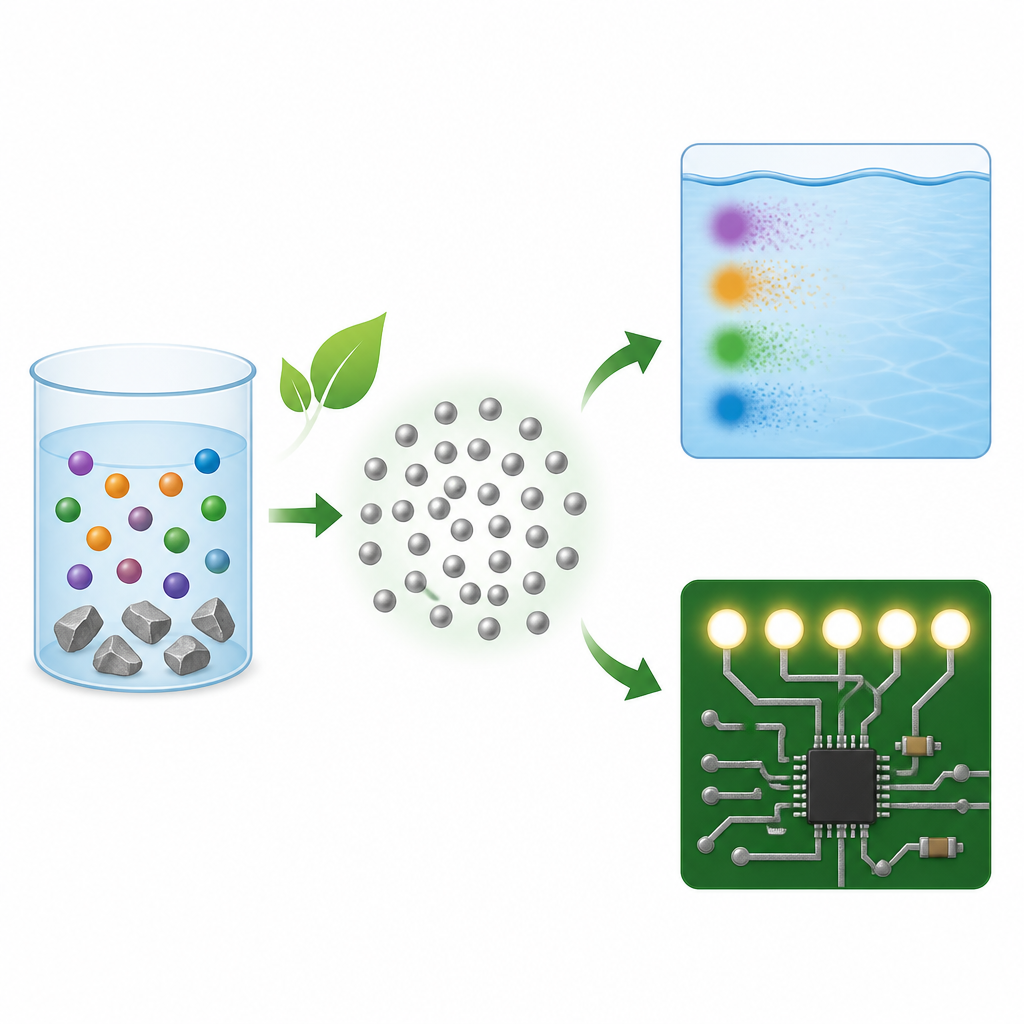
From cleaner rivers to bendable gadgets, many future technologies rely on particles so small they are invisible to the eye. This study shows a simple way to make tiny silver grains in water, without harsh chemicals or high heat, and then turns them into tools that can scrub dye pollution from water and draw working wires for self-powered lights.
A gentler recipe for tiny silver grains
Silver nanoparticles are prized because they interact strongly with light and electricity, but making them is often slow, costly, or polluting. Common methods use strong chemical reducers, high temperatures, or powerful equipment, and they can leave behind waste and unstable particles that quickly tarnish. The authors tackled this by designing a room-temperature water process that uses scrap magnesium metal and tartaric acid, a mild compound also found in grapes and wine, to grow clean, uniform silver nanoparticles in a more environmentally friendly way.
How simple ingredients shape stable particles
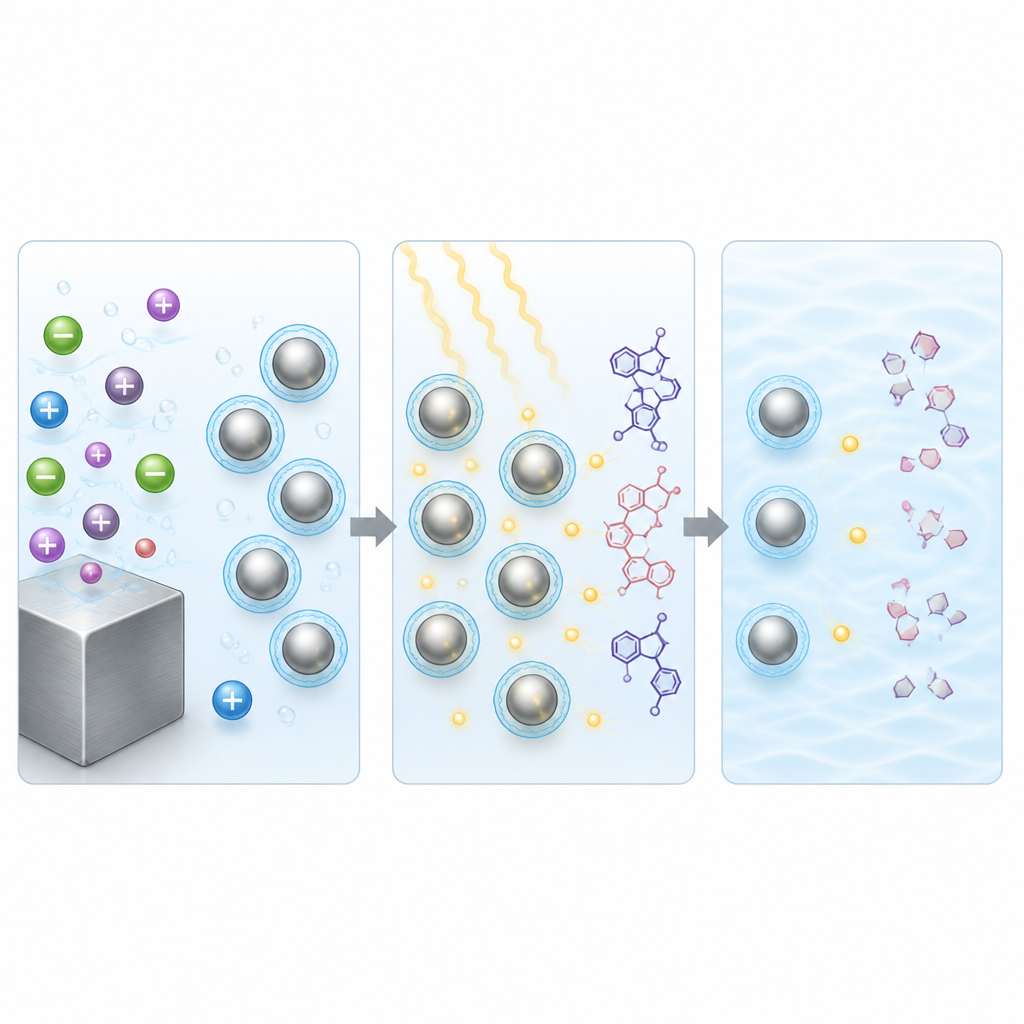
In the new method, silver salt is dissolved in water with tartaric acid, which grabs onto silver ions and forms a loose complex. When pieces of magnesium are added, magnesium gives up electrons to the silver ions, turning them into tiny bits of metallic silver while the magnesium itself dissolves away into the water. As these newborn silver seeds grow into particles around 20 to 50 nanometers across, tartaric acid sticks to their surfaces like a protective skin, keeping them from clumping and guarding them from reacting with oxygen in air. A battery of tests, including X-ray, light absorption, and electron microscopy, confirms that the particles are pure silver, highly crystalline, and show the special light signature expected for stable metallic nanoparticles.
Cleaning colorful dyes out of water
The team then asked whether these tiny silver grains could help clean up stubborn dye pollutants, the brightly colored molecules released by some industries into water. They mixed the nanoparticles with water containing two common dyes, Acid Yellow and Rose Bengal, and shone visible light from a strong lamp. Over three hours, more than ninety percent of each dye vanished, as tracked by how much their color faded when measured with a light sensor. The results follow a well-known rate pattern, showing that the reaction speed depends on how much dye is left, and tests with chemical “traps” reveal that short-lived, highly reactive forms of oxygen and hydroxyl groups do much of the work in breaking the dye molecules apart.
Drawing working circuits with a silver pen
Because the particles are metallic and resistant to oxidation, the researchers also turned them into a conductive ink. They mixed the silver nanoparticles with a cellulose-based binder to form a smooth liquid that could be loaded into a marker and written onto ordinary paper. After gentle heating, the drawn lines behaved like metal wires: when connected to a small battery, they lit up colored light-emitting diodes. In a more demanding test, the ink traces carried the output from a simple hand-tapped triboelectric nanogenerator, a device that harvests mechanical energy from touch, and successfully powered a strip of 240 connected LEDs, all using only the printed silver paths.
Why this matters for water and flexible electronics
Put simply, the study delivers a water-based recipe to make tiny, long-lasting silver grains using mild ingredients, and shows that they can both help break down dye pollution under visible light and serve as the heart of low-cost, printable wiring. For a layperson, the key message is that scrap metal and a food-related acid can be combined to create advanced materials that clean dirty water and carry electricity on paper, pointing toward greener ways to build sensors, disposable electronics, and self-powered devices.
Citation: Kandikonda, R.K., Katru, R., Madathil, N. et al. Metal-displacement-derived silver nanoparticles for visible-light catalysis and TENG-enabled circuit integration. Sci Rep 16, 14780 (2026). https://doi.org/10.1038/s41598-026-44065-8
Keywords: silver nanoparticles, photocatalysis, dye degradation, conductive ink, triboelectric nanogenerator