Clear Sky Science · en
Preparation of a distillers’ grains derived lignin-chitosan adsorbent for enhanced distillery wastewater treatment
Turning Brewery Waste into a Clean Water Tool
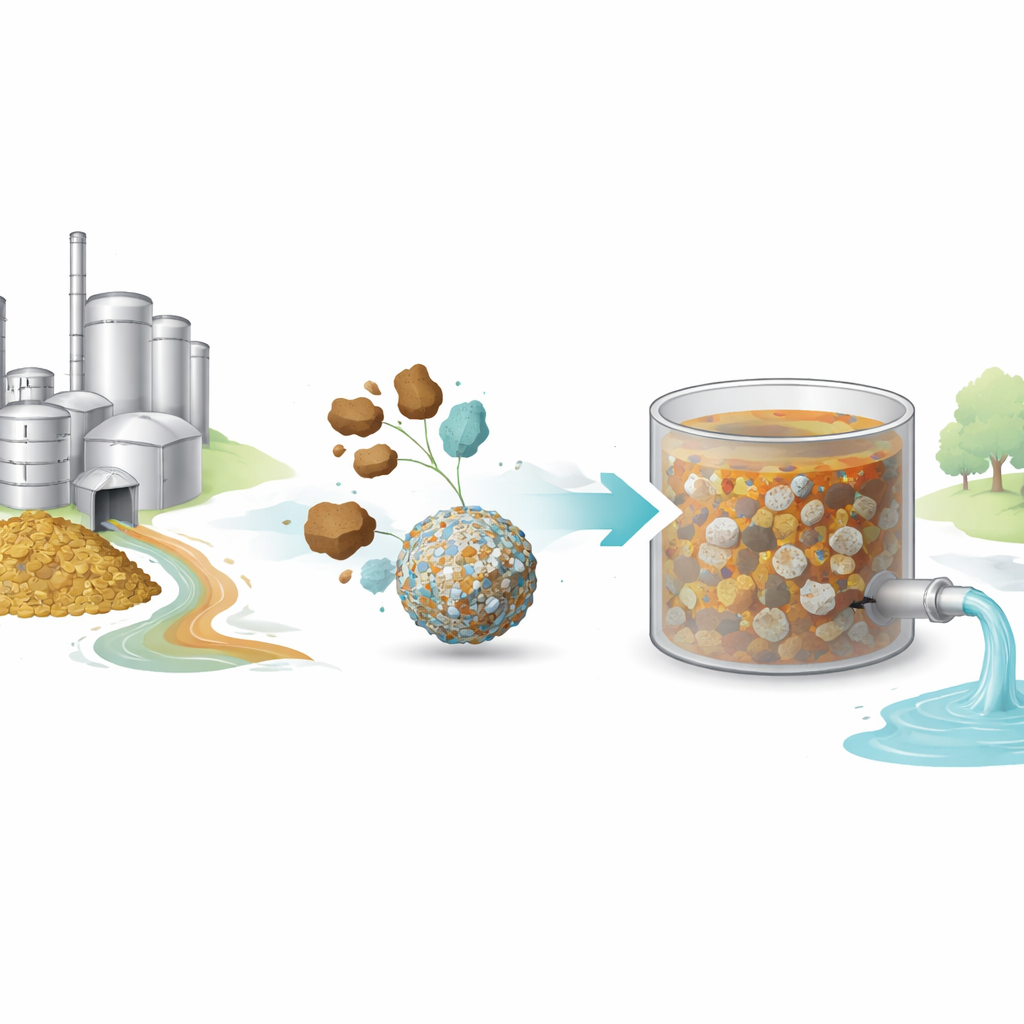
Every glass of alcohol we drink leaves behind a surprising legacy: mountains of soggy grain and tanks of dirty wastewater. Both are costly to handle and can damage rivers and lakes if not treated properly. This study explores an elegant idea—using one waste to clean up another. By transforming leftover distillers’ grains into a reusable material that can scrub pollutants from distillery wastewater, the researchers show a path toward cleaner water and a more circular, less wasteful industry.
From Leftover Grains to Helpful Material
When alcohol is made from crops like wheat, huge amounts of wet grain remain after fermentation. These distillers’ grains are rich in lignin, a tough plant component with a natural talent for grabbing onto many kinds of molecules. The challenge is that raw lignin is hard to work with in water. The team solved this by carefully extracting lignin from wheat distillers’ grains using a recyclable acid and then combining it with chitosan, a biodegradable substance often obtained from shellfish shells. Chitosan brings positively charged sites that attract negatively charged pollutants, while lignin offers a scaffold rich in reactive groups for catching other contaminants.
Building a Better Pollutant Sponge
Using a series of chemical steps, the researchers linked lignin and chitosan into a single composite adsorbent—a solid material that acts like a sponge for dissolved pollutants. Microscopic imaging showed that the new material had a rough, folded surface riddled with pores, unlike the relatively smooth lignin and cracked chitosan it came from. Other tests confirmed that the composite carried a mixture of useful chemical groups, including oxygen-, nitrogen-, and sulfur-containing sites that could attract both positively and negatively charged substances. This combination turned the particles into versatile “docking platforms” where a wide range of unwanted molecules in water could latch on.
Cleaning Up Distillery Wastewater
The team then tested how well the lignin–chitosan adsorbent cleaned real distillery wastewater. They focused on four standard measures of water quality: overall organic pollution (chemical oxygen demand, or COD), total phosphorus, total nitrogen, and ammonium. Under optimized conditions—about two grams of adsorbent per liter, neutral pH, and just over two hours of contact time—the material removed roughly 90 percent of the organic load and phosphorus, and over 80 percent of nitrogen and ammonium. The process followed a pattern in which pollutants formed a thin, orderly layer on the adsorbent surface, and calculations showed that the interactions were mainly chemical in nature and favored at warmer temperatures.
How the Pollutant Capture Works
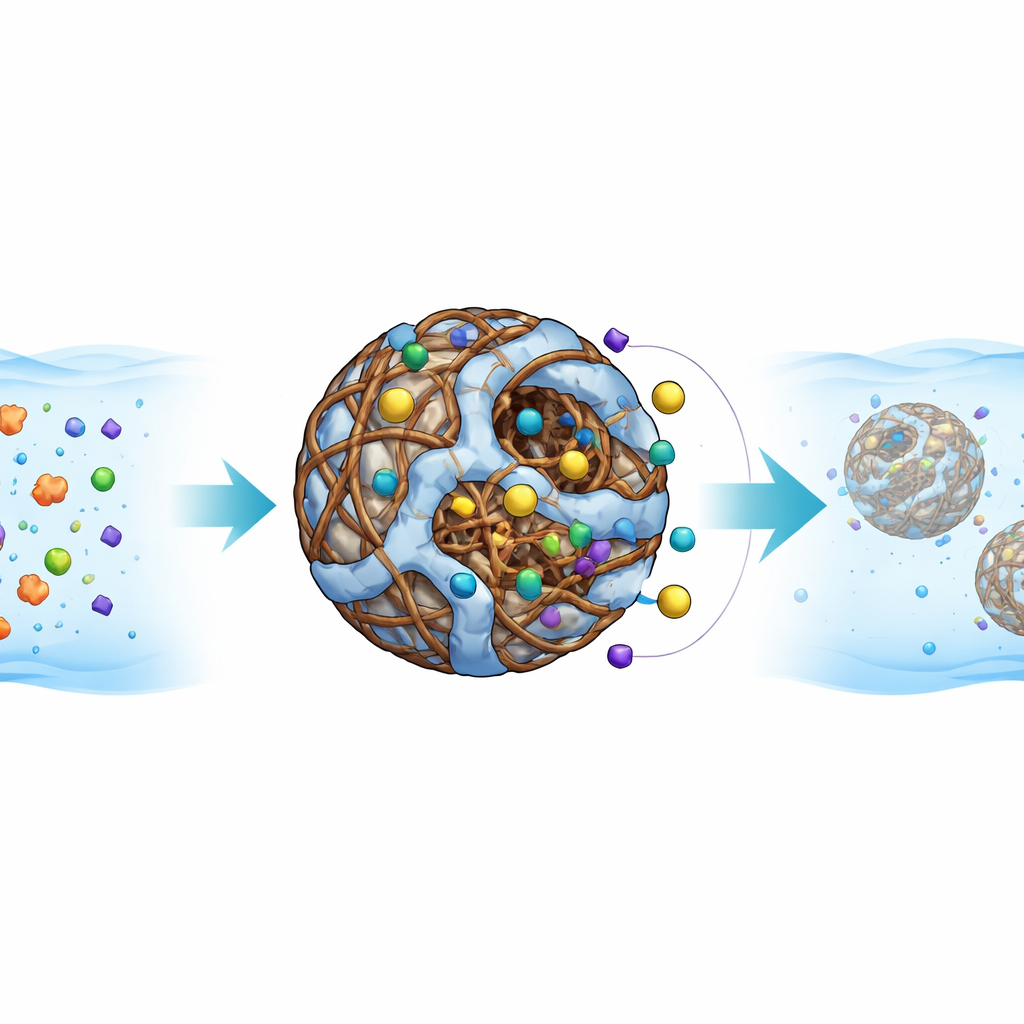
Detailed surface analyses, combined with experiments over different temperatures and pollutant levels, revealed that no single mechanism explains the adsorbent’s performance. Instead, several forces work together. Negatively charged phosphorus compounds are pulled in by positively charged nitrogen groups on chitosan and by sulfur-bearing groups, forming stable complexes. Ammonium and other nitrogen species interact through charge exchange and hydrogen bonding. Many organic molecules are drawn to the lignin-rich regions by water-repelling interactions, slipping into the material’s pores. Even when other common ions are present, the adsorbent still removes most of the key pollutants, and after five cycles of use and regeneration it retains more than 80 percent of its original cleaning power.
A Greener Option for Cleaner Water
In simple terms, the study shows that what used to be a troublesome waste—distillers’ grains—can be upgraded into an effective, low-cost cleaning agent for distillery wastewater. By pairing plant-based lignin with chitosan and adding sulfur-based tweaks, the researchers created a robust material that grabs multiple types of pollutants at once and can be reused several times. Compared with many commercial options, it works well, is relatively inexpensive, and relies on renewable or waste-derived ingredients. If scaled up, this approach could help distilleries shrink their environmental footprint by turning their own leftovers into a practical tool for protecting rivers, lakes, and groundwater.
Citation: Wang, Y., Wang, H. & Liu, J. Preparation of a distillers’ grains derived lignin-chitosan adsorbent for enhanced distillery wastewater treatment. Sci Rep 16, 14499 (2026). https://doi.org/10.1038/s41598-026-44058-7
Keywords: distillery wastewater, lignin chitosan adsorbent, industrial water treatment, waste valorization, nutrient removal