Clear Sky Science · en
Ballistic and drop-weight impact response of SS304 metal mesh embedded woven flax/hemp fiber hybrid composites
Why lighter armor matters
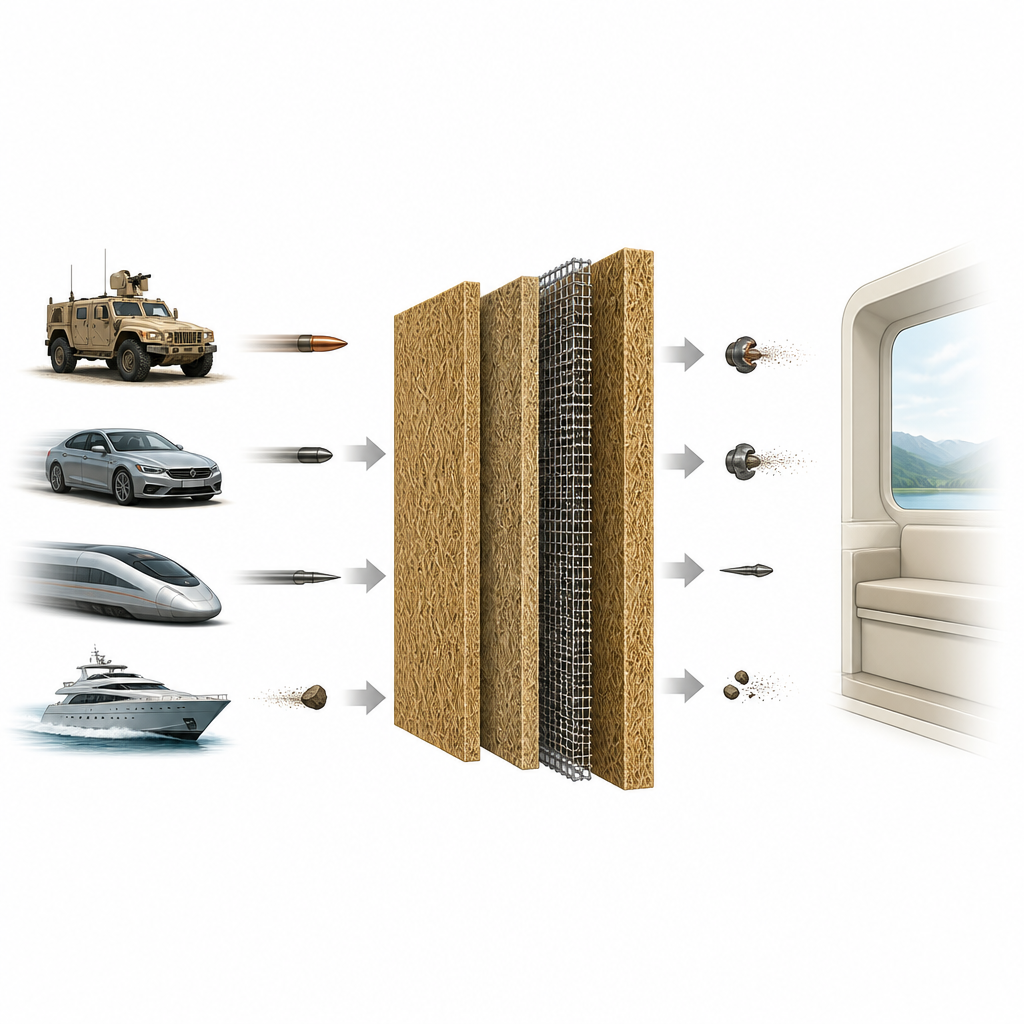
From bulletproof vests to armored vehicles, protective gear often relies on heavy metals that add weight and fuel costs. This study explores whether layers of plant-based fibers combined with a thin steel mesh can create lighter panels that still stand up to hard hits and fast projectiles. For anyone interested in safer cars, military equipment, or greener materials, it offers a glimpse of how nature’s fibers might help us rethink armor.
Building protection from plants and steel
The researchers designed sandwich-like panels using flax and hemp plant fibers bonded with epoxy resin, with a fine stainless-steel (SS304) mesh hidden inside. They made two versions. In the first, called S1, the metal mesh sat between two flax fabric layers. In the second, S2, they went a step further and wove flax and hemp yarns directly through the steel mesh before adding the outer flax layers. This extra weaving was intended to tie the metal and plant layers together more tightly, so that impacts would be shared and slowed rather than causing sudden cracks.
Putting the panels to the drop test
To see how these panels handled everyday style hits, such as falling objects or low-speed collisions, the team used a drop-weight machine. A heavy impactor was dropped from heights of 0.5 and 1 meter onto small square samples. Sensors recorded how the force and energy changed during impact, and the researchers examined the dents and internal damage on both the front and back faces. At the lower drop height, both designs showed only shallow dents, but the woven version S2 consistently had slightly smaller indentations and less visible damage. At the higher drop height, damage spread more widely, especially on the back surface, yet S2 still showed smaller cracked and delaminated areas than S1, meaning it distributed the blow more effectively.
Facing high-speed projectiles
Real armor must withstand far more than dropped tools, so the researchers also fired small, hemispherical projectiles at high speed using a gas-gun system. High-speed cameras measured how fast the projectiles were traveling before and after punching through the panels, allowing the team to calculate how much energy each panel absorbed. Again, the woven S2 samples outperformed S1. S2 slowed the projectiles more, soaking up about 19 percent more energy. Microscopic inspection showed how this happened. In S1, damage was sharp and brittle, with clean fiber breaks and large delaminated zones. In S2, the woven flax and hemp yarns stretched, pulled out, and bridged cracks, while the steel mesh bent and confined damage, creating a more gradual, energy-hungry failure path.
How weaving changes the way panels fail
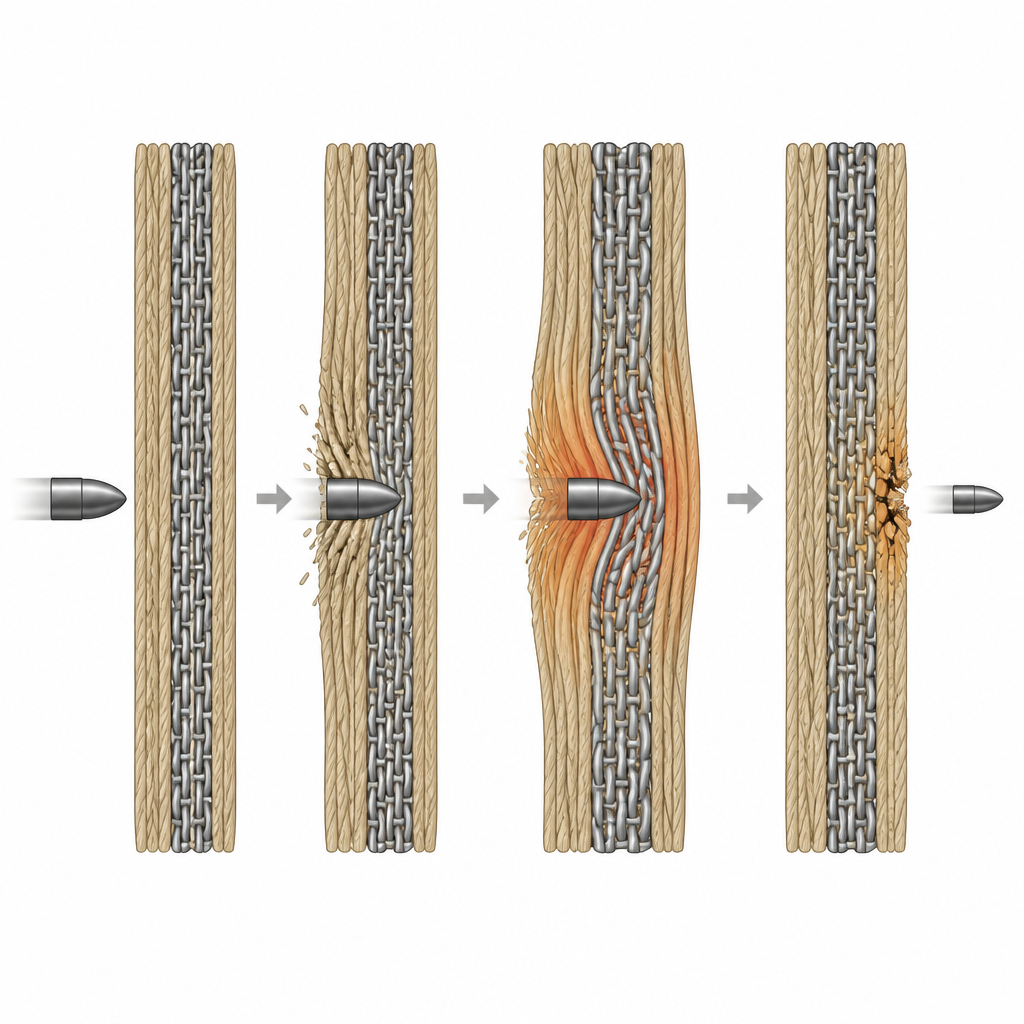
By looking at the size of dents, the spread of internal cracks, and how much material was lost, the team mapped out the chain of events during impact. In both low-speed and ballistic tests, damage began with tiny cracks in the resin between fibers, then layers started to separate, and finally fibers broke or were pulled out. In the non-woven design, these steps happened quickly and locally. In the woven design, the interlaced flax and hemp yarns created many small bridges between layers, which helped carry load across the panel. The steel mesh acted like a thin cage, spreading stresses sideways and preventing cracks from racing through the entire thickness. As a result, S2 panels absorbed 20–25 percent more impact energy per unit mass than S1 and suffered smaller damaged volumes and lower mass loss.
What this means for future armor
To a layperson, the key message is that smart layering and weaving can make lighter, greener protection systems more effective. By combining renewable plant fibers with a fine stainless-steel mesh and carefully interlacing them, the researchers created panels that manage hits through controlled, step-by-step damage instead of sudden shattering. These hybrid flax–hemp–steel structures show promise as lightweight alternatives to traditional all-metal or fully synthetic armor in vehicles, aircraft parts, and protective panels, offering a path toward safer and more sustainable impact-resistant designs.
Citation: Elayaraja, R., Rajamurugan, G. Ballistic and drop-weight impact response of SS304 metal mesh embedded woven flax/hemp fiber hybrid composites. Sci Rep 16, 15835 (2026). https://doi.org/10.1038/s41598-026-44055-w
Keywords: natural fiber composites, ballistic protection, flax hemp hybrid, lightweight armor, impact resistance