Clear Sky Science · en
Model-order-reduced spectral-element method for high-accuracy and fast 3-D transient electromagnetic forward modeling with SAI-Krylov
Peering Underground with Faster Virtual Sensors
Finding buried ore bodies, groundwater, or hidden faults often relies on subtle ripples in the Earth’s electromagnetic field. Turning those ripples into a picture of what lies underground demands heavy number‑crunching on super‑sized 3‑D models, which can be painfully slow. This paper introduces a new way to simulate these electromagnetic surveys that keeps the accuracy needed for real‑world exploration, while slashing the time and memory cost on a computer.
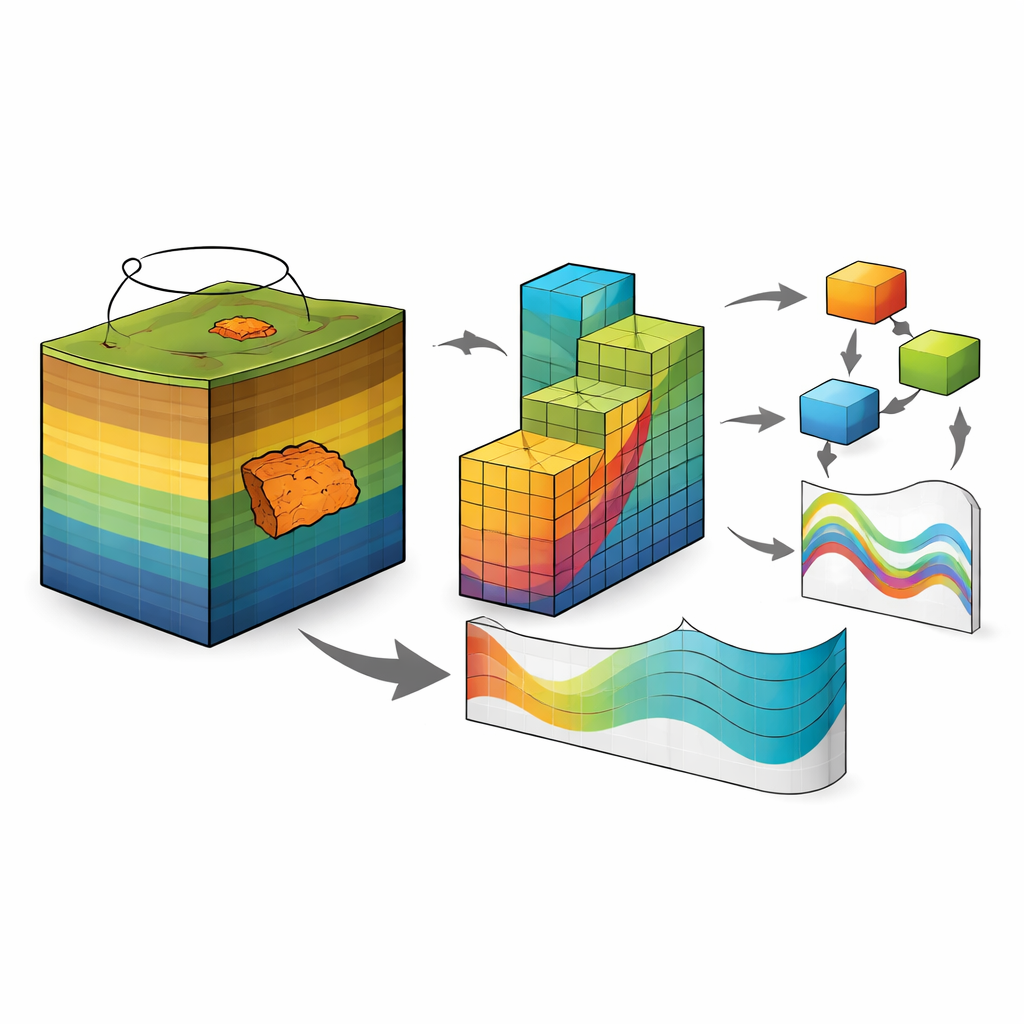
Why Simulating Electromagnetic Surveys Is Hard
Transient electromagnetic (TEM) methods work by sending a pulse of electrical current through a wire loop or grounded cable at the surface. When the current is switched off, swirling currents are induced underground and gradually fade with time, carrying clues about rock conductivity and hidden ore bodies. To predict what receivers will measure, scientists solve Maxwell’s equations on a 3‑D grid. Traditional approaches use simple building blocks with only linear changes inside each cell. These low‑order approximations are easy to program but struggle to capture fine details without exploding the number of unknowns and the cost of time stepping through thousands of tiny time intervals.
Sharper Grids with Fewer Building Blocks
The authors adopt a high‑order spectral‑element method, which enriches each grid cell with more flexible mathematical shapes rather than relying on straight‑line variations. In practice, this means the model can represent changes in the electric field much more smoothly using the same mesh, or reach a given accuracy with far fewer cells. They carefully design how unknowns are placed along edges, how each physical cell is mapped to a simple reference cube, and how special Gauss–Lobatto points and weights are used. A key trick, called reduced integration, slightly relaxes the exactness of certain integrals but makes the crucial conductivity matrix strictly diagonal. This greatly increases sparsity, lowering both memory use and the cost of solving the resulting linear systems, while preserving high accuracy for the orders of interest.
Compressing the Math without Losing the Physics
Even with a sharper grid, marching forward in time the usual way remains expensive, because every change in time step forces a fresh factorization of a huge matrix. The authors instead rewrite the problem as a continuous‑time system and use a model‑order‑reduction technique based on a shift‑and‑invert Krylov subspace algorithm. In plain terms, they project the full, enormous system onto a much smaller set of “representative” patterns that capture how electromagnetic fields actually evolve. A smart spectral transformation clusters the important modes, so the algorithm converges quickly. Crucially, the method decides on the fly how large this reduced space needs to be, using an inexpensive residual measure as a stopping rule. As a result, the solver requires only one major matrix factorization plus a modest number of back‑substitutions, yet can evaluate the electromagnetic response at any time without stepping through every intermediate instant.
Putting the Method to the Test
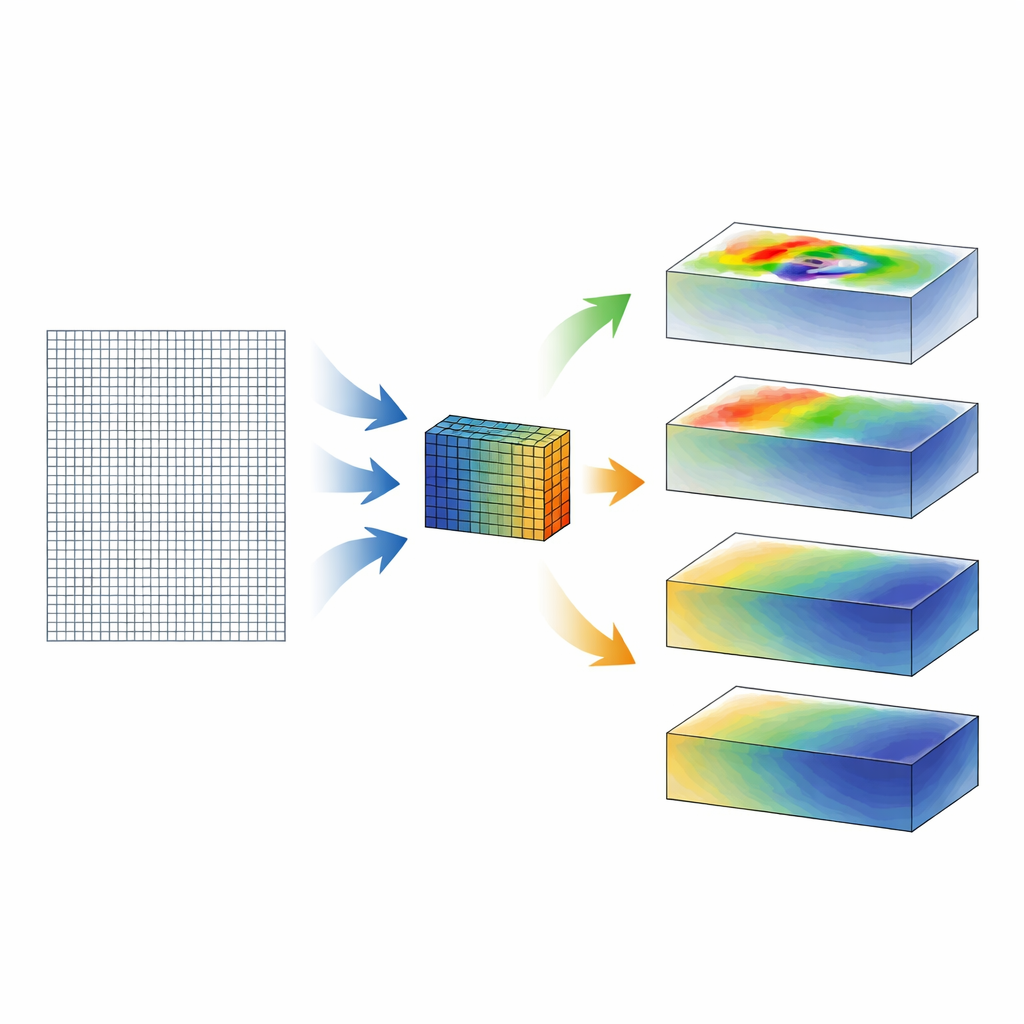
To judge both accuracy and efficiency, the authors simulate several benchmark scenarios. For a simple half‑space with known analytic behavior, they compare different polynomial orders and integration strategies against a standard backward time‑stepping scheme. From second order upward, errors stabilize at around one percent or less, and with the new reduced model they can push mean errors down to about half a percent while achieving speedups of roughly 16 to 20 times for higher‑order runs, without ballooning memory demands. In layered models with strong resistivity contrasts, the new spectral‑element plus Krylov approach stays within about one percent error across the full time window and outperforms conventional finite‑element baselines that rely on low‑order cells and more dissipative time stepping. Finally, in a fully 3‑D sulfide‑ore scenario, the method tracks how induced fields from both grounded wires and loop sources spread, interact with a complex conductive body, and eventually outline the buried target with high spatial resolution.
What This Means for Exploring the Subsurface
For geophysical surveys that depend on detailed 3‑D electromagnetic modeling, this work offers a way to have it both ways: high fidelity and high speed. By pairing high‑order spectral elements with a carefully designed model‑order‑reduction scheme, the authors show that one can achieve sub‑percent errors for practical TEM responses while cutting computation time by an order of magnitude relative to a respected baseline. In everyday terms, this means faster turnaround from raw survey design to interpretable images of the subsurface, making it more feasible to explore for minerals, assess geohazards, or track groundwater using rigorous physics‑based simulations rather than oversimplified shortcuts.
Citation: Fan, Y., Lu, K., Huang, Y. et al. Model-order-reduced spectral-element method for high-accuracy and fast 3-D transient electromagnetic forward modeling with SAI-Krylov. Sci Rep 16, 13356 (2026). https://doi.org/10.1038/s41598-026-44053-y
Keywords: transient electromagnetics, spectral element method, model order reduction, geophysical exploration, numerical simulation