Clear Sky Science · en
Spontaneous imbibition and oil displacement experimental investigation in fracture–matrix cores of tight sandstone reservoirs
Getting More Oil from Tough Rock
Much of the world’s remaining oil is locked in rocks so tight that it barely flows, even after wells are drilled and fractured. This study looks at how a specially designed fluid can coax more oil out of these stubborn tight sandstone reservoirs by seeping into tiny rock pores, loosening trapped oil, and pushing it toward the well. The work shows not only how well this fluid performs, but also what happens to the oil inside the rock at each stage of the process.
Why Tight Sandstone Is Hard to Produce
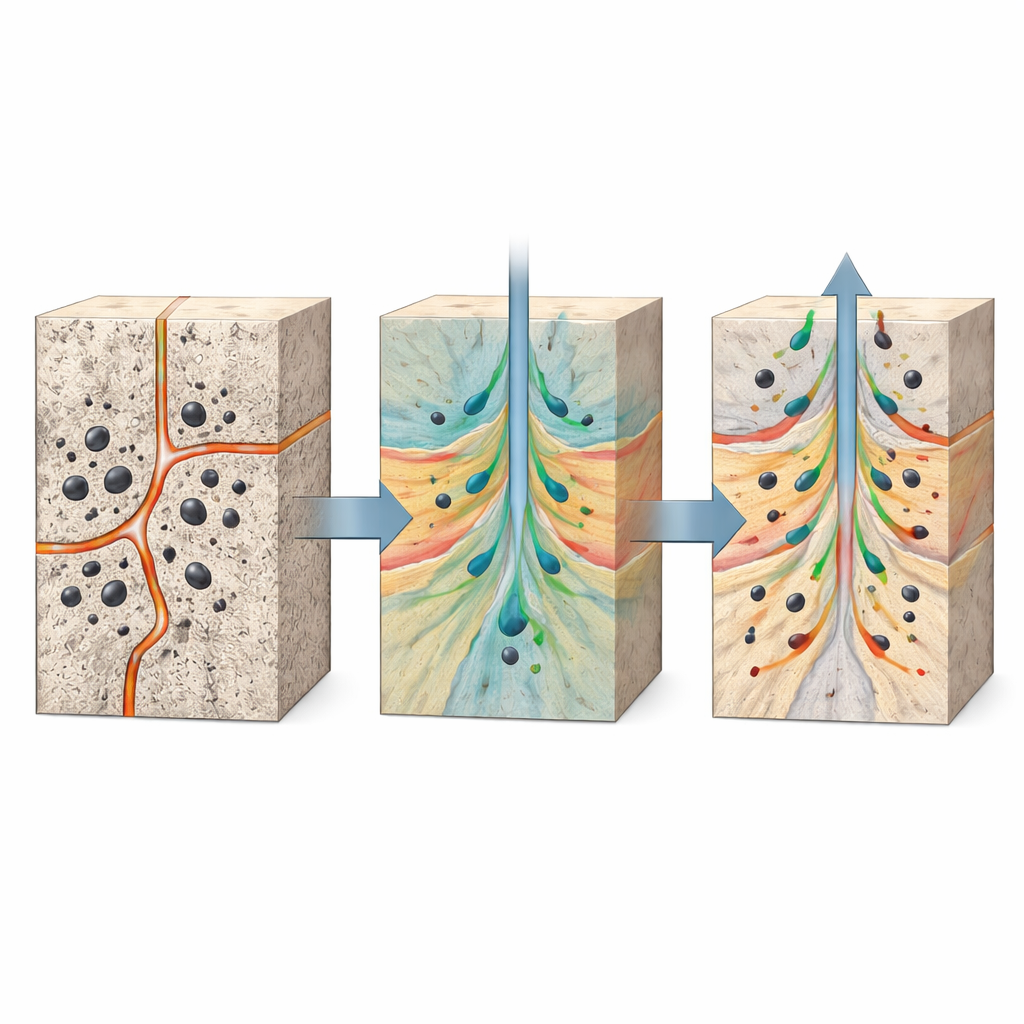
Tight sandstone reservoirs differ from classic oil fields because their pores are tiny and poorly connected, and oil often sits in a complex system of fractures and rock matrix. Conventional water flooding works poorly here: water tends to race through the fractures, bypassing much of the oil trapped in the surrounding rock. To improve recovery, operators use hydraulic fracturing to create large fracture networks and inject specially formulated fluids. The idea is that these fluids should not only open the rock but also soak into it during a shut-in period, dislodging oil from the smallest pores so that it can later be produced as pressure in the reservoir is lowered.
A Tailor-Made Helper Fluid
The researchers focused on a surfactant-based oil displacement agent called C‑22, used together with real crude oil and rock cores from a tight oil field in western China. Surfactants are soap-like molecules that gather at the boundary between oil and water, helping to reduce the “stickiness” that keeps oil attached to the rock. The team first measured how well different surfactant mixtures could lower the tension at the oil–water boundary and how stable they remained under reservoir-like conditions of high temperature. C‑22 showed excellent performance, achieving extremely low interfacial tension at modest concentration and remaining clear and unchanged after a week at 68 °C, suggesting that it can work reliably underground over the timescales relevant for field operations.
Watching Oil Move Inside the Rock
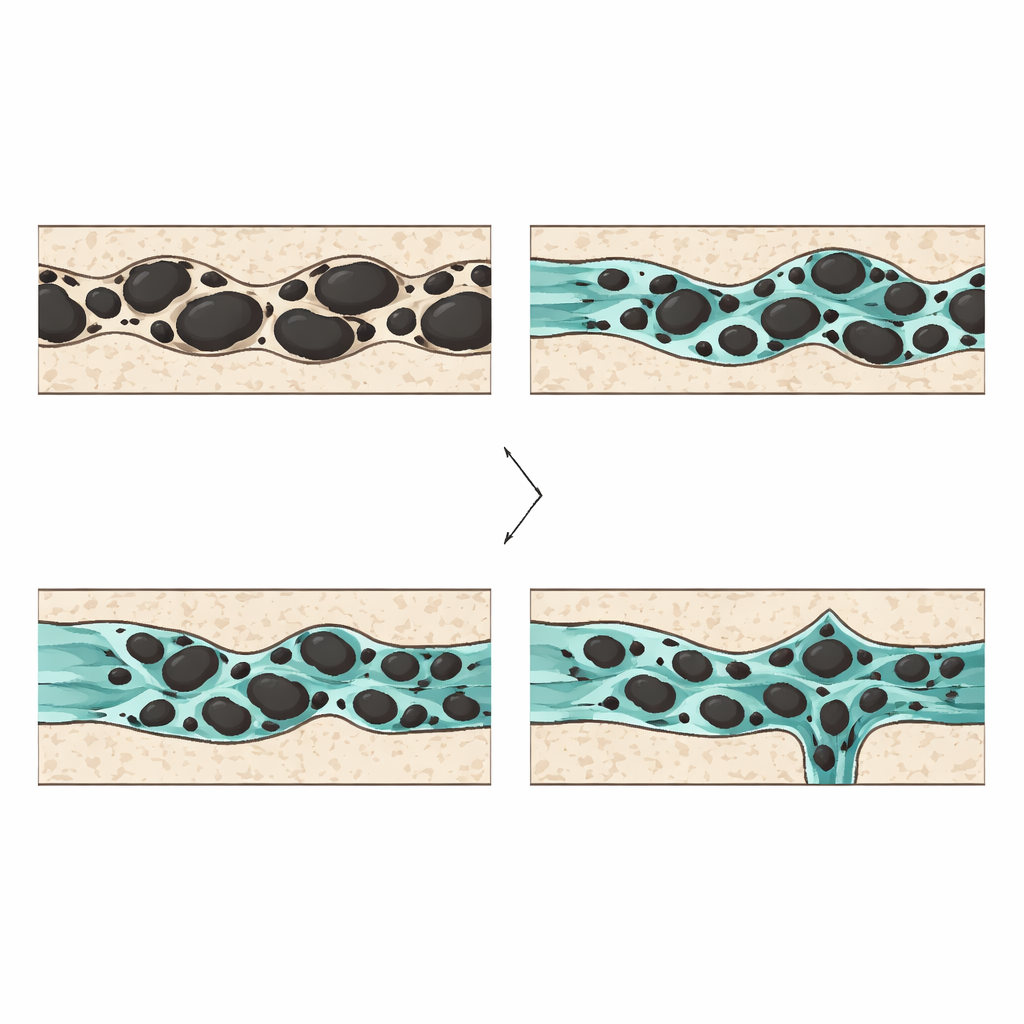
To see how oil actually moves in the fractured rock, the authors used specialized sandstone “cores” that contained both fractures and a surrounding matrix, then saturated them with the field crude oil. They performed soaking (spontaneous imbibition) tests, in which the C‑22 solution surrounds the core and slowly invades it under capillary forces, and depletion tests, in which the pressure is gradually reduced to simulate production. A nuclear magnetic resonance (NMR) system tracked signals from hydrogen nuclei, revealing how much oil remained in pores of different sizes over time. The data showed that during soaking, oil in larger pores and fractures is mobilized quickly, while oil in medium-sized pores follows, and oil in the tiniest pores is the last to move. During pressure depletion, medium and large pores again contribute most of the early flow, but small pores become more important later, highlighting the dual role of fractures and matrix in long-term production.
Finding the Best Recipe and Timing
By systematically varying the surfactant type, its concentration, and how long the rock is left to soak, the team identified operating conditions that give the biggest boost in oil recovery. They found that simply driving the interfacial tension as low as possible does not always yield large gains once a certain threshold is reached; fluids with similar tension levels tend to give similar performance. For C‑22, a concentration around 0.2–0.3 weight percent struck the best balance, significantly improving recovery compared with lower doses, while higher concentrations offered little extra benefit. Likewise, extending the soaking time up to about 12 hours delivered a notable jump in recovery, but keeping wells shut in longer produced only marginal improvements, suggesting a practical upper limit for field operations.
What This Means for Future Oil Production
The study concludes that a carefully tuned surfactant fluid like C‑22 can substantially improve oil recovery from tight sandstone by altering how oil behaves in the smallest pores and by coordinating flow from both fractures and matrix. Under optimized conditions—interfacial tension on the order of 10⁻² milli–newtons per meter, a C‑22 concentration of about 0.3 percent, and a soaking time of 12 hours—the researchers achieved much higher recovery than with water alone, with final displacement tests reaching nearly 19 percent additional oil. For non-specialists, the key message is that smart chemistry and well-chosen operating schedules can make previously stubborn rocks yield more of their trapped oil, using the same fractures already created for production but putting them to work more efficiently.
Citation: Chen, W., He, R., Li, L. et al. Spontaneous imbibition and oil displacement experimental investigation in fracture–matrix cores of tight sandstone reservoirs. Sci Rep 16, 14070 (2026). https://doi.org/10.1038/s41598-026-44044-z
Keywords: tight sandstone oil, hydraulic fracturing, surfactant flooding, spontaneous imbibition, nuclear magnetic resonance cores