Clear Sky Science · en
Ensuring the integrity of AI models: a blockchain-based approach for protecting medical imaging training data
Why protecting medical scans matters
When doctors use artificial intelligence to spot brain tumors on MRI scans, they are placing enormous trust in the data and the software. But what if someone quietly altered those scans so that the AI learned the wrong lessons—or misread a tumor as harmless? This article explores how a combination of blockchain technology and distributed file storage can lock down medical images from the moment they are created, helping ensure that life‑or‑death decisions are not based on corrupted data.
The hidden threat in medical images
Modern AI systems, especially deep learning models, can detect subtle patterns in MRI brain images that humans might miss, boosting accuracy and easing doctors’ workload. Yet these models are only as trustworthy as the images they are trained on. Adversaries can perform “data poisoning” attacks by slipping slightly altered MRI scans into training datasets. The changes are so small that humans cannot see them, but they can push the AI model toward dangerous mistakes, such as consistently misclassifying a tumor type. Similar tweaks can be applied at the testing stage, where an attacker subtly modifies a single scan to fool a deployed model into giving the wrong diagnosis. Because today’s medical imaging pipelines often lack strong guarantees about where data came from and whether it was changed, these attacks are hard to detect and could have life‑threatening consequences.
Why existing defenses fall short
Researchers have tried several tactics to defend AI models, but most of them treat symptoms rather than causes. Adversarial training exposes models to many manipulated examples so they learn to resist certain attacks, but this is computationally costly and tends to protect only against known tricks. Image “cleaning” methods, such as compression or denoising, can remove some perturbations but may fail against more sophisticated attacks and do not prove where the data originated. Other approaches, such as digital watermarking or special secure hardware, offer useful features like tamper detection or protected computation, but they assume the images entering the system are already trustworthy. None of these methods provide an end‑to‑end record of every medical image from the moment it is captured at a scanner through storage, sharing, and use in AI training.
A new data pipeline built on shared trust
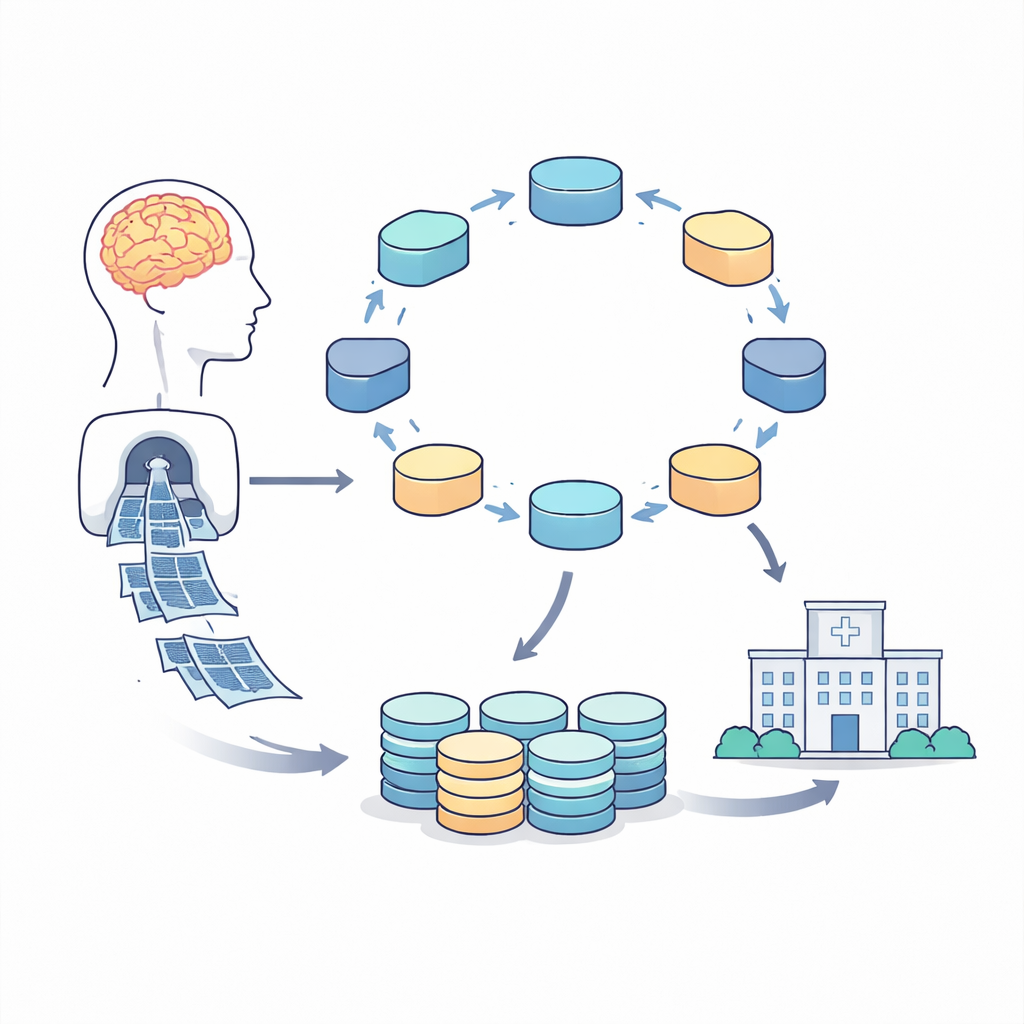
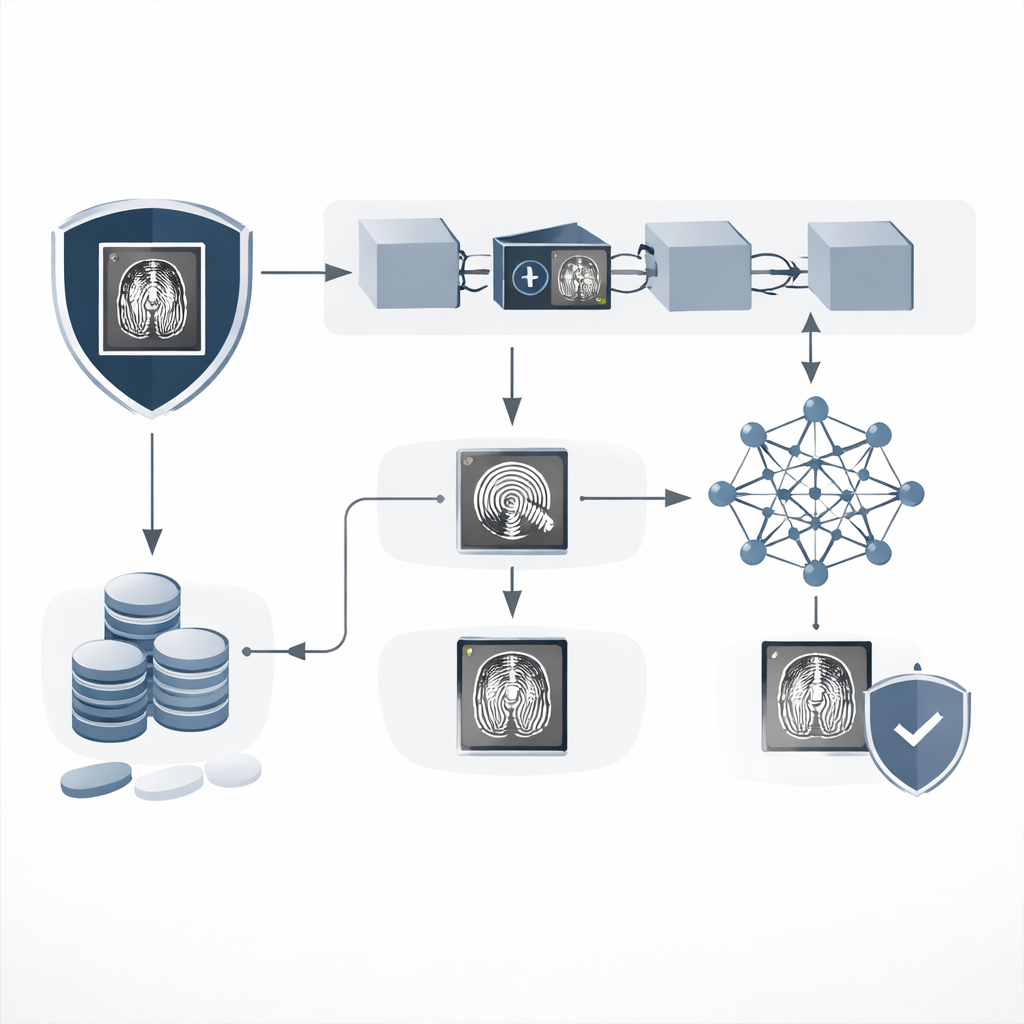
The authors propose a new architecture that starts protecting images the instant they are created in a diagnostic center. In their design, three roles cooperate: the DataOwner (such as a hospital imaging department) that generates MRI scans, the DataCustodian that manages secure storage and permissions, and the ResearchCenter that trains AI models. Instead of placing images directly on a blockchain—which would be slow and heavy—raw MRI files are stored in a private, isolated network of distributed storage nodes called a Private IPFS. Each image receives a unique cryptographic fingerprint, or content identifier, that changes if even a single pixel is altered. That fingerprint, along with information about who uploaded the image and when, is then written to a permissioned blockchain built on Hyperledger Fabric, which is shared only among approved organizations.
How the system stops tampering
Whenever a researcher wants to use images, they send a digitally signed request that is recorded on the blockchain. Only authorized parties can approve this request, and the approval itself becomes part of the permanent record. The researcher then retrieves the image from the private storage network and recomputes its fingerprint. If the new fingerprint does not match the one stored on the blockchain, the image is flagged as tampered and is blocked from entering the AI training pipeline. This creates a tamper‑evident, fully auditable trail: every upload, access request, approval, and retrieval is logged across multiple independent computers, making quiet manipulation far more difficult. The authors implemented this design with real MRI brain tumor images, measured its performance using a tool called Hyperledger Caliper, and showed that it can handle secure, near‑real‑time uploads with low failure rates and manageable delays.
What this means for safer AI in hospitals
In plain terms, the proposed system acts like a locked, transparent vault for medical images. Everyone can see when a scan enters or leaves the vault, and any attempt to alter a scan leaves obvious fingerprints. By combining a permissioned blockchain with private distributed storage and strict access controls, the framework tackles the root of the problem: it keeps poisoned or forged images from ever reaching the AI model. While practical challenges remain—such as connecting this setup to existing hospital software and navigating complex privacy regulations—the approach offers a promising path toward AI tools that clinicians and patients can trust, especially in high‑stakes areas like brain tumor diagnosis.
Citation: Shinde, R., Patil, S., Kotecha, K. et al. Ensuring the integrity of AI models: a blockchain-based approach for protecting medical imaging training data. Sci Rep 16, 13989 (2026). https://doi.org/10.1038/s41598-026-44040-3
Keywords: medical imaging security, blockchain healthcare, adversarial attacks, brain tumor MRI, trustworthy AI