Clear Sky Science · en
Transforming waste into worth: Procambarus clarkii carapace as a high-performance biosorbent for methyl red dye
From River Pest to Helpful Cleaner
Imagine if a troublesome river invader could be turned into a low-cost tool for cleaning polluted water. This study does exactly that: it takes the hard outer shell of the red swamp crayfish, an invasive species in Egypt’s Nile River, and repurposes it as a natural filter to pull a harmful red dye out of wastewater. For anyone concerned about safe drinking water, industrial pollution, or creative recycling of biological waste, this work shows how a local environmental problem can be turned into part of the solution.
Why Colored Wastewater Is a Growing Worry
Many factories that make textiles, paper, and leather release brightly colored synthetic dyes into rivers and streams. These dyes, including one called methyl red, do not break down easily in nature and can damage skin, eyes, lungs, and potentially increase cancer risk. Even in small amounts, they can travel through the food chain and linger in the environment for years. While there are advanced treatment methods that can remove these dyes, such as special membranes or ion-exchange systems, they tend to be expensive and complex to run, especially for large volumes of wastewater in developing regions.
Turning Crayfish Shells into a Simple Filter
The researchers focused on Procambarus clarkii, the red swamp crayfish, which has spread aggressively in the Nile, outcompeting native species and disturbing fish habitats. Its shell, or carapace, is a byproduct of seafood processing and is usually discarded. Yet it is naturally rich in calcium carbonate, chitin, and proteins—materials known for their ability to bind pollutants. In this study, the team simply cleaned, boiled, dried, and ground the shells into a fine powder, without adding any chemicals or activating agents. This raw powder was then tested as a “biosorbent,” meaning a natural material that can latch onto unwanted molecules in water. 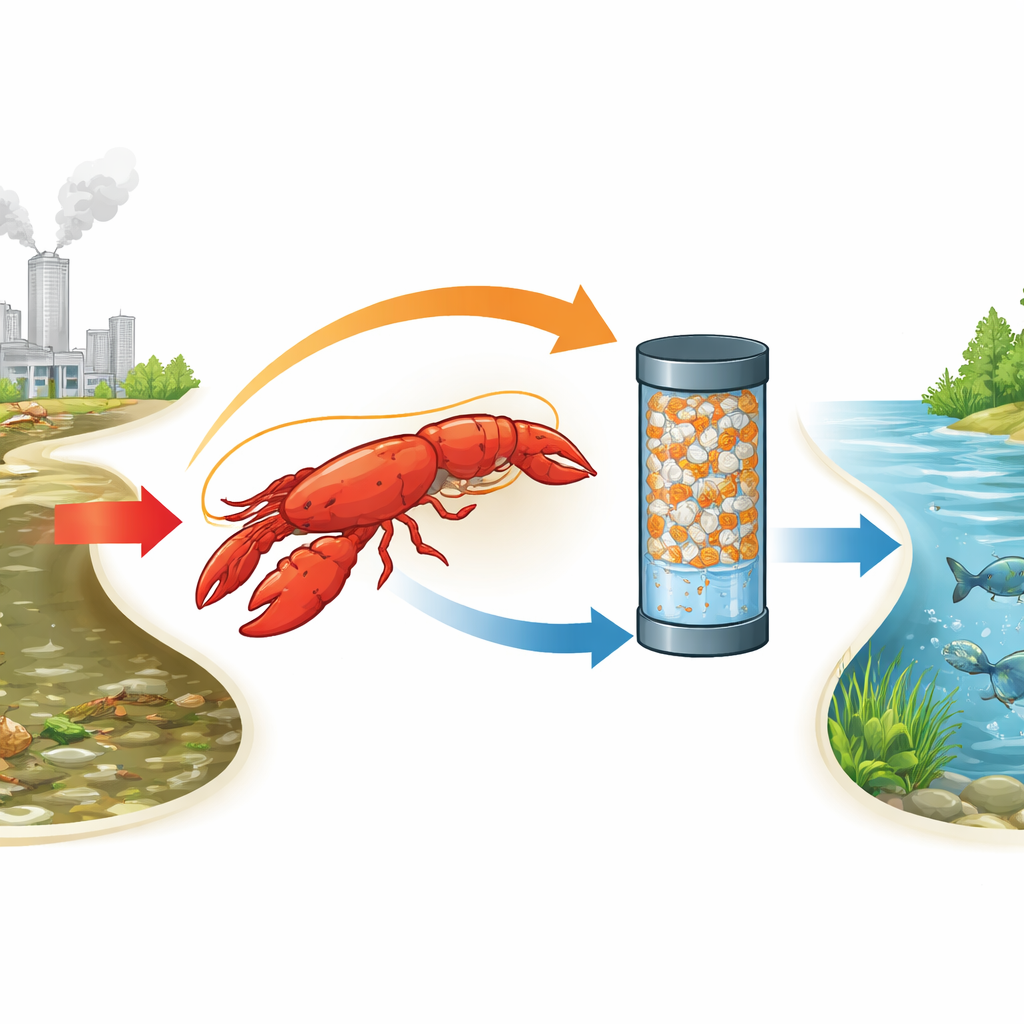
How the Shell Grabs the Dye
Detailed imaging and chemical tests revealed that the crayfish shell powder has a rough, layered, and porous structure from the microscopic down to the nano-scale. Although its overall surface area is modest compared to engineered materials like activated carbon, the shell is packed with chemical groups—such as hydroxyl, amino, and carbonate groups—that can interact strongly with dye molecules. In neutral water (around pH 7), these groups tend to carry a positive charge, while methyl red carries a negative charge. This charge difference pulls the dye toward the shell surface. Once close, the dye is further held in place by hydrogen bonding and ion exchange with the mineral-rich parts of the shell. Together, these effects allow the powder to remove up to 97% of the dye within two hours, forming a thin layer of captured molecules on its surface. 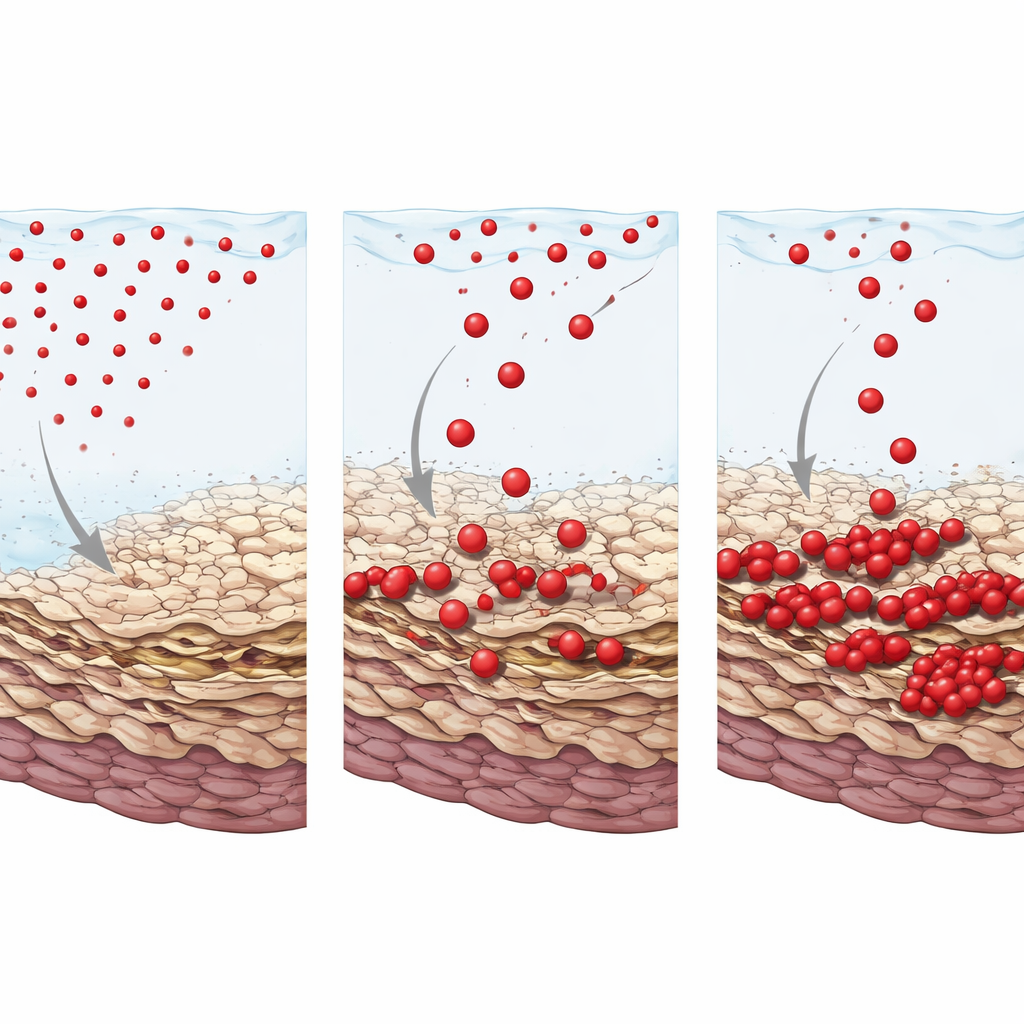
How Well It Works in Practice
The team systematically explored how dye removal changes with dye concentration, shell dose, acidity, contact time, and temperature. The best performance came at neutral pH using modest amounts of shell powder, where the material reached a maximum uptake of about 14 milligrams of dye per gram of shell. Mathematical models showed that the dye forms a single layer on the shell surface and that the adsorption process proceeds in a stepwise fashion: a rapid initial phase as many free sites are available, followed by a slower phase as the surface fills and dye molecules begin to repel each other. Temperature and energy calculations indicated that the process happens spontaneously and releases heat, consistent with strong binding between dye and shell. The shell material could also be used more than once; after two and three cleaning cycles, it still retained about 70% and 50% of its original efficiency, respectively.
Balancing Performance, Cost, and Ecology
While some chemically engineered adsorbents can hold more dye per gram than this raw crayfish shell, they usually require costly and sometimes polluting preparation steps. In contrast, the shell powder used here is cheap, requires no chemical treatment, and helps make use of an invasive species that is already harming local ecosystems. By converting both industrial dye pollution and crayfish overpopulation into a combined water-treatment approach, the study points to a practical, eco-friendly option for communities facing colored wastewater. With further work on treating other pollutants and scaling up to continuous-flow systems, discarded crayfish shells could become a valuable tool in the wider effort to provide cleaner water.
Citation: Darweesh, R.F.H., Ahmed, A.S., Zaki, R.M. et al. Transforming waste into worth: Procambarus clarkii carapace as a high-performance biosorbent for methyl red dye. Sci Rep 16, 11366 (2026). https://doi.org/10.1038/s41598-026-44037-y
Keywords: wastewater treatment, biosorbent, crayfish shell, methyl red dye, water pollution