Clear Sky Science · en
The antibacterial effect of Tanacetum argyrophyllum essential oil on kanamycin-resistant Escherichia coli by disruption of energy metabolism and proton fluxes
Why a mountain herb matters for modern medicine
Hospitals around the world are struggling with bacteria that no longer respond to familiar antibiotics. This study looks to a traditional Armenian mountain herb, Tanacetum argyrophyllum, to see whether its fragrant essential oil can help slow or stop these hard-to-treat microbes. The researchers show not only that the oil can hinder the growth of ordinary and drug-resistant Escherichia coli, but also how it interferes with the bacteria’s internal “power grid,” making existing antibiotics work better.
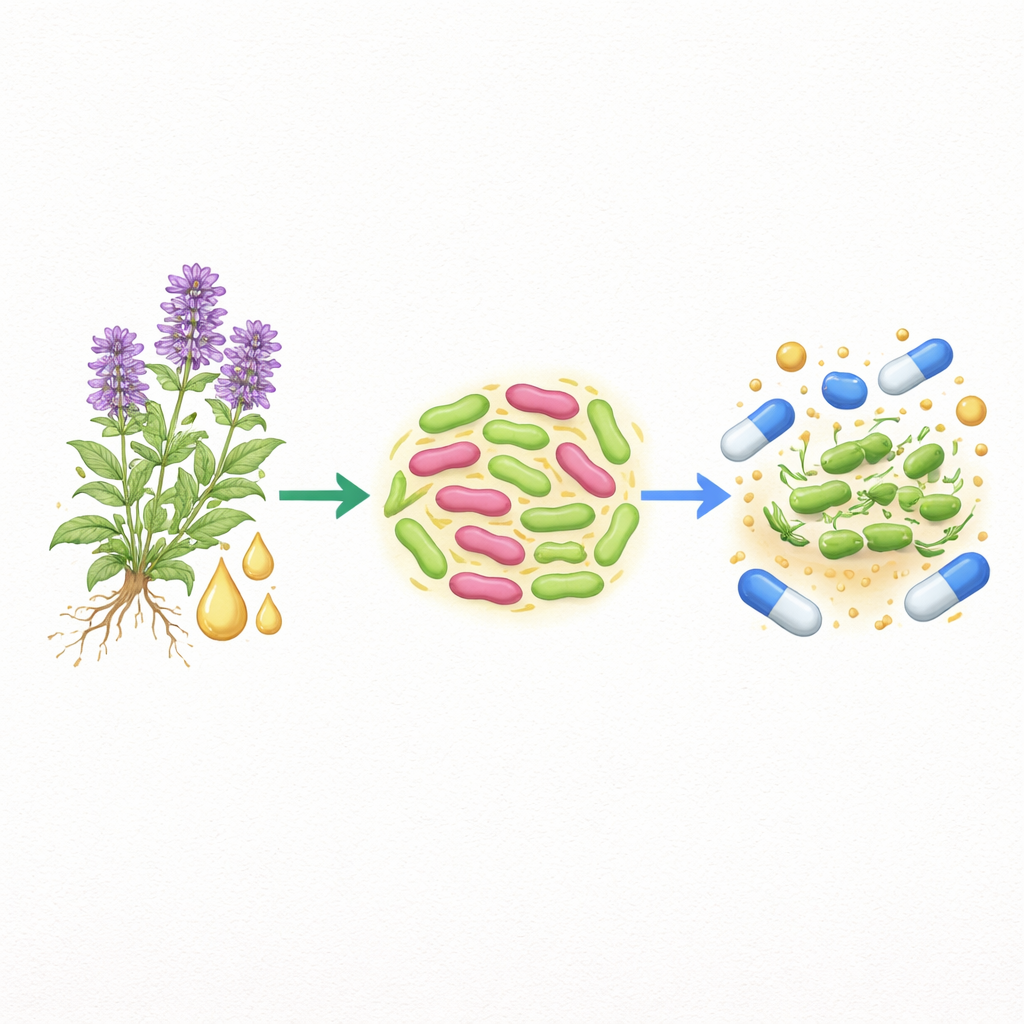
From wild plant to potent aromatic oil
The team collected Tanacetum argyrophyllum from high-altitude grasslands in Armenia and extracted essential oil from its above-ground parts using a traditional water-distillation method decoded from medieval manuscripts. Chemical analysis revealed a complex mixture dominated by three small, oily molecules: eucalyptol, camphor, and camphene. These belong to a family of plant chemicals called terpenes, already known for their strong scents and antimicrobial effects. Together with several minor components, they give the oil a rich, terpene-heavy profile that hinted it could act as a natural germ-fighter.
Putting the oil to the test against germs
To see how well this oil worked, the researchers challenged a range of microbes, including yeast, common Gram-positive bacteria, and two forms of E. coli: a standard laboratory strain and a version carrying a plasmid that makes it resistant to the antibiotic kanamycin. Using standard lab tests, they found that the oil slowed or stopped growth across all tested species. The most sensitive bacteria were Staphylococcus aureus and Bacillus subtilis, which were inhibited at relatively low oil concentrations. The E. coli strains, protected by their extra outer membrane, needed higher doses, but even the kanamycin-resistant strain was held in check. Follow-up plate counts confirmed that exposure to the oil cut the number of living E. coli colonies by about 30 percent, showing a clear hit to bacterial survival.
Helping old antibiotics work again
Because antibiotic resistance is such a pressing problem, the scientists next asked whether the plant oil could change how bacteria respond to existing drugs. They combined non-lethal amounts of the oil with kanamycin and measured how much antibiotic was needed to stop growth of the resistant E. coli. When paired with a moderate dose of the oil, the effective dose of kanamycin dropped fourfold, a strongly synergistic effect. In other words, the oil made the resistant bacteria behave more like sensitive ones. This boost was specific, however: the same oil did not noticeably change the performance of ampicillin, a different kind of antibiotic that attacks the cell wall rather than relying on the cell’s energy machinery for entry.
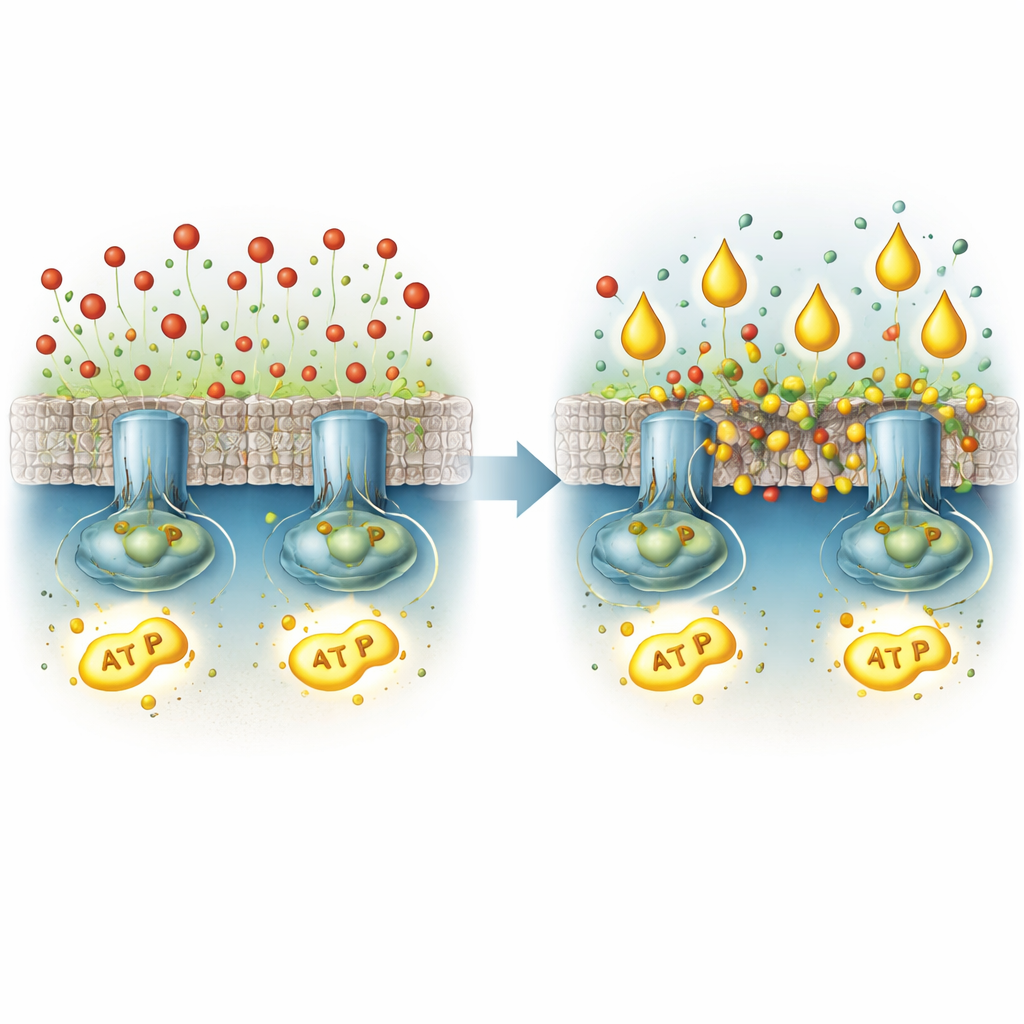
Shutting down the bacterial power supply
To uncover what was happening inside the cells, the researchers zoomed in on bacterial energy metabolism. Healthy bacteria maintain a constant flow of protons across their membranes, generating an electrical and chemical gradient that powers a rotary enzyme called ATPase—essentially the cell’s molecular turbine for making ATP, its energy currency. The team measured both proton movements and ATPase activity in normal and resistant E. coli, with and without the oil. In both strains, exposure to the essential oil sharply reduced proton flux and cut ATPase activity by about one-and-a-half times. These changes were similar to those caused by a known ATPase-blocking chemical, suggesting that the oil directly disrupts the membrane machinery that keeps the proton gradient and energy production running.
What this means for future treatments
The study shows that essential oil from Tanacetum argyrophyllum does more than simply slow bacterial growth on contact. It interferes with the very systems bacteria use to generate and manage energy, making them less able to divide, more vulnerable during early adaptation, and more susceptible to certain antibiotics like kanamycin that depend on energized membranes for uptake. Because the oil works equally well on antibiotic-sensitive and resistant E. coli, it could serve as a natural helper compound alongside standard drugs. While more work is needed to test safety in human cells and confirm these effects in living organisms, this mountain herb’s oil emerges as a promising tool in the ongoing effort to outpace antibiotic-resistant infections.
Citation: Margaryan, L., Tadevosyan, S., Sahakyan, A. et al. The antibacterial effect of Tanacetum argyrophyllum essential oil on kanamycin-resistant Escherichia coli by disruption of energy metabolism and proton fluxes. Sci Rep 16, 13576 (2026). https://doi.org/10.1038/s41598-026-44036-z
Keywords: antibiotic resistance, essential oils, Escherichia coli, energy metabolism, terpenes