Clear Sky Science · en
Advanced nonlinear dynamics and bifurcation structures in multi-coupled oscillators using a powerful non-perturbative framework
Why this matters beyond equations
Many real-world technologies, from earthquake-resilient buildings to tiny sensors in phones and medical devices, depend on systems that vibrate and interact in complicated ways. When two parts of a machine can move and trade energy back and forth, their motion can suddenly shift from calm to wildly unpredictable. This paper presents a powerful way to understand and predict such behavior without resorting to heavy numerical computation, offering engineers and scientists a clearer view of when systems will stay stable and when they may tip into chaos.
Two moving parts, many surprising behaviors
The authors focus on systems with two linked motions, called two degrees of freedom. Think of a pair of pendulums coupled by a spring, or two masses connected by flexible supports. Even these seemingly simple setups can show synchronization, resonance, and chaotic swings. The paper examines three representative examples: a strongly self-excited pair that can sustain vibrations on its own, a pair governed by very stiff nonlinear springs that store and release energy in unusual ways, and a more familiar pair of nearly simple pendulums. Together, these cases cover a wide spectrum of behaviors relevant to mechanical, electrical, and even biological systems.

A new route that avoids shaky shortcuts
Traditional analytical tools for studying such vibrating systems rely on perturbation methods. These techniques work well when the nonlinearity is weak and some effects can be treated as small corrections. However, many real devices operate in regimes where these assumptions fail: the motion may be large, the restoring forces strongly nonlinear, and the energy loss or coupling far from gentle. In these situations, standard approximations can become inaccurate or even misleading. The approach developed here, called a non-perturbative approach rooted in He’s Frequency Formula, sidesteps these limitations by not expanding the equations in small parameters or trimming away higher-order terms.
Turning complexity into an equivalent simpler picture
The core idea is to transform the original complicated equations of motion into a set of simpler, linear equations that still “remember” the crucial nonlinear effects. The method begins by assuming physically reasonable trial motions that match the initial conditions of the system. Using these assumed motions over a full cycle, the authors compute effective damping and frequency parameters through integrals that capture how the system actually behaves over time. These effective quantities depend on the vibration amplitude and coupling strength, so the resulting linear equations are not crude simplifications but carefully tuned stand-ins for the original nonlinear system.
Once this mapping is done, the motion can be described using well-understood linear oscillator formulas, while still reflecting strong nonlinear trends such as amplitude-dependent frequency shifts. The authors verify the reliability of these equivalent models by comparing them with direct numerical simulations for all three cases. The match is striking: errors remain very small across both short-lived transients and long-term behavior, confirming that the reduced description closely tracks the true dynamics.
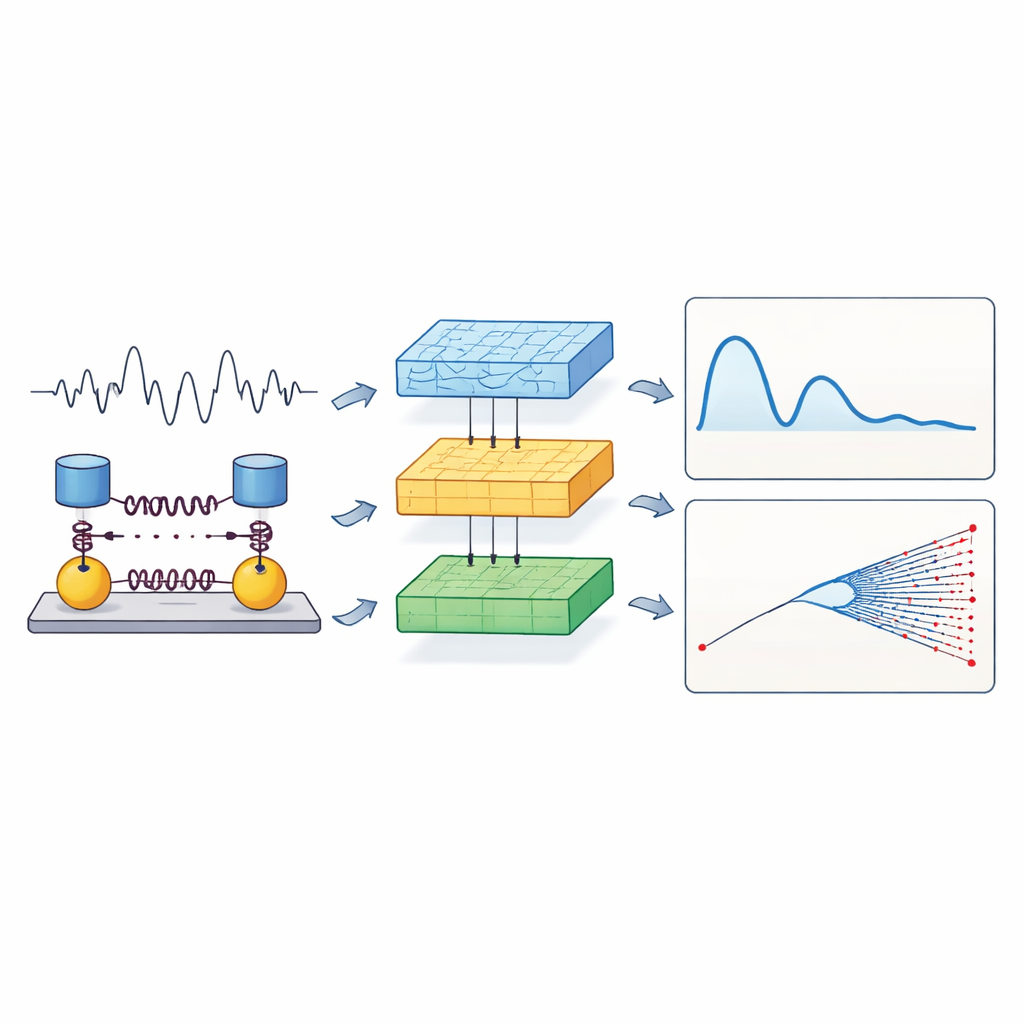
From calm oscillations to chaos and back
With accurate analytical expressions in hand, the study then explores how the systems change as key parameters are varied. By constructing bifurcation diagrams and Poincaré maps—standard tools in dynamical systems—the authors show how motion shifts from simple periodic cycles to complex, chaotic states and how small islands of regularity reappear within chaos. They map out stability boundaries that separate safe, bounded motion from regimes where oscillations can grow or become erratic. The method reveals how different kinds of coupling—through inertia, damping, or nonlinear springs—can first destabilize and then restabilize motion as their strength is tuned, providing physical insight that would be hard to extract from raw simulations alone.
What this means for real devices and designs
Viewed in everyday terms, the paper shows that it is possible to build a kind of analytical “twin” of a complicated vibrating system that is both simple enough to handle on paper and faithful enough to guide design. This unified framework works across very different types of coupled oscillators, from nearly linear pendulums to strongly nonlinear self-excited systems. Because it can predict when vibrations will remain controlled, when synchronization will occur, and when dangerous chaotic behavior may appear, the approach is valuable for designing vibration absorbers, energy harvesters, precision sensors, and even models of biological rhythms. For readers, the key takeaway is that the authors have developed a robust, efficient way to understand and manage complex coupled vibrations without sacrificing the essential physics.
Citation: Moatimid, G.M., Mohamed, Y.M. & Abohamer, M.K. Advanced nonlinear dynamics and bifurcation structures in multi-coupled oscillators using a powerful non-perturbative framework. Sci Rep 16, 12042 (2026). https://doi.org/10.1038/s41598-026-44027-0
Keywords: nonlinear oscillators, coupled vibrations, stability and chaos, vibration control, bifurcation analysis