Clear Sky Science · en
Dynamic characteristics and adaptability research of high-speed railway roadbed with silt-cement improved aeolian sand
Why desert railways need smarter foundations
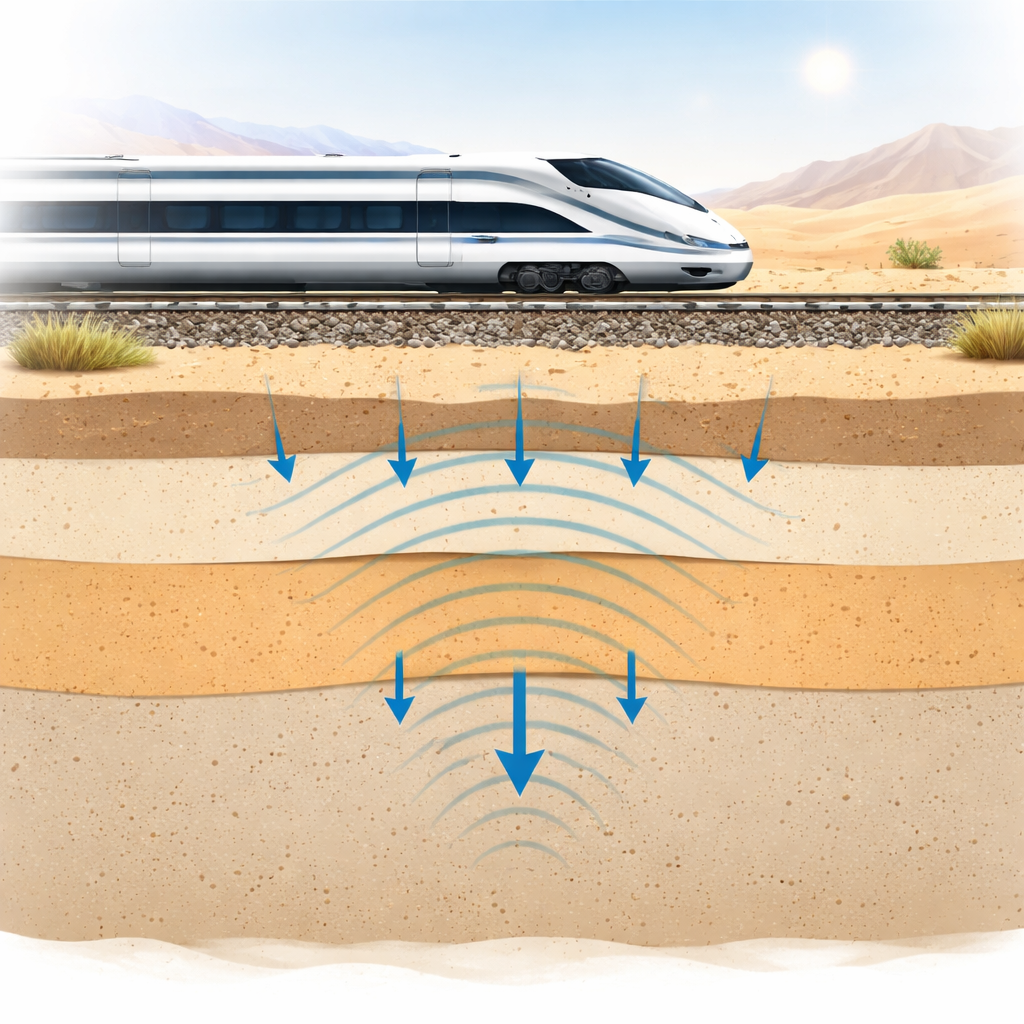
As high-speed rail lines push across dry, sandy regions, engineers face a stubborn problem: the loose sand beneath the tracks does a poor job of supporting trains that race by at hundreds of kilometers per hour. Too much shaking and settling in the ground can shorten the life of the tracks and threaten safety. This study explores a new way to strengthen that sandy foundation by mixing it with silt and cement, then tests how well this hybrid material handles the constant pounding and vibration from fast trains.
Building a small railway to test a big idea
The researchers focused on a real high-speed railway in China that crosses desert fringe areas, where wind-blown sand is the main local soil. Instead of importing large amounts of better-quality fill, the project team improved the native sand by adding about 30% silt and a small amount of cement. To see whether this mix could truly stand up to high-speed traffic, the authors built a carefully scaled-down model of the track and its supporting layers at one-tenth real size inside a large test box. They reproduced the main layers found in the field: the rails and sleepers, a gravel layer, two layers of silt–cement improved aeolian sand with different cement contents, and the natural sandy and silty ground underneath.
Simulating high-speed trains in the lab
Instead of simply pushing on the rails with a static load, the team developed a special wheelset device that more closely mimics how real trains vibrate as they roll. Springs and moving masses recreate the effect of a train bogie bouncing on the track, while sensors buried at different depths record how strongly the ground shakes and how much it settles over time. By adjusting the vibration frequency and force, the experiments simulate trains running between 150 and 450 kilometers per hour, both as single trains and as two trains passing each other.
How the new ground mix calms vibrations
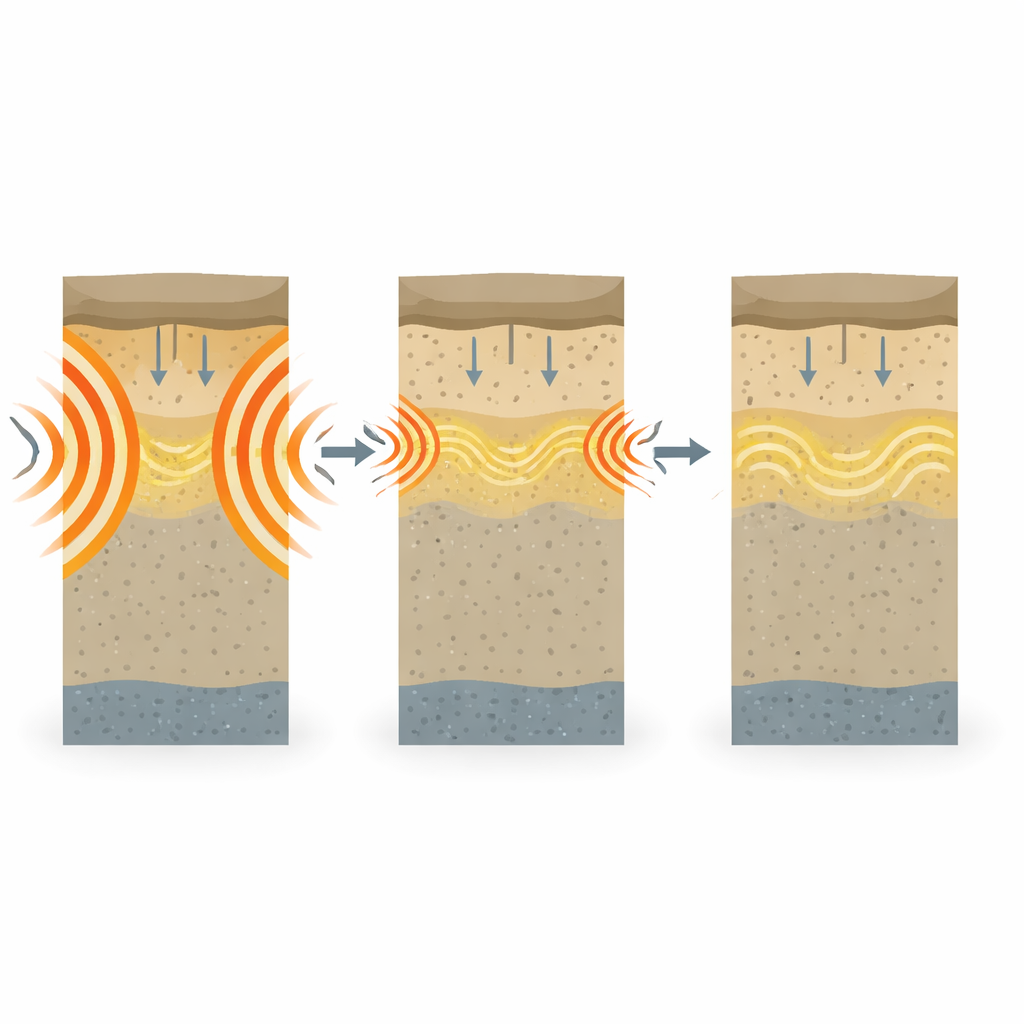
Measurements of acceleration—how quickly the ground speeds up and slows down during each vibration—showed that shaking is strongest at the rail surface and drops quickly with depth. More than half of the vibration energy was absorbed in the improved sand layers just below the gravel, particularly in the upper of the two mixed layers. High-frequency vibrations, which are more damaging to nearby structures, faded especially fast, while lower-frequency motions penetrated deeper. When the researchers compared their results with earlier studies on other improved soils, they found that the silt–cement sand foundation sent a smaller share of vibration into the deeper ground and surrounding environment, suggesting it is kinder to nearby buildings and residents.
Keeping long-term settlement under control
Shaking the model repeatedly also revealed how the track foundation slowly settles. Under 100,000 vibration cycles representing a single train line, total settlement in the improved sand was less than a third of a millimeter when scaled up to real size—smaller than what is typically seen in other strengthened soils and far below the 20 millimeters per year allowed by design rules. This indicates very good resistance to gradual sinking under normal traffic. However, when the tests simulated two trains passing each other, settlement jumped to nearly one millimeter for the same number of cycles, more than twice the single-train value. The researchers interpret this as a sign that overlapping vibration from converging trains can meaningfully weaken the ground’s resistance to deformation.
What this means for future high-speed lines
For planners of high-speed rail in sandy deserts, the study offers encouraging news. Mixing local aeolian sand with silt and cement can create a track foundation that efficiently soaks up vibration, limits long-term settlement, and reduces the thickness of fill needed compared with some conventional designs. The experiments suggest that keeping train speeds below about 350 kilometers per hour on these sections preserves internal stability, and that extra caution is needed where trains frequently meet or overtake. In plain terms, the work shows that smartly engineered sand can be turned into a reliable, quieter, and more economical base for tomorrow’s fast trains—provided its limits under heavy, overlapping traffic are respected.
Citation: Li, X., Huang, C., Ren, K. et al. Dynamic characteristics and adaptability research of high-speed railway roadbed with silt-cement improved aeolian sand. Sci Rep 16, 14533 (2026). https://doi.org/10.1038/s41598-026-44024-3
Keywords: high-speed railway, subgrade vibration, aeolian sand, soil improvement, cumulative settlement