Clear Sky Science · en
Halide-assisted Al-doped graded shells for emission tunability and photostability in CdSe NPLs
Brighter, Longer-Lasting Tiny Light Sheets
Modern displays, lasers, and sensors increasingly rely on tiny crystals that glow when excited by light or electricity. This study focuses on a special kind of ultra-thin crystal, called a nanoplatelet, that can produce exceptionally pure colors but typically fades or degrades over time. The researchers show how to redesign the outer layers of these crystals so they shine more efficiently and stay bright much longer, even under harsh conditions, making them more practical for real-world devices.
Flat Crystals That Act Like Precision Light Sources
The work centers on cadmium selenide (CdSe) nanoplatelets—flat, sheet-like particles only a few atoms thick but tens of nanometers wide. Because electrons are confined mainly in the thickness direction, these platelets emit light with a very narrow color range, which is ideal for vivid, accurate reds, greens, or blues. However, their large surface area is covered with defects and dangling bonds that act like tiny traps, stealing energy that would otherwise be emitted as light. As a result, bare platelets are prone to dimming and damage when exposed to strong light or reactive chemicals, limiting their usefulness in devices like LEDs and lasers.
Smoothing the Edges with a Gentle Outer Layer
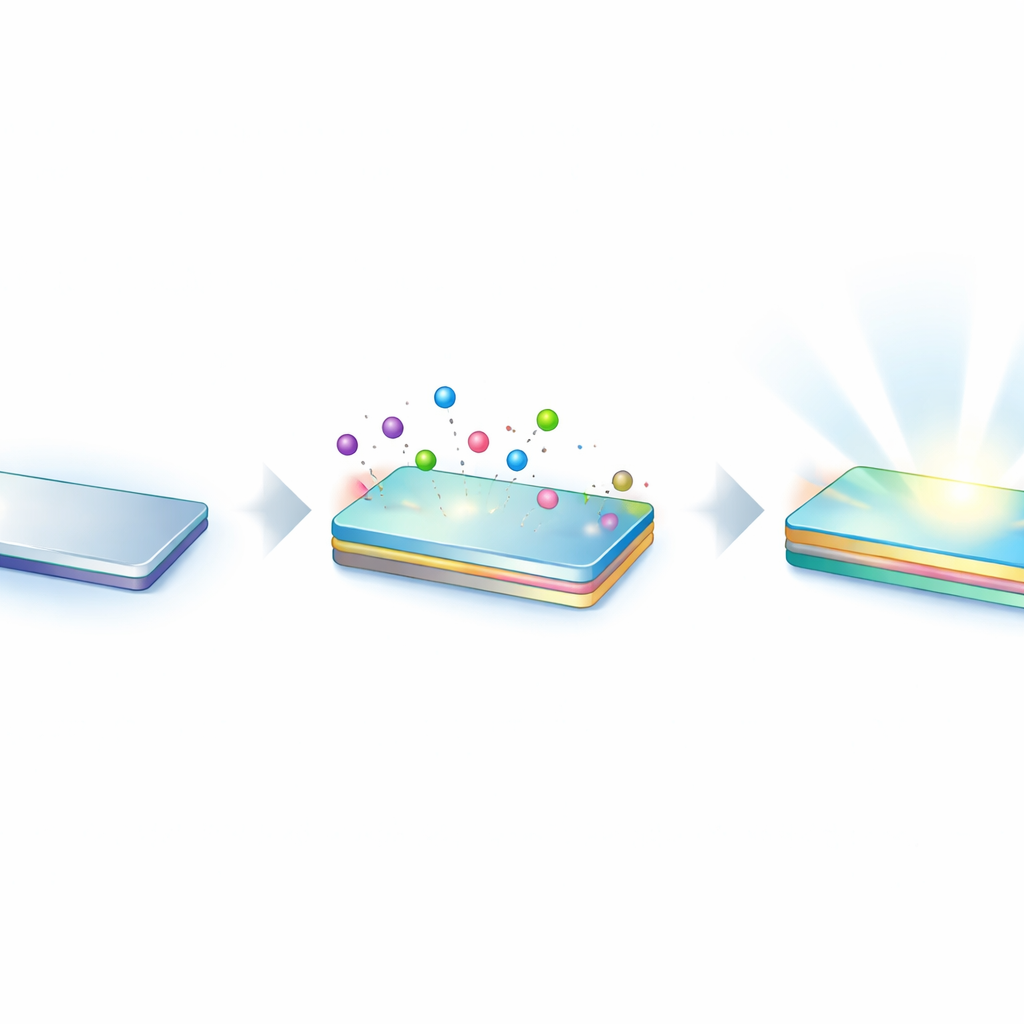
To protect the fragile CdSe core, the team grew a surrounding shell made of a mixed material, Cd1−xZnxS. Instead of forming a sharp, abrupt border between the core and shell, they engineered a gradual change in composition—a graded shell—so the atomic spacing changes smoothly rather than suddenly. This gentle transition reduces internal strain that would otherwise distort the flat crystal and create new defects. The key trick is adding chloride ions (a type of halide) during a one-pot synthesis. These ions latch onto the broad faces of the platelets and lower their surface energy, encouraging new material to deposit evenly across the surfaces rather than piling up at corners and edges. By simply adjusting the concentration of these precursors, the researchers could control the shell thickness and, in turn, the color of the emitted light over a wide range.
Tuning Color, Reducing Energy Loss, and Blocking Self-Reabsorption
With the graded shell in place, the platelets show strong red shifts in their emission as the shell grows thicker: their glow moves to longer wavelengths because electrons can spread out more into the shell. This engineered structure also increases the separation between the energies of absorbed and emitted light (a larger Stokes shift), which helps prevent the platelets from reabsorbing their own light—a major source of energy loss in dense films and optical gain materials. Measurements of light-decay times reveal that the optimized graded shells markedly slow down non-radiative processes: lifetimes stretch from only a few nanoseconds in bare platelets to nearly 20 nanoseconds with the halide-assisted shells, indicating that many fewer excitations are lost to traps. Photoluminescence quantum yields peak when the chloride content is tuned just right, showing that there is an ideal balance between shell growth and surface damage.
Armor Against Light, Oxygen, and Moisture
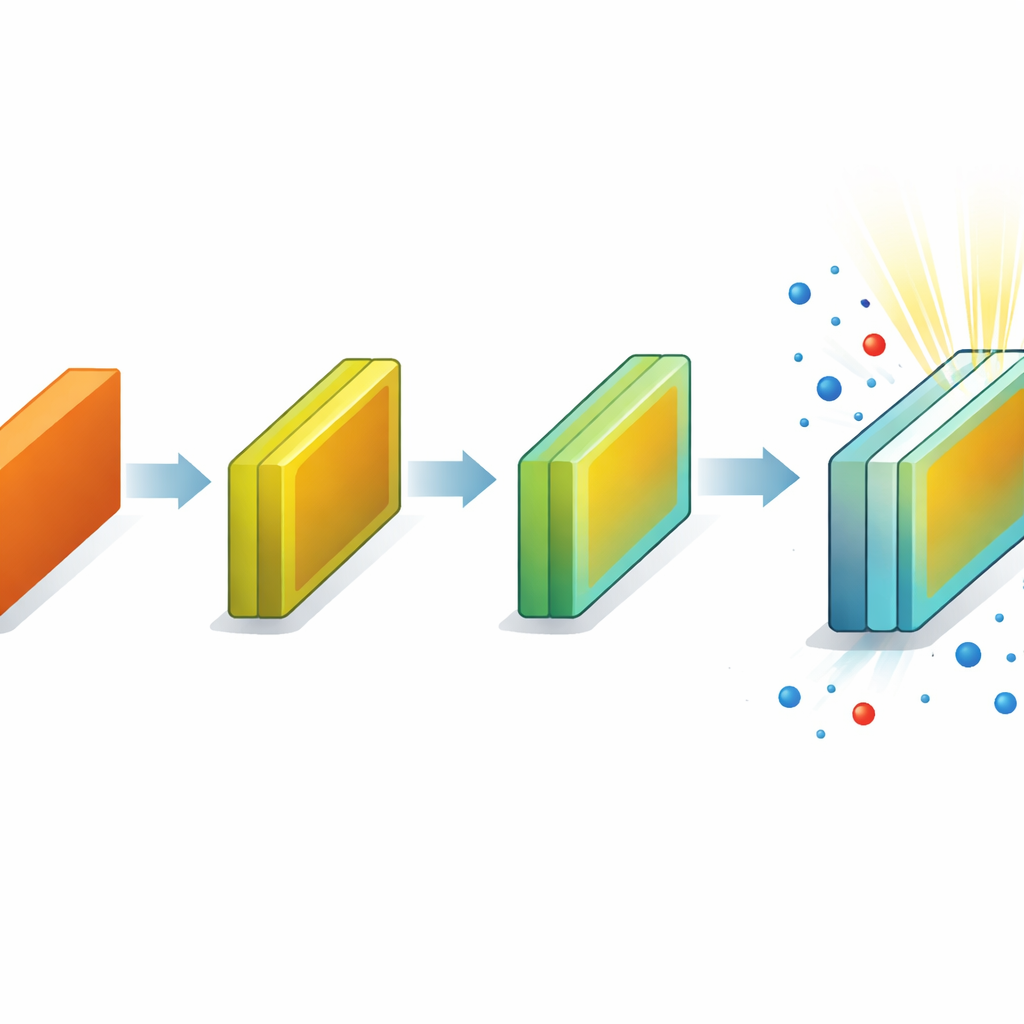
The researchers then added one more level of protection: an outer zinc sulfide shell that is lightly doped with aluminum. This layer acts as an inorganic barrier to oxygen and water, both of which can attack surface atoms and degrade the glow. Even when the usual organic protective molecules on the surface were deliberately stripped away to speed up damage, the aluminum-containing shell kept most of the light emission intact during prolonged ultraviolet irradiation, while undoped samples faded rapidly. Chemical analysis suggests that aluminum forms tightly bound oxide-like environments within or at the surface of the shell, helping to block the diffusion of reactive species without creating a separate bulky coating, so the platelets stay flat and structurally intact.
From Laboratory Curiosity to Practical Light Engines
Overall, the study demonstrates a simple, scalable route to building flat, graded, and doped shells around CdSe nanoplatelets that simultaneously boost brightness, shift color in a controllable way, and dramatically improve durability. For non-specialists, the key message is that carefully sculpting the outer atomic layers of these nanoscale light sources turns them from delicate, short-lived emitters into robust, tunable building blocks. Such engineered nanoplatelets could power next-generation displays, low-threshold lasers, and even solar-light–collecting panels that demand both precise color control and long-term photostability.
Citation: Bae, H., Nguyen, T. & Jung, J. Halide-assisted Al-doped graded shells for emission tunability and photostability in CdSe NPLs. Sci Rep 16, 13427 (2026). https://doi.org/10.1038/s41598-026-44008-3
Keywords: nanoplatelets, core–shell nanocrystals, photostability, light-emitting devices, halide-assisted synthesis