Clear Sky Science · en
Research on traffic flow prediction of progressive graph convolutional networks based on spatio-temporal self-attention mechanism
Why Smarter Traffic Forecasts Matter
Rush-hour traffic can feel unpredictable, yet cities depend on anticipating it to manage congestion, set signal timings, and guide drivers. This study presents a new way to forecast traffic that adapts in real time as conditions change, aiming to make predictions more accurate minutes to an hour into the future. By learning how different parts of a road network influence one another over time, the method promises smoother commutes, better use of existing roads, and more reliable travel planning.
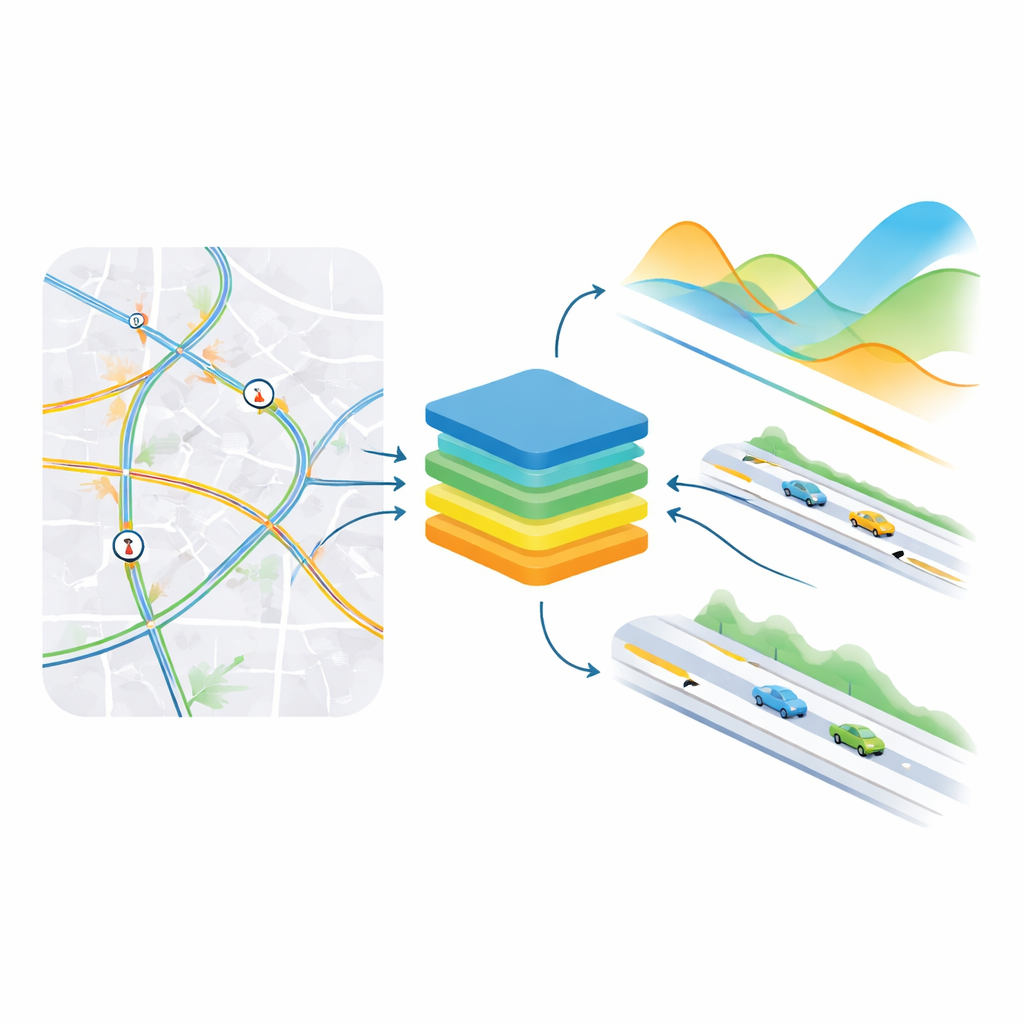
Changing Traffic Patterns Across a City
Traffic is far from random. It shows repeating daily and weekly rhythms—like morning and evening rush hours—layered with surprises caused by weather, accidents, school schedules, and special events. Traditional forecasting tools often assume these patterns are fairly simple and stable, which makes them struggle with the messy reality of a large city. They may capture either the time dimension (how traffic changes at a given point) or the space dimension (how nearby roads affect one another), but rarely both together in a flexible way. As a result, their accuracy drops quickly when trying to predict more than a few minutes ahead.
From Fixed Maps to Living Road Networks
Recent advances in artificial intelligence use the idea of a road network as a graph: each sensor on a highway is a point, and the roads linking them are connections. Earlier systems learned how strongly each road affects its neighbors during training, then fixed those relationships when used in practice. The authors argue this is a serious limitation. In real life, two roads might behave similarly during the school run but diverge in the evening, or distant routes might move together when a major incident diverts traffic. A fixed map of influences cannot keep up with these evolving patterns, leading to a mismatch between what the model learned in the past and what it faces today.
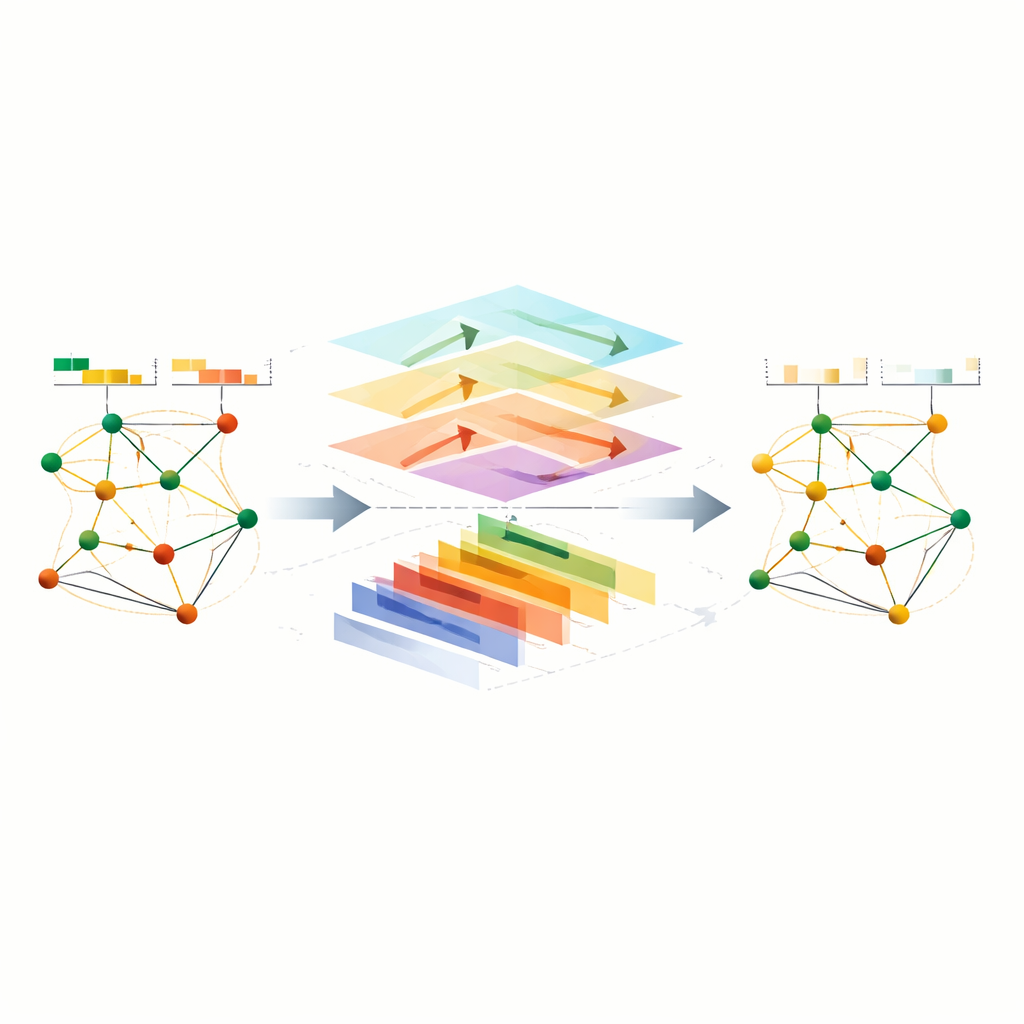
A Model That Adapts as Traffic Moves
The proposed PGCN-STSA model treats the road network as a living system whose internal links can shift over time. Instead of relying only on physical distance or a static map, it continually measures how similar the recent behavior of each pair of sensors is. If two locations show matching ups and downs in speed, the model strengthens the connection between them; if their patterns diverge, that link weakens. This “progressive” graph is updated using recent data, so the model’s view of the network evolves alongside real traffic. On top of that, a special attention mechanism helps the system focus on the most relevant times and places, while a carefully designed convolution step allows it to see far back into the recent past without becoming too slow or complex.
Testing on Real-World Highways
To see whether this adaptive approach actually helps, the researchers tested it on two well-known highway data sets from Los Angeles and the San Francisco Bay Area. In both cases, hundreds of roadside sensors recorded vehicle speeds every five minutes over several months. The new model was asked to predict traffic 15, 30, and 60 minutes into the future and was compared with a wide range of existing methods—from classic statistics to some of the latest deep-learning systems. Across almost all settings, the adaptive model produced smaller errors. Even though the percentage improvements might look modest, in the context of already strong benchmarks they indicate a meaningful gain in accuracy and stability, especially for longer prediction horizons where mistakes usually grow quickly.
What This Means for Everyday Travel
For the everyday traveler, the technical details translate into a simple benefit: better guesses about how traffic will unfold over the next hour. A system built on this kind of model could adjust more quickly to lane closures, changing school schedules, or shifting commute habits, improving navigation apps, traffic signal control, and planning tools. The work also highlights a broader idea in data science: instead of assuming that relationships in a complex system are fixed, it can be more powerful to let the model continuously relearn how different parts influence each other. As cities become more connected and data-rich, such adaptable forecasting tools may become central to keeping people and goods moving efficiently.
Citation: Liu, C., Kou, Y., Wang, S. et al. Research on traffic flow prediction of progressive graph convolutional networks based on spatio-temporal self-attention mechanism. Sci Rep 16, 14112 (2026). https://doi.org/10.1038/s41598-026-44004-7
Keywords: traffic forecasting, intelligent transportation, graph neural networks, deep learning, spatio-temporal data