Clear Sky Science · en
Conditional survival rates after neoadjuvant chemoradiotherapy combined with surgery in intermediate-low locally advanced rectal cancer based on two-centre retrospective analysis
Why this study matters to patients and families
For many people diagnosed with rectal cancer, the most pressing question after major treatment is, “What are my chances now—and how will they change as time goes on?” This study tackles that question for a specific group of patients who received both chemotherapy and radiation before surgery. Instead of offering a single, fixed survival estimate at diagnosis, the researchers looked at how survival prospects improve for those who have already lived cancer‑free for one, two, three years or more. Their findings offer a more hopeful and realistic picture of life after treatment and can help doctors and patients plan follow‑up care in a smarter, more personalized way.
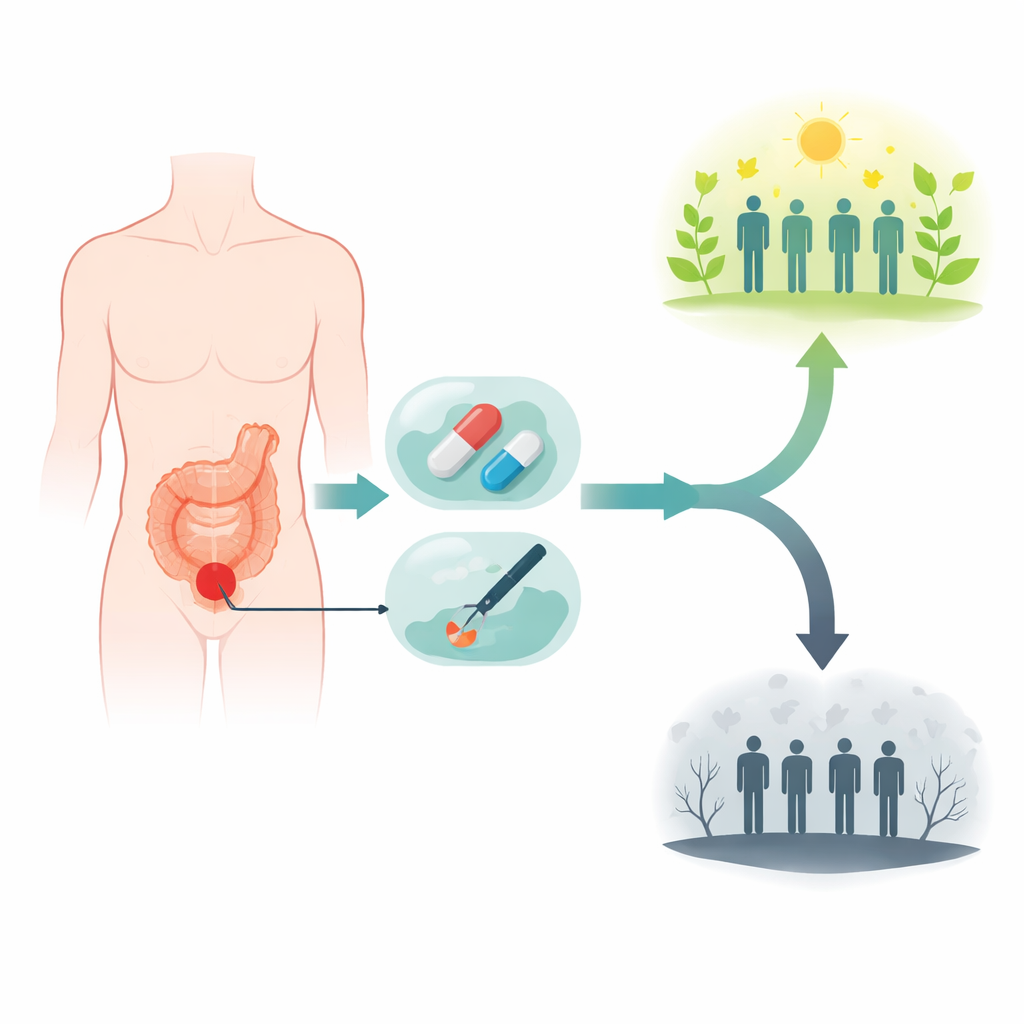
A closer look at a high‑risk group
The research focused on 1,589 people in China with “intermediate‑low” locally advanced rectal cancer—tumors located within 10 centimeters of the anus that had grown deeply or involved nearby lymph nodes but had not spread to distant organs. All patients received a modern treatment package: radiation combined with chemotherapy before surgery, followed by an operation using the total mesorectal excision technique, and additional chemotherapy when appropriate. They were treated between 2012 and 2023 at two major colorectal centers and followed for a median of nearly four years, with some followed for up to twelve years.
From fixed survival to survival that changes over time
Traditional survival statistics give one number at the time of diagnosis—for example, the chance of living five or ten years. But this “one‑size‑fits‑all” figure does not update as a patient continues to survive, and it can make long‑term survivors feel as if they are stuck with an old, pessimistic estimate. The authors instead used “conditional survival,” which answers a more practical question: given that a patient has already lived a certain number of years after surgery, what is the chance of living at least five more? Using this dynamic approach, they found that the five‑year conditional survival rate rose steadily as more time passed. For the entire group, the chance of living five more years was about 84% after one or two years of survival, grew to about 89% after four years, and exceeded 92% after five years.
Who keeps their risk and who leaves it behind
The team then asked which clinical features still mattered as time went on. At the start, several factors were linked with a higher risk of death: tumors closer to the anus, cancer spread to a key group of lymph nodes near the main artery, higher blood levels of a tumor marker called CEA after chemoradiotherapy, poorer tumor shrinkage, and more advanced post‑treatment stage in the removed tissue. However, as years passed without a cancer‑related death, the influence of many of these warning signs faded. By contrast, the stage of the tumor after treatment and surgery—known as the ypTNM stage—remained a powerful and even stronger predictor of long‑term outcome. Patients whose disease had been down‑staged to the earliest categories (yp0–I) saw their five‑year conditional survival climb to 100% after three years of survival, suggesting that their risk of dying from rectal cancer had essentially vanished.

Turning statistics into a personalized roadmap
To make these insights usable in the clinic, the researchers built simple visual tools called nomograms. These charts combine several pieces of information—such as distance from the tumor to the anus, post‑treatment CEA level, tumor shrinkage score, key lymph node involvement, and post‑treatment stage—to estimate an individual patient’s chance of living at least five more years after already surviving one, two, three, or four years. The models showed acceptable accuracy in internal testing and tracked well with what was actually observed. This means doctors could use them during follow‑up visits to give more tailored reassurance, identify higher‑risk survivors who may need closer monitoring, and potentially relax the visit schedule for those who appear to be “statistically cured.”
What this work means for life after rectal cancer
Overall, the study shows that for patients with intermediate‑low rectal cancer treated with modern chemoradiotherapy and surgery, the outlook improves the longer they remain cancer‑free. Many early warning signs become less important over time, while the stage found in the surgical specimen continues to guide long‑term expectations. For people whose tumors have completely or nearly completely responded, surviving three years may mark a turning point where their risk of dying from the cancer becomes very low. Although the prediction tools still need to be confirmed in other hospitals and countries, this work moves beyond static survival numbers toward a more hopeful, evolving picture of recovery—one that better reflects how risk truly changes as survivors move further away from their diagnosis.
Citation: Wang, G., Huang, J., Tang, H. et al. Conditional survival rates after neoadjuvant chemoradiotherapy combined with surgery in intermediate-low locally advanced rectal cancer based on two-centre retrospective analysis. Sci Rep 16, 13694 (2026). https://doi.org/10.1038/s41598-026-44000-x
Keywords: rectal cancer, conditional survival, chemoradiotherapy, surgical outcomes, prognostic nomogram