Clear Sky Science · en
Bifurcation analysis and exploration of new optical soliton solutions in parabolic law medium with weak non-local nonlinearity
Light Pulses That Refuse to Spread Out
Modern communication—whether streaming movies or sending a message across the globe—relies on light pulses racing through transparent fibers. Normally, these pulses spread and distort as they travel, which blurs information. This paper explores a special kind of self-organizing light pulse, called a soliton, that can keep its shape over long distances even in complex materials. Understanding when and how such stubbornly stable pulses form could lead to faster, more reliable optical links and new ways to control light in advanced photonic devices. 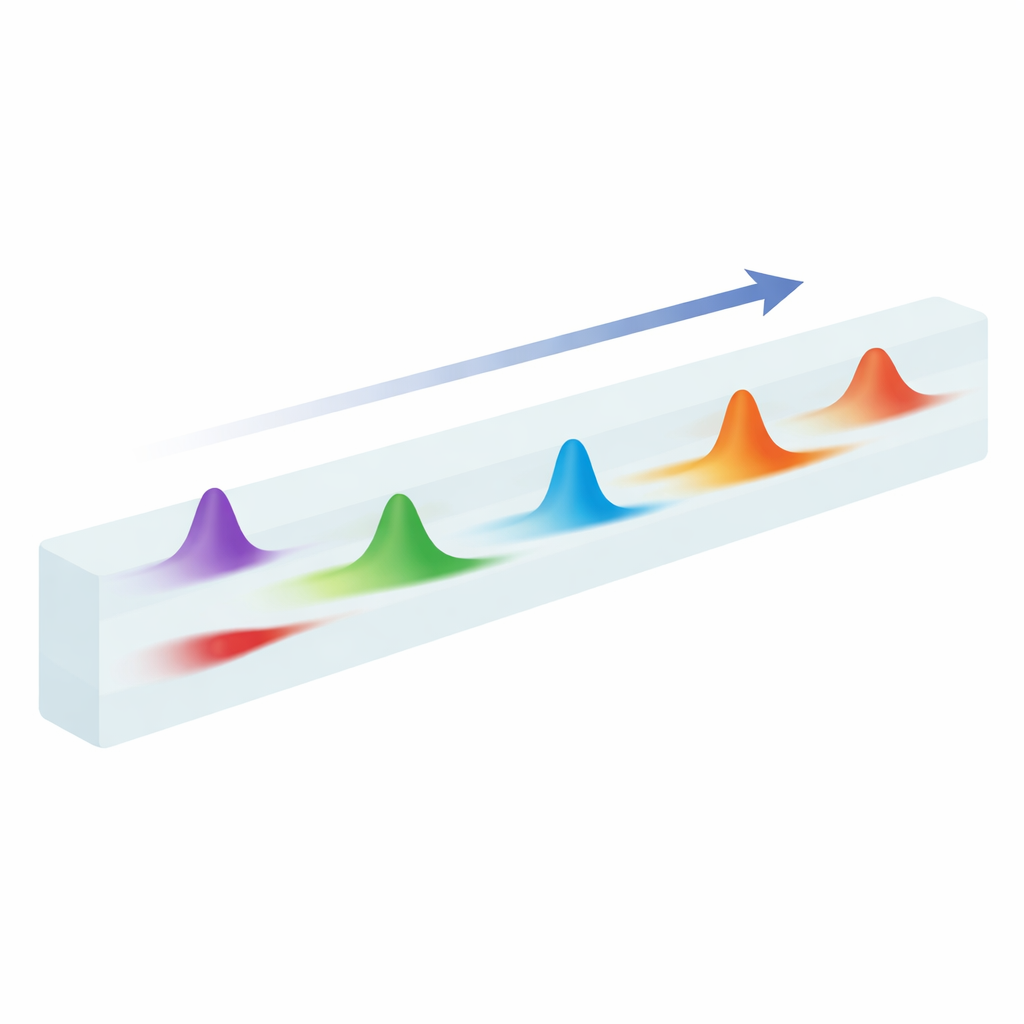
Why Solitary Light Pulses Matter
In many physical systems, from oceans to plasmas to optical fibers, waves do not simply pass by each other and fade. Under the right conditions, they can form solitary structures—solitons—that travel without changing shape. In optical fibers, these structures arise from a delicate balance: spreading caused by dispersion is exactly cancelled by the material’s nonlinear response to intense light. Such self-stabilizing pulses are attractive for technology because they can carry information over long distances with little distortion, and they can act like tiny building blocks for all-optical switching, logic, and signal processing.
A More Realistic Picture of the Medium
Most earlier studies of optical solitons assumed that the material responds only to the light intensity at each point. The authors examine a more realistic case: a synthetic medium whose response is “weakly nonlocal,” meaning that the material at one point also feels the influence of light in its neighborhood. They consider a standard wave equation used in physics, the nonlinear Schrödinger equation, modified to include this nonlocal effect and a so‑called parabolic law response, which is common in graded-index fibers and certain plasmas. This refined model is capable of capturing richer behaviors, such as more complicated shapes of pulses and subtle interactions between them, while still being simple enough to analyze mathematically.
Finding New Families of Stable Pulses
To uncover what kinds of light pulses this model allows, the team uses two advanced analytical tools known as the Khater method and the (1/G′)‑expansion approach. These techniques let them derive exact, closed‑form expressions for a wide variety of solitary waves instead of relying purely on numerical simulation. They identify families of bright pulses, dark dips on a steady background, and kink and anti‑kink structures that resemble smooth steps between two different light levels. By tuning the parameters that describe the material and the pulse speed, they show how these shapes can appear in many variants—rational, exponential, and trigonometric—each with its own profile and stability properties. 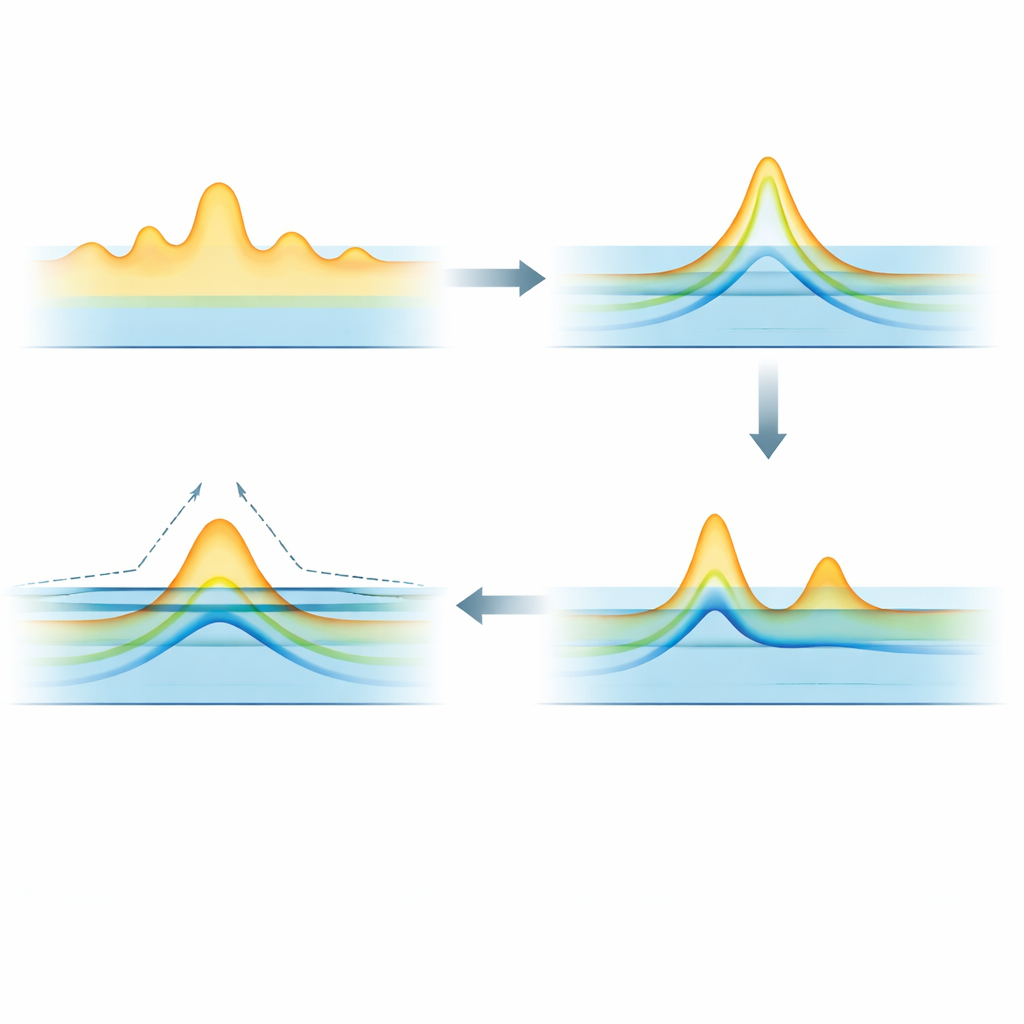
Tracking How Behavior Changes With Conditions
Beyond listing possible pulse shapes, the authors carefully chart how the overall behavior of the system changes as material and wave parameters vary—a branch of mathematics known as bifurcation analysis. They rewrite the wave equation as a dynamical system and examine its “phase portraits,” geometric diagrams that show all possible motions of the system in a compact way. This reveals where the system sits in a stable state, where it is unstable, and where periodic or more complex motions arise. Compared with a closely related earlier study, their version of the model—with a key sign change in the dispersion term and no simplifying parameter reductions—exhibits many more distinct configurations. In total, they identify twenty different phase‑portrait patterns and twelve types of equilibrium arrangements, pointing to a much richer underlying dynamics.
Connecting Mathematics to Real-World Light Control
The paper closes by linking these abstract results back to potential applications. Stable solitary pulses, dark dips, and kink‑like fronts can all play roles in optical communication systems, for example as robust information carriers, switching fronts between two transmission states, or components in dark‑pulse technologies. The existence of multiple, coexisting soliton shapes indicates that the modeled medium can support highly complex wave behavior, yet in ways that are still predictable through the exact formulas derived here. For non‑experts, the take‑home message is that by refining our equations for how light and matter interact, and by systematically charting their possible behaviors, researchers are building a toolkit for designing optical materials that guide, store, and process information‑carrying light pulses with unprecedented precision.
Citation: Ali, K.K., Siddique, I., Baloch, S.A. et al. Bifurcation analysis and exploration of new optical soliton solutions in parabolic law medium with weak non-local nonlinearity. Sci Rep 16, 13542 (2026). https://doi.org/10.1038/s41598-026-43996-6
Keywords: optical solitons, nonlinear Schrödinger equation, nonlocal nonlinearity, optical communications, bifurcation analysis