Clear Sky Science · en
Thermal and dielectric performance of transformer oil-based nanofluid with fullerene C60 nanoparticles
Keeping the Power Grid Cool and Safe
As our homes, cars, and factories draw more electricity than ever, the humble distribution transformer has to work harder while remaining reliable and safe. Inside these metal boxes, a special insulating oil both cools the windings and prevents electrical short circuits. This study explores whether adding an unusual form of carbon, called fullerene C60, to transformer oil can make transformers run a bit cooler and much more resistant to electrical failure—without major changes to how they are built or operated. 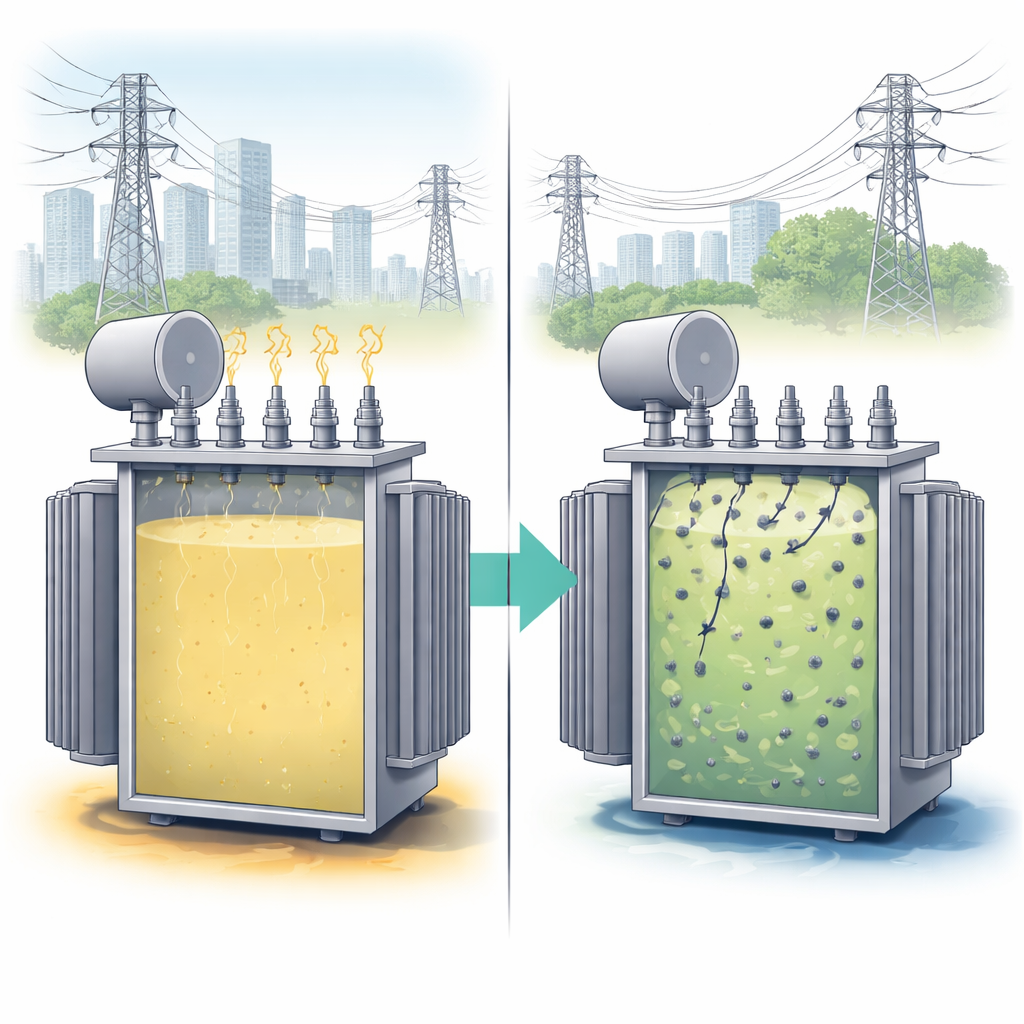
A New Twist on Transformer Oil
Traditional transformer oils are carefully engineered liquids, but they are reaching their limits as power demands and temperatures rise. Researchers worldwide have been testing “nanofluids”—ordinary liquids enhanced with tiny solid particles—to improve heat removal and electrical insulation. Many of these require chemical additives to keep the particles suspended, which can complicate performance. Fullerene C60 offers an appealing alternative: these soccer-ball-shaped carbon molecules dissolve and remain stable in non‑polar liquids like transformer oil, and earlier studies hinted that they could boost electrical strength without spoiling thermal behavior.
From Factory Floor to Full-Scale Transformer
To move beyond small laboratory samples, the team prepared nearly 400 liters of C60 nanofluid in an actual transformer production hall. They started with a biodegradable commercial transformer oil and dissolved C60 powder at elevated temperature using an industrial oil-treatment machine normally used for drying and filtering oil. After several hours of pumping and heating, the result was a low‑concentration nanofluid (about 0.004% C60 by volume). Part of this fluid filled a three‑phase, 250‑kilovolt‑ampere distribution transformer, which then underwent standard temperature‑rise and high‑voltage tests used in industry. Additional samples were kept aside for precise laboratory measurements of density, viscosity, thermal conductivity, flash point, and key electrical properties. 
Small Changes in Flow, Big Changes in Insulation
The physical behavior of the oil itself stayed surprisingly familiar. The nanofluid’s density was only about two‑tenths of a percent higher than the base oil, and its ability to conduct heat was actually slightly lower—by less than one percent. Viscosity, which controls how easily the oil circulates through narrow channels, was essentially unchanged at the higher shear rates typical of forced flows, but became a few percent lower than the original oil at the very gentle shear levels relevant for natural convection inside a sealed transformer. This subtle thinning suggests the nanofluid can circulate at least as well, and possibly a bit better, than the plain oil. The main trade‑off was a modest drop in flash point—the temperature at which vapors above the liquid can ignite—by a few percent, though the values still comfortably met international safety standards.
Stronger Protection Against Electrical Failure
The most dramatic effect showed up in the nanofluid’s insulating strength. When subjected to repeated high‑voltage tests, the C60‑enhanced oil with the longest preparation time showed an average breakdown voltage about 65% higher than that of the original oil. In practical terms, this means the fluid can withstand substantially higher electric stresses before a spark tunnels through it. The researchers link this to the electronic nature of C60 molecules, which are very good at capturing stray electrons. By soaking up these fast charges, the nanoparticles slow or suppress the runaway electrical “streamers” that normally trigger breakdown. Even after the fluid cycled through an operating transformer and absorbed some extra moisture from the environment—a known enemy of insulation—it still outperformed the untreated oil.
Testing in a Working Transformer
When the same transformer was tested first with conventional oil and then with the C60 nanofluid, both under controlled short‑circuit loading, temperature sensors inside the tank recorded only a small difference in temperature rise—about one degree Celsius in favor of the nanofluid. Because ambient air was slightly cooler during the nanofluid test, the team used a simplified analytical model of oil circulation to tease apart the effects. The model, informed by independent measurements of density, viscosity, and heat transfer at the tank walls, indicated that the nanoparticles lead to marginally faster natural circulation and slightly better thermal coupling between hot windings and cooling fins. The result is a modest but real improvement in cooling, achieved without sacrificing stability or making the fluid harder to handle.
What This Means for Future Transformers
Overall, the study shows that adding a tiny amount of fullerene C60 to modern transformer oil can greatly strengthen its electrical insulation while keeping its flow and heat‑removal behavior essentially intact. The nanofluid remained stable for at least a year, passed standard transformer tests, and even allowed operation at voltages above the transformer’s nominal rating. For power utilities and equipment makers, this points to a potential drop‑in upgrade path: safer, more robust transformers without major redesigns. Further work will need to explore higher nanoparticle concentrations, long‑term aging, and economic factors, but this industrial‑scale demonstration suggests that “nano‑tuned” oils could help the grid handle a hotter, more electrified future with fewer failures.
Citation: Rajnak, M., Paulovicova, K., Kurimsky, J. et al. Thermal and dielectric performance of transformer oil-based nanofluid with fullerene C60 nanoparticles. Sci Rep 16, 13849 (2026). https://doi.org/10.1038/s41598-026-43994-8
Keywords: transformer oil, nanofluid, fullerene C60, dielectric strength, power distribution