Clear Sky Science · en
Development and external validation of a predictive model for in-hospital mortality in patients with liver cirrhosis and sepsis
Why this matters for people with liver disease
Liver cirrhosis is becoming more common worldwide, and when people with cirrhosis develop severe infection, their risk of dying in the hospital rises sharply. Yet the tools doctors currently use to judge who is most at risk were not designed for this fragile group. This study set out to build a simple, bedside risk chart that helps doctors quickly spot which hospitalized patients with cirrhosis and sepsis are in greatest danger, so care teams can focus attention and resources where they are needed most. 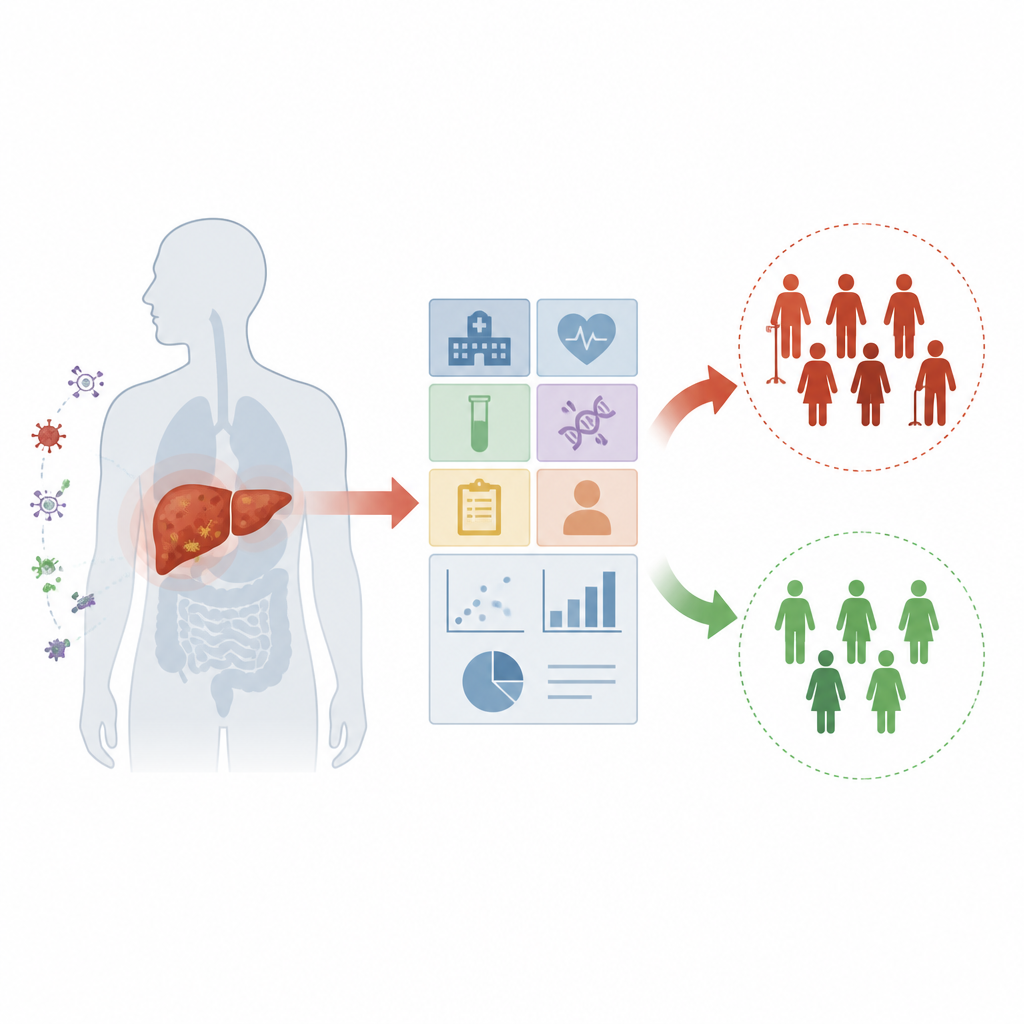
A serious pairing of liver damage and infection
Cirrhosis slowly scars the liver, disrupting blood flow, immune defenses, and the body’s ability to clot blood. Sepsis is a severe reaction to infection that can lead to failure of multiple organs. When these two conditions occur together, the body’s defenses are already weakened, and the chances of survival fall. Existing scoring systems for sepsis or critical illness, such as general intensive care scores, do not fully reflect the special problems of a damaged liver. Many patients with cirrhosis already have abnormal lab results at baseline, so standard scores can misjudge how sick they truly are. The authors argued that patients with cirrhosis and sepsis need a risk tool tailored to their biology and patterns of illness.
Building a picture of risk from real-world data
To create such a tool, the researchers turned to two large hospital databases that collect detailed information from intensive care units in the United States. From these sources they identified nearly 2,800 adults who had both cirrhosis and sepsis. They randomly split the larger group into a training set and an internal test set, while the second database served as an external test set from different hospitals. Within the first 24 hours of each patient’s intensive care stay, the team gathered routine measurements: age, vital signs, blood tests that reflect liver and kidney function, and whether the patient needed certain treatments such as dialysis, strong blood pressure drugs, or steroids. Advanced statistical methods were used to sift through more than 30 possible factors and select a smaller set that together gave the clearest picture of the chance of dying before hospital discharge.
From statistics to a bedside risk ruler
The final model was turned into a “nomogram,” essentially a visual risk ruler that assigns points to each factor and adds them up to estimate the likelihood of in-hospital death. Eleven everyday measurements made the cut: age, body temperature, breathing rate, a measure of red blood cell variation, blood levels of lactate and bilirubin, a clotting test, a liver enzyme, and whether the patient was receiving dialysis, strong blood pressure drugs, or steroids. When the nomogram was tested, it separated higher-risk from lower-risk patients reasonably well in both the original and external hospital groups. Its accuracy, measured by the area under the receiver operating curve, was similar to or better than widely used intensive care scores, while being more focused on the unique problems of cirrhosis. 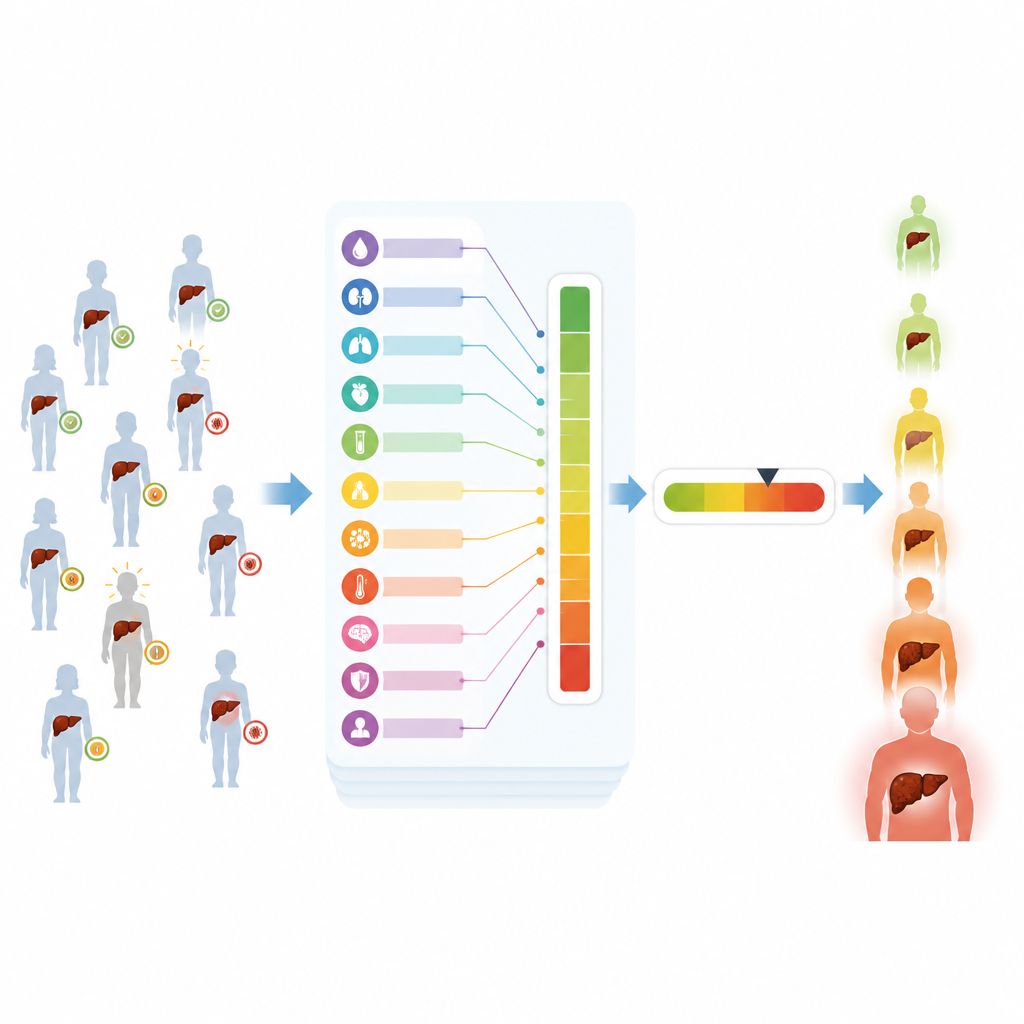
What the key signals tell doctors
The study also explored why these particular factors matter. Older age and abnormal clotting reflect a body and liver with less reserve. High lactate and fast breathing suggest poor blood flow and stressed organs. Changes in red blood cell size and rising bilirubin point to long-standing liver strain and ongoing injury. Low body temperature, often overlooked, appeared to signal a worrisome “shut down” state in which the immune system can no longer mount a vigorous response. The need for dialysis or strong blood pressure drugs tended to mark patients who were already critically ill, while patterns in a liver enzyme hinted that very low levels could mean that too much of the liver has already been replaced by scar tissue to release the enzyme, a marker of end-stage damage rather than health.
How this tool could help patients and clinicians
In plain terms, this work offers doctors a tailored chart that uses information they already collect to quickly gauge the risk of death for patients with cirrhosis and sepsis. The nomogram is not meant to replace more detailed scoring systems, but to provide an easy to interpret snapshot that can flag high-risk patients early, prompt closer monitoring, and support honest discussions with families. The authors note that their study has limits and that more research is needed in broader patient groups, but their model is a step toward more personalized care for people whose damaged livers leave them especially vulnerable when severe infection strikes.
Citation: Hu, Y., Zhang, L. & Yin, J. Development and external validation of a predictive model for in-hospital mortality in patients with liver cirrhosis and sepsis. Sci Rep 16, 15885 (2026). https://doi.org/10.1038/s41598-026-43991-x
Keywords: liver cirrhosis, sepsis, risk prediction, intensive care, nomogram