Clear Sky Science · en
Next-generation digital twin model with unobtrusive RF multi-sensing for AI-based human monitoring
Why a room can watch over your breathing
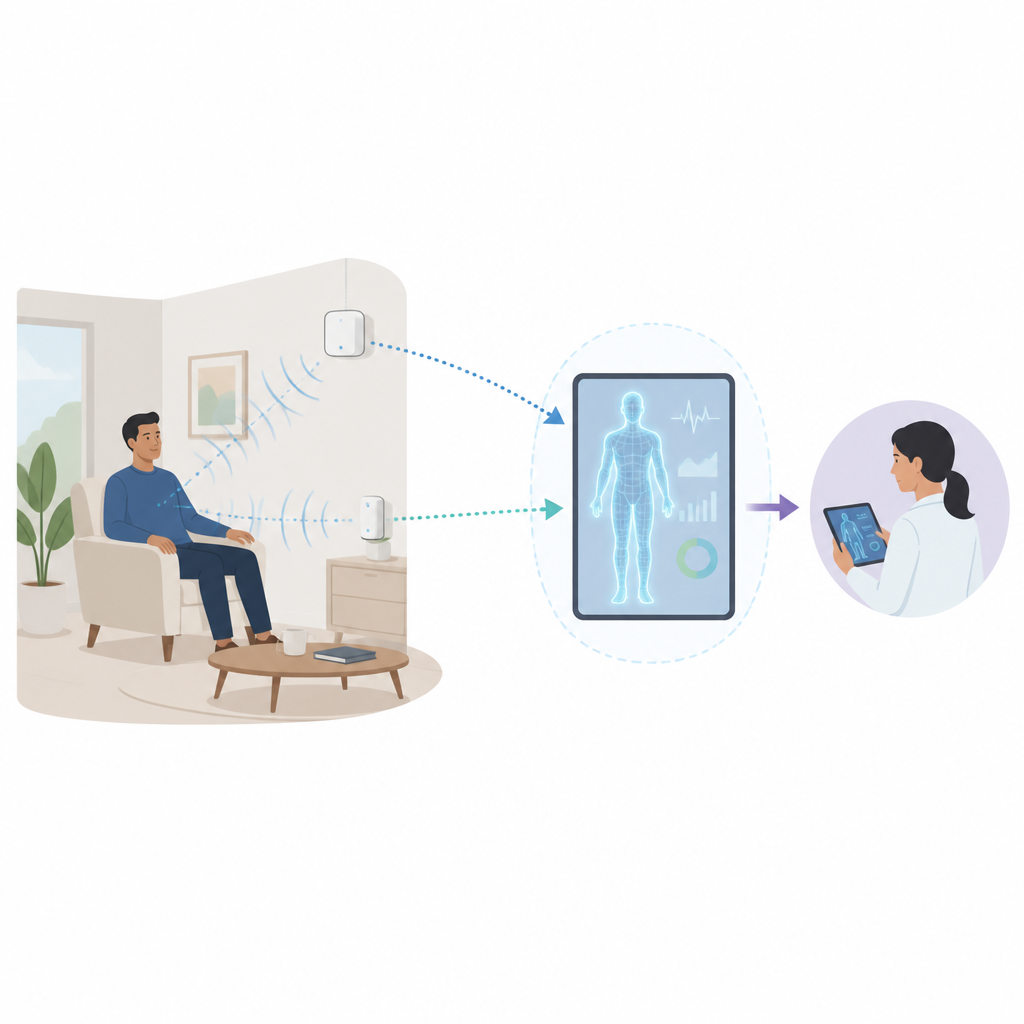
Imagine if your living room could quietly keep an eye on your breathing and hydration, alerting doctors when something looks wrong, without any wires, chest bands, or cameras. This paper explores how everyday wireless signals in a room can be turned into a kind of living mirror of a person’s body, opening the door to gentler, continuous monitoring for older adults, people with chronic lung disease, and others who need long term care.
A digital copy of you in the clinic
At the center of this work is a “digital twin” of a person: a virtual stand in that updates in real time as the person breathes. Instead of relying on hospital machines strapped to the body, the system uses radio waves in the room to sense how the chest moves and how moist the exhaled air is. These signals feed a constantly updated digital model that reflects the person’s breathing rate and the water content in their breath. Doctors could consult this model to decide when to check on a patient, change how closely they are observed, or adjust care plans, all while the person sits or rests as they normally would.
Listening to the body with invisible waves
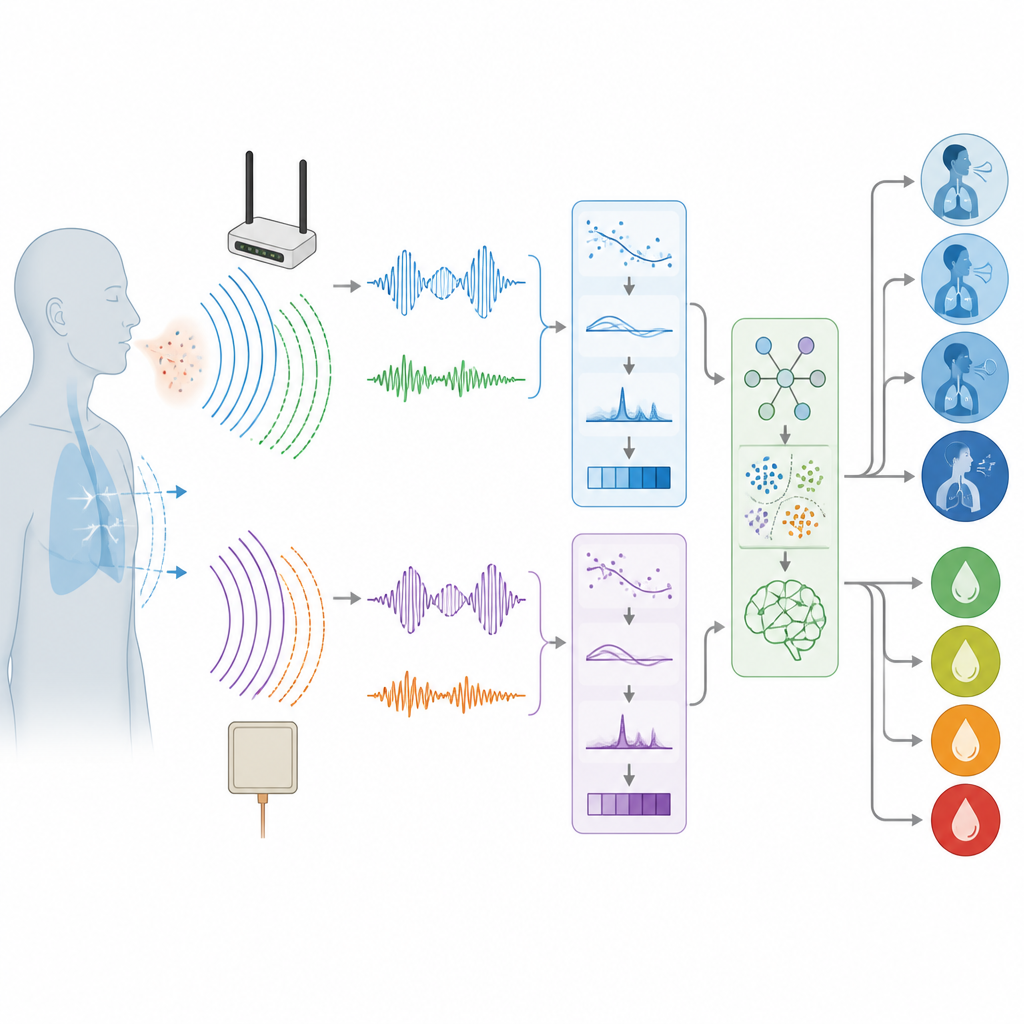
The team built their pilot system around two small, contact free radio sensors. One is based on an inexpensive Wi Fi chip that measures tiny changes in the wireless signal as it passes between a sender and receiver. When a person’s chest rises and falls, it subtly disturbs the signal, and those ripples carry information about breathing rate. The second sensor is a flexible ultra wideband antenna placed near the mouth to pick up changes in the radio reflection as moist breath flows out. Because water vapor interacts strongly with radio waves, patterns in these reflections reveal how much moisture is present in each breath, offering a window into the state of the airways and hydration.
Cleaning noisy signals into clear vital signs
Radio signals in a real room are messy. They bounce off walls, furniture, and even small movements that are not related to breathing. To turn this clutter into reliable vital signs, the authors designed a careful signal processing pipeline. They first remove constant offsets and random spikes, then pass the data through filters that only keep the slow rhythms where normal breathing lives. A statistical method called principal component analysis then pulls out the single pattern that best matches regular chest motion. Finally, the system looks at how strong this rhythm is at different frequencies to estimate breaths per minute. In their lab tests with one volunteer breathing at set slow, medium, and fast rates, this method hit the accepted clinical accuracy window of plus or minus five breaths per minute at all three levels.
Teaching the twin with real and synthetic data
Building a smart digital twin also requires teaching computer models what different breathing and hydration states look like. Yet collecting large, labeled medical datasets is slow and costly, especially for new sensing methods. To cope, the researchers invented statistical tricks to generate realistic “synthetic” data based on their measurements. For hydration, they worked directly in the frequency patterns of the radio reflections, nudging the curves in controlled ways that preserved their overall shape. Checks using several forms of correlation showed that the synthetic signals stayed very close to the real ones. With these expanded datasets, machine learning and deep learning methods could classify breathing as normal or abnormal and group hydration levels with respectable accuracy, especially when using compact neural networks followed by simpler classifiers.
A loop that learns and guides care
Unlike a one way monitor that only reports numbers, this digital twin is designed as a loop between the patient, the sensors, and the clinician. As the sensors stream data, the twin updates its view of breathing and hydration and feeds summary decisions and confidence levels to a doctor. The doctor can then choose to tighten or relax monitoring, shift attention between the two sensors, or change alert thresholds. Those choices, in turn, influence how and when new data are gathered. Over time, the system can learn the individual’s typical patterns, becoming a more personal and helpful companion for long term care.
From pilot study to future bedside helper
This study shows that it is possible to combine everyday style wireless hardware, clever signal cleaning, synthetic data, and machine learning into an early digital twin of a person’s breathing and exhaled hydration. In a single subject tested under carefully controlled conditions, the approach delivered clinically acceptable breathing rates and promising classification of hydration related patterns. The authors stress that much larger and more diverse studies are needed before such a system could guide real treatment. Still, the work points toward a future in which hospital rooms and homes quietly “listen” with radio waves, building digital stand ins of patients that help caregivers watch over them without wires or discomfort.
Citation: Khan, S., Alzaabi, A., Saied, I.M. et al. Next-generation digital twin model with unobtrusive RF multi-sensing for AI-based human monitoring. Sci Rep 16, 15612 (2026). https://doi.org/10.1038/s41598-026-43984-w
Keywords: digital twin healthcare, contactless respiration monitoring, RF sensing, AI health monitoring, exhaled breath hydration