Clear Sky Science · en
SCD-CHAOS: dynamic S-box and chaotic hybrid adaptive image encryption using multi-map diffusion
Why hiding pictures on tiny devices matters
Smart cameras, doorbells, medical sensors and other small gadgets are sending more and more pictures across the internet. If those images travel in plain sight, eavesdroppers can spy on people’s homes, health or habits. Strong encryption can hide this information, but many classic methods are too heavy for low‑power chips. This study presents a new way to scramble images so they look like random noise, while still running fast enough on modest hardware used in Internet of Things devices.

A new twist on digital lock and key
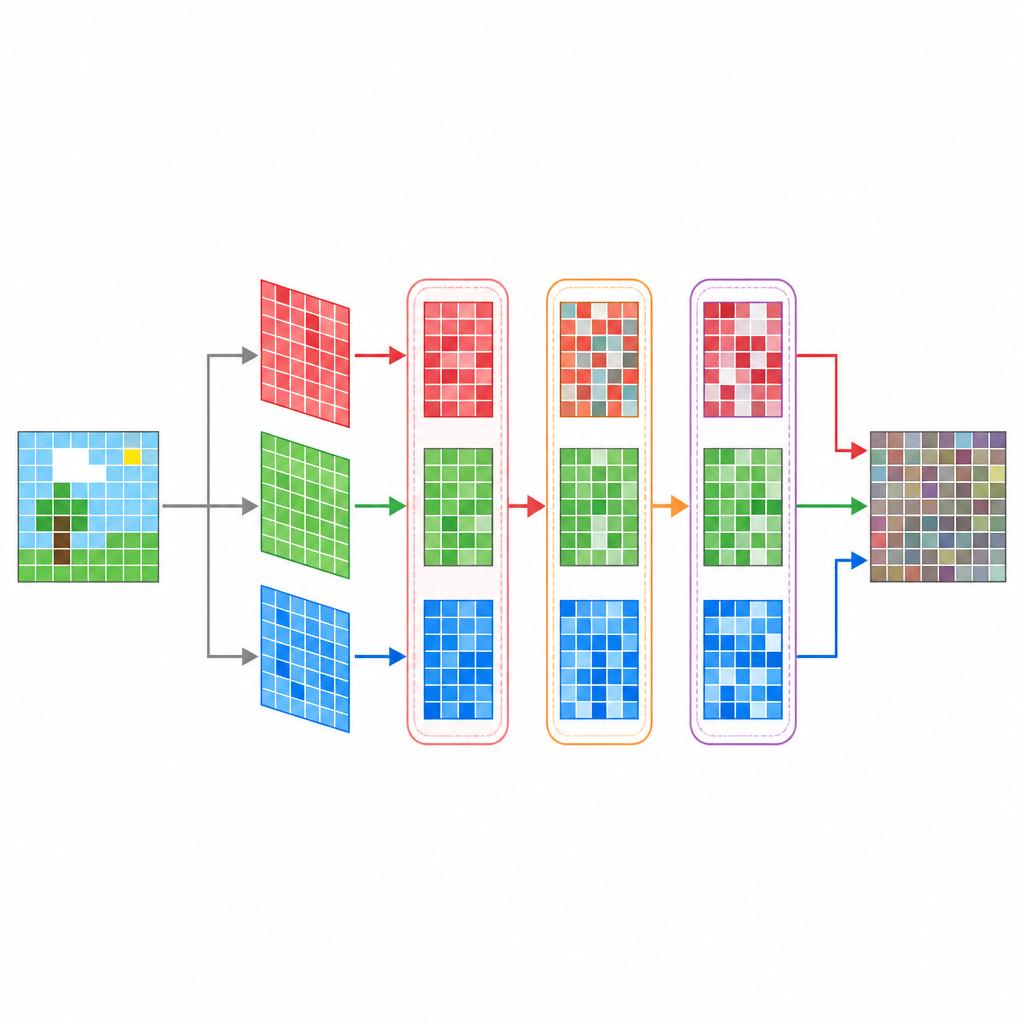
The authors introduce SCD‑CHAOS, an image protection method designed specifically for resource‑limited devices. Instead of relying on traditional math used in bank‑grade ciphers, it takes advantage of chaotic patterns – systems that behave unpredictably even though they follow simple rules. Two such patterns, called Tent and Henon maps, are combined to generate a constantly changing secret code. Every picture is first shrunk to a standard 64 by 64 pixels for benchmarking, then each color layer is split and rearranged based on this code so that neighboring pixels in the original photo end up far apart in the scrambled version.
How pictures are taken apart and jumbled
Inside SCD‑CHAOS, the red, green and blue parts of an image are turned into long lines of numbers. The Tent map controls how their positions are shuffled, breaking up recognizable shapes and edges. At the same time, the Henon map drives how the brightness of each pixel is altered. The two chaotic streams are fused into a hybrid key that is different for every pixel. This key is then used in a simple on‑off style operation, similar to flipping bits, which is cheap to perform on tiny processors but very hard to reverse without the exact same key.
A shape‑shifting substitution table
Many ciphers use a fixed look‑up table to swap each possible pixel value for another. Attackers can sometimes exploit patterns in those tables. SCD‑CHAOS avoids this by building a fresh table, known as an S‑box, each time it encrypts an image. The current state of the chaotic maps determines how the table is arranged, so even if two images and passwords are the same, their scrambled outputs will differ. This constant evolution smooths out the statistics of the encrypted picture, flattening its brightness histogram so that it closely resembles pure noise and reveals almost nothing about the original content.
Putting the system to the test
The team checked how well their scheme hides structure by measuring how much encrypted pixels differ from the original ones and from each other. They report that almost every pixel changes when the key is altered slightly, and that brightness differences between pairs of encrypted images hover around the levels expected for a strong cipher. Measures of randomness approach their ideal values, and the similarity between original and scrambled images is nearly zero, while the match between original and decrypted images is almost perfect. Even though the method is highly disruptive, it remains exactly reversible when the correct key is used.
Built for the real world of small devices
Beyond theory, the authors implemented SCD‑CHAOS on popular low‑cost boards such as the ESP32 and an ARM Cortex‑M4 microcontroller. For modest image sizes, encryption and decryption take only fractions of a second and consume little memory and power, which is crucial for battery‑powered sensors. The total range of possible keys is enormous, far beyond what can be explored by brute‑force guessing. In simple terms, the study shows that it is possible to turn everyday pictures into noise that only the intended receiver can undo, all while staying within the tight speed and energy budgets of next‑generation connected devices.
Citation: Yogi, B., Majumdar, R., Ghosh, P. et al. SCD-CHAOS: dynamic S-box and chaotic hybrid adaptive image encryption using multi-map diffusion. Sci Rep 16, 15818 (2026). https://doi.org/10.1038/s41598-026-43981-z
Keywords: image encryption, IoT security, chaotic maps, lightweight cryptography, data privacy