Clear Sky Science · en
Land-use controls on soil organic carbon dynamics across Amazonian ecosystems, Brazil
Why the Ground Beneath the Amazon Matters
The Amazon rainforest is often called the lungs of the planet, but a quieter giant lies underfoot: the soil. This study explores how different ways of using Amazonian land—keeping it as forest, turning it into pasture, or plowing it for crops—change the amount of carbon stored in the top layer of soil. Because soil carbon helps regulate the climate and supports fertile ground for food and forests, understanding these changes is essential for anyone concerned with climate change, biodiversity, and sustainable agriculture.
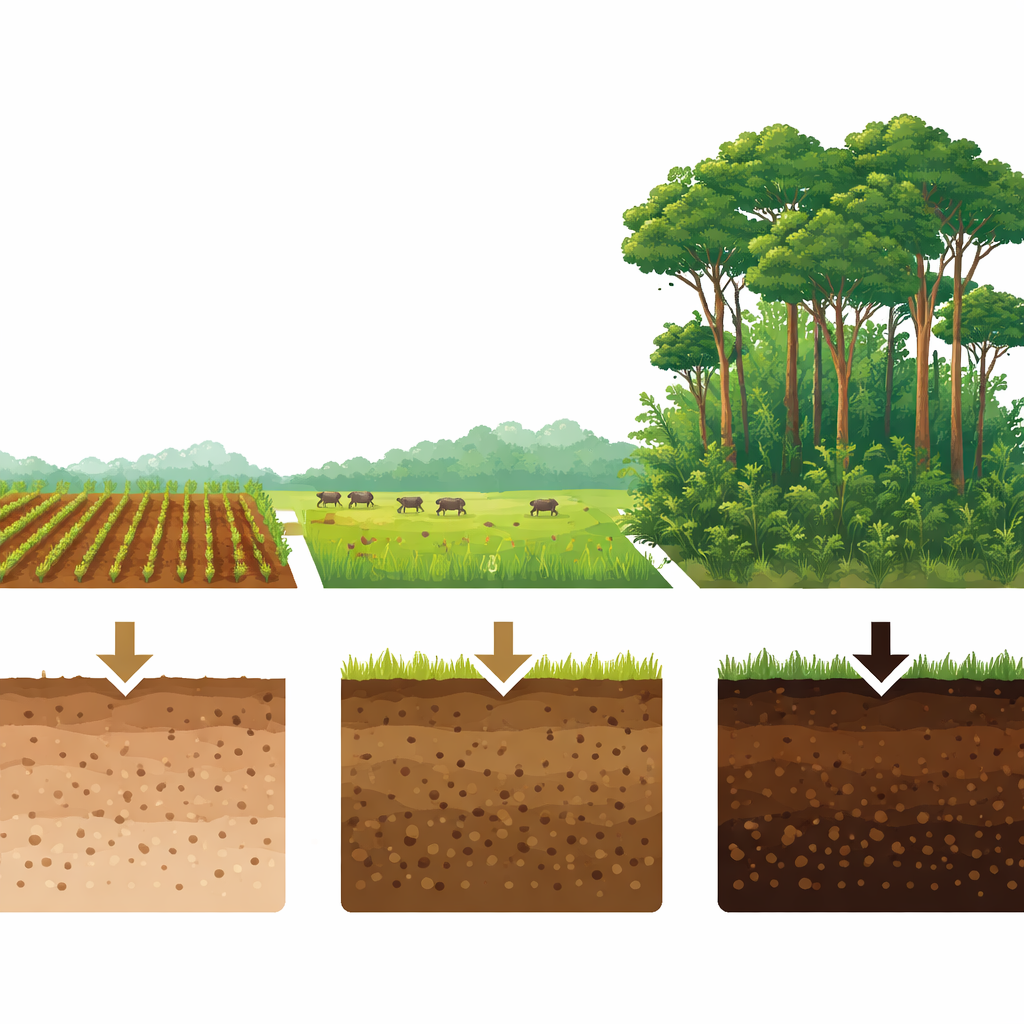
Different Ways We Use the Land
The researchers focused on a section of the Brazilian Amazon that includes forests, cattle pastures, and croplands. Using 649 soil samples taken from the top 30 centimeters of the ground, plus older “legacy” soil data, they compared how soil properties varied from one land use to another. Forest soils contained much more organic carbon and nitrogen than pasture or cropland soils, reflecting decades of leaf litter, roots, and minimal disturbance. Croplands, by contrast, showed the lowest carbon levels, likely due to repeated tillage, residue removal, and exposure of soil to sun and rain. Pastures tended to fall in between, storing more carbon than fields but less than intact forests.
What Makes Some Soils Hold More Carbon
Beyond simply measuring carbon, the team examined other soil characteristics such as texture (sand, silt, and clay), density, acidity, and the ability of soil particles to hold and exchange nutrients. Two chemical features stood out: cation exchange capacity (a measure of how many nutrient-carrying charged sites the soil has) and base saturation (how filled those sites are with certain nutrients). Forest soils generally had higher values for these properties, alongside richer carbon stocks. This suggests that where soil minerals and organic matter interact strongly, carbon is more likely to be protected in stable forms, while certain nutrient conditions can also speed its breakdown.
Teaching Computers to Read the Soil
To move from scattered measurements to continuous maps, the scientists turned to advanced computer models. They trained several machine-learning algorithms—Random Forests, Support Vector Machines, and neural networks—alongside more traditional statistical methods, to predict soil carbon from the measured soil and environmental variables. After rigorous cross-checking, Random Forest emerged as the most accurate, capturing nearly all of the variation in soil carbon across the landscape. While classic models were easier to interpret, they could not match the predictive power of these newer tools, which excel at handling complex, non‑linear relationships.
Seeing Hidden Patterns and Causes
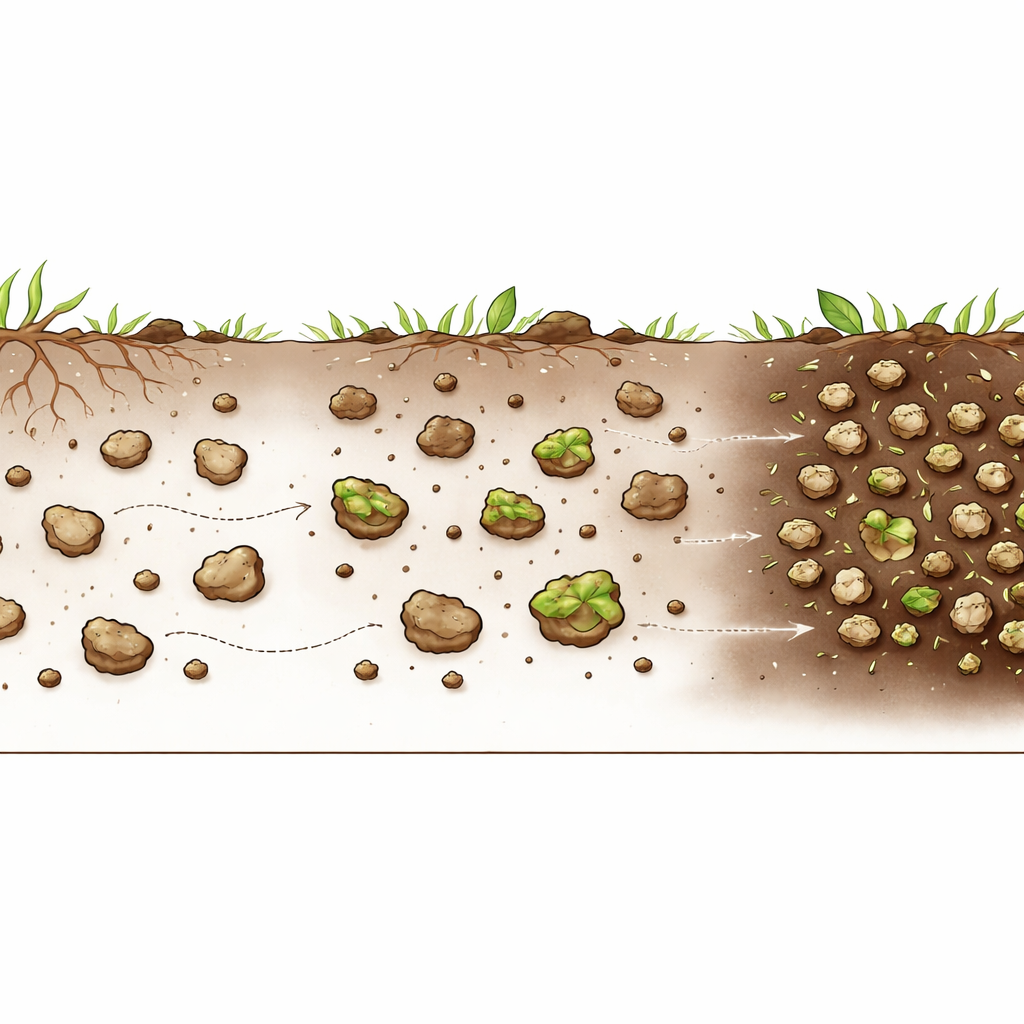
Because powerful prediction does not automatically reveal cause and effect, the team also used a technique called structural equation modeling. This allowed them to trace how soil chemistry, physical structure, and local conditions each contribute—directly and indirectly—to carbon storage. They found that nutrient-holding capacity tended to increase carbon retention, while higher base saturation often had the opposite effect, possibly by encouraging microbes to break down organic matter faster. Soil temperature and compaction played only minor direct roles within the relatively uniform climate of the study area, reinforcing the idea that local soil chemistry is a dominant lever for soil carbon in this part of the Amazon.
Maps That Can Guide Future Choices
By applying the best-performing model to spatial data, the researchers produced detailed maps of soil carbon under forest, pasture, and cropland. Forest areas displayed the highest and most continuous carbon stocks; pastures showed moderate and patchy reserves; croplands had the lowest and most fragmented carbon. These patterns confirm that clearing forest for agriculture typically drains carbon from the soil, while allowing land to remain or return to forest can rebuild this hidden reservoir over time. The authors caution that their study only covers the upper 30 centimeters of soil and relies on current relationships that could shift with climate or management changes.
What This Means for People and the Planet
In plain terms, the study shows that keeping Amazonian land covered with forest—or at least managing it gently—helps lock more carbon in the soil, supporting both climate stability and soil health. Advanced computer models, especially Random Forests, provide a powerful way to turn scattered soil measurements into practical maps that can steer conservation and farming decisions. As future work adds deeper soil layers and long-term monitoring, this approach could help policymakers and land managers decide where protecting or restoring forests, and improving soil chemical quality, will deliver the greatest benefit for the climate and for the communities that depend on the Amazon.
Citation: Tiruneh, G.A., Righi, C.A., Polizel, J.L. et al. Land-use controls on soil organic carbon dynamics across Amazonian ecosystems, Brazil. Sci Rep 16, 13693 (2026). https://doi.org/10.1038/s41598-026-43978-8
Keywords: soil carbon, Amazon rainforest, land use change, machine learning, climate mitigation