Clear Sky Science · en
Automated production cutting optimization for minimizing material waste of pipelines in prefabricated MEP systems based on integer programming
Why cutting pipes smarter really matters
Behind every modern building lies a dense network of pipes that deliver water, carry away waste, feed sprinklers, and circulate heating and cooling. These Mechanical, Electrical and Plumbing (MEP) systems are expensive to build, and a surprising amount of money is literally thrown away as metal offcuts when standard-length pipes are cut to fit each project. This study shows how combining digital building models with advanced math can almost eliminate that waste, cutting costs and conserving resources at the same time.
The hidden waste in building pipes
In today’s large, complex buildings, MEP work can account for more than 30% of total construction costs. Prefabricated MEP pipelines—made in factories and then assembled on site—promise better quality and faster construction. But one stubborn problem remains: how to cut thousands of pipes of different diameters and lengths from standard stock without piling up expensive leftovers. Poor cutting plans can make cutting losses more than 30% of all material waste on a project, driving up costs and undermining the environmental benefits of prefabrication.
Turning 3D building models into usable numbers
Modern projects increasingly use Building Information Modeling (BIM), where the entire building—including every pipe—is stored in a rich 3D digital model. However, extracting the exact sizes and quantities of pipes from these models has often required manual work, which is slow and error-prone. The authors developed a custom plug-in for Autodesk Revit that automatically gathers all key pipeline information: where they are, what type they are, their diameters, and their lengths. The tool cleans the data, filters out invalid elements, groups pipes by type and size, and generates ready-to-use statistics and reports, providing a reliable foundation for optimization rather than guesswork.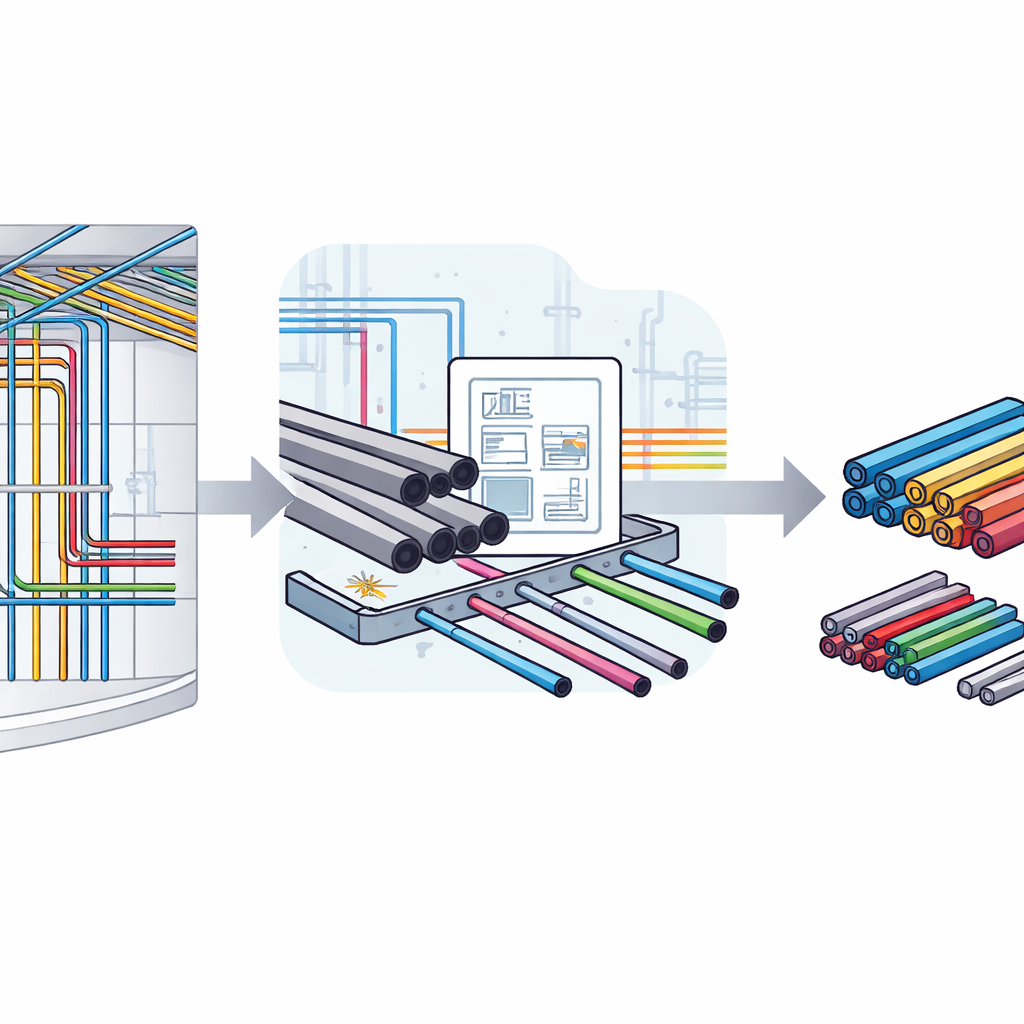
Using math to plan every cut
Once the pipe needs are known, the challenge becomes a classic “cutting stock” puzzle: how to slice standard raw pipes into the required shorter pieces with the smallest possible waste and cost. The researchers built an integer programming model—a way of describing the problem so that a computer can search systematically for the best combination of cutting patterns. The model respects real-world rules: each finished pipe must come from a single cut, total length in each pattern cannot exceed the raw pipe length, and leftover pieces shorter than a factory-defined minimum are treated as scrap. The goal is simple but powerful: minimize total material consumption while still meeting all project demands.
An algorithm that learns better patterns step by step
Because there are astronomically many ways to cut long pipes into short ones, the team used a technique called a column generation algorithm to search efficiently. Instead of trying all possibilities at once, the algorithm starts with a few basic cutting patterns, checks how well they perform, and then gradually adds new patterns that promise to reduce waste. This back-and-forth process continues until no new pattern can improve the result. The method works for both simple cases—where only one stock length is available—and more realistic situations where several stock lengths can be combined. It is particularly well suited to large projects with many pipe types and thousands of required pieces.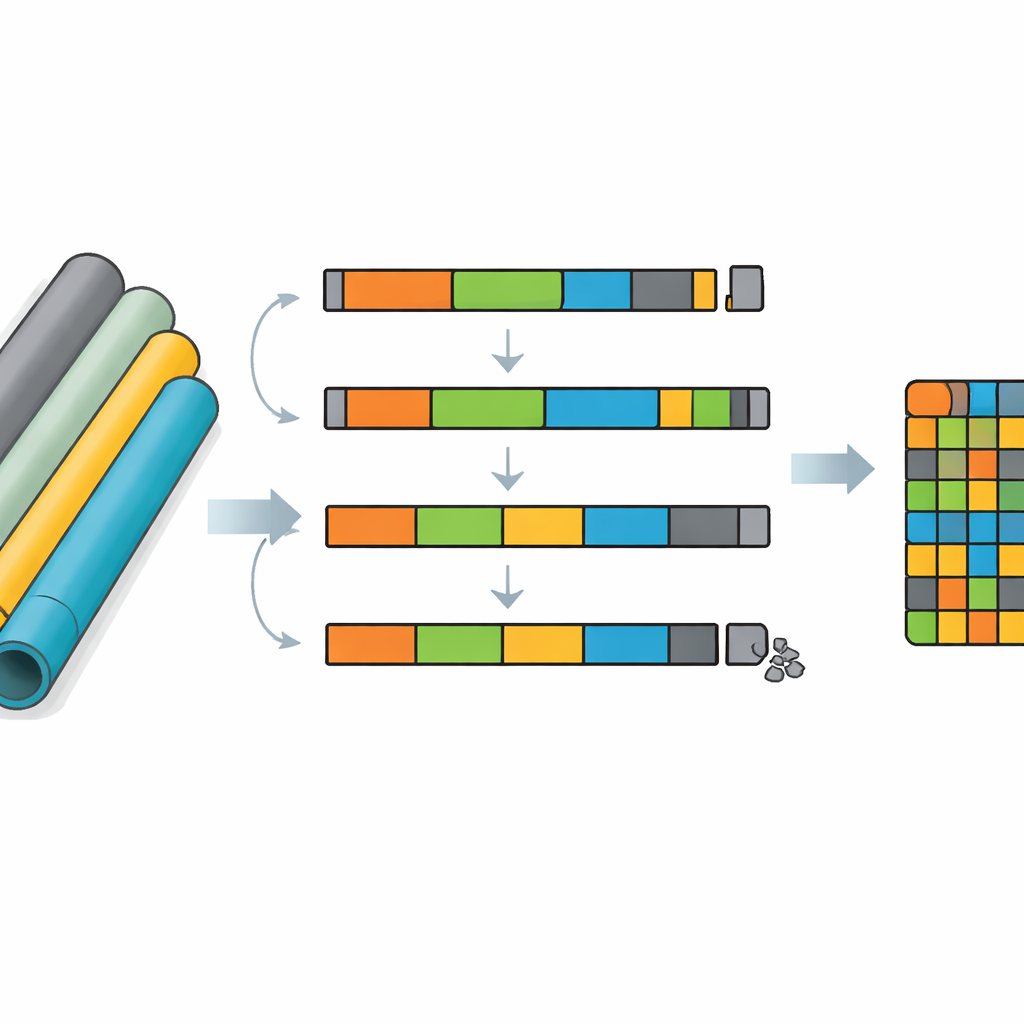
Real project test: less waste with slightly more computing
The approach was tested on a large transportation hub in Beijing, involving multiple pipe systems and many different diameters and lengths. In the single stock-length scenario, the optimized plans reduced the waste rate to just 0.54%, with 1040 meters of pipe consumed. When multiple stock lengths were allowed and optimized together, waste fell below 1% with only 1025 meters used—better than using any single length alone. Compared with a widely used genetic algorithm and a simple greedy rule-of-thumb strategy, the new method consistently achieved far lower waste and lower total material use, while the extra computing time stayed under a minute, a negligible cost in the context of factory planning.
What this means for buildings and the planet
To a layperson, the core message is straightforward: by letting computers “think through” how to cut standard pipes for a specific building, factories can nearly eliminate offcuts, saving metal, money, and storage space. The combination of automatic data extraction from digital building models and a mathematically guided cutting plan turns a messy, experience-based task into a repeatable, high-precision process. For construction firms, this means tighter cost control and less material handling; for society, it points toward more resource-efficient buildings. The same logic could be extended beyond pipes to many other products cut from standard lengths, offering a general recipe for doing more with less.
Citation: Fan, X., Yang, L. & Zhao, X. Automated production cutting optimization for minimizing material waste of pipelines in prefabricated MEP systems based on integer programming. Sci Rep 16, 13293 (2026). https://doi.org/10.1038/s41598-026-43977-9
Keywords: prefabricated MEP pipelines, cutting stock optimization, building information modeling, material waste reduction, integer programming algorithms