Clear Sky Science · en
Enhanced performance of a hybrid PV/T V-shaped solar still using a graphene–silver–silica composite
Turning Sunlight Into Drinking Water
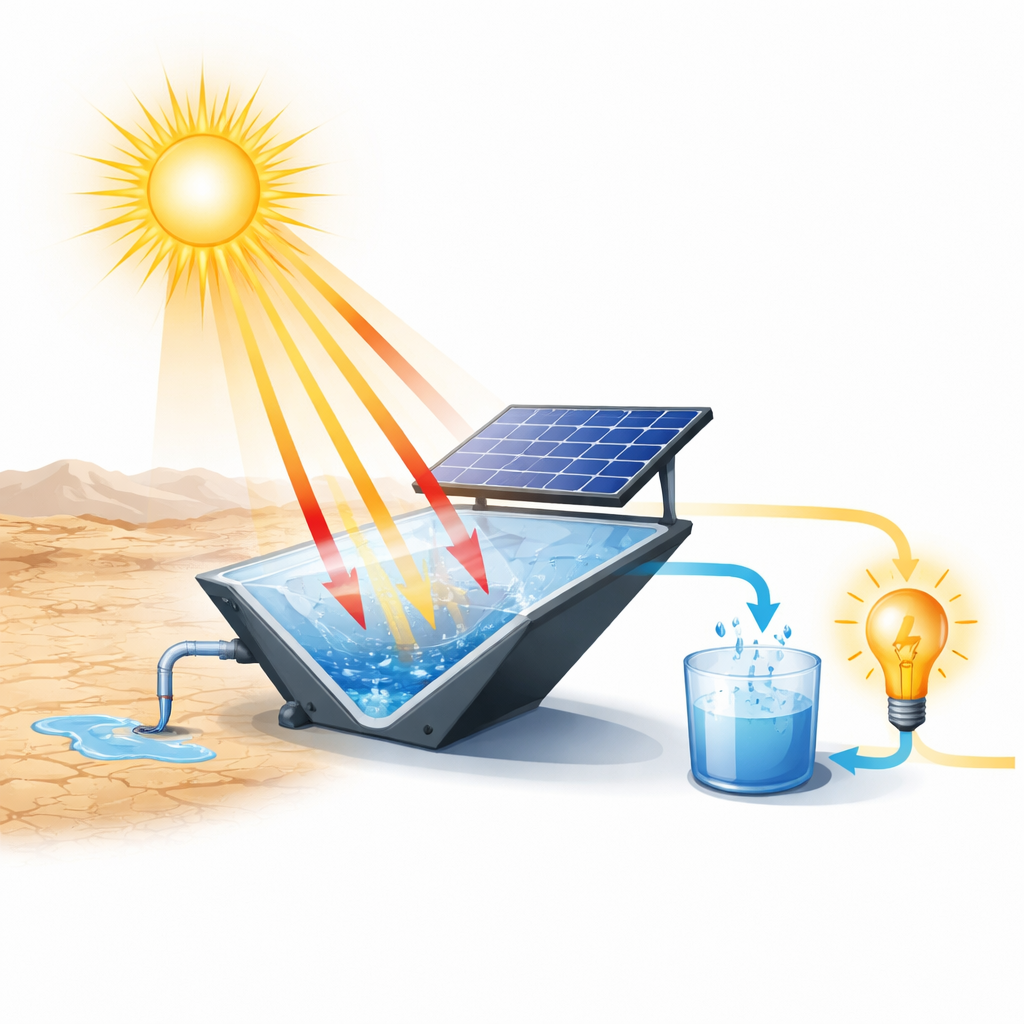
Many communities around the world struggle with two basic needs at the same time: safe drinking water and reliable electricity. This study explores a compact rooftop-sized device that tackles both problems at once. By cleverly combining solar panels with a simple water purifier known as a solar still—and boosting it with a special heat-managing material made from graphene, silver, and silica—the researchers show how one unit can both make freshwater from salty or brackish sources and generate electricity more efficiently and at lower cost.
Why Freshwater And Power Are Hard To Get
In dry and remote regions, hauling water and building power lines are often too expensive. Desalination plants exist, but they tend to be large, energy-hungry facilities clustered near cities. Solar stills offer a simpler approach: they use sunlight to warm salty water so it evaporates, then collect the condensed vapor as freshwater. Separately, solar panels turn sunlight into electricity, but they work less efficiently as they heat up. The authors point out that combining these two ideas—water distillation and solar electricity—can create local, low-carbon “water and power stations” that are easy to deploy in off‑grid areas.
A New V-Shaped Solar Still With A Smart Heart
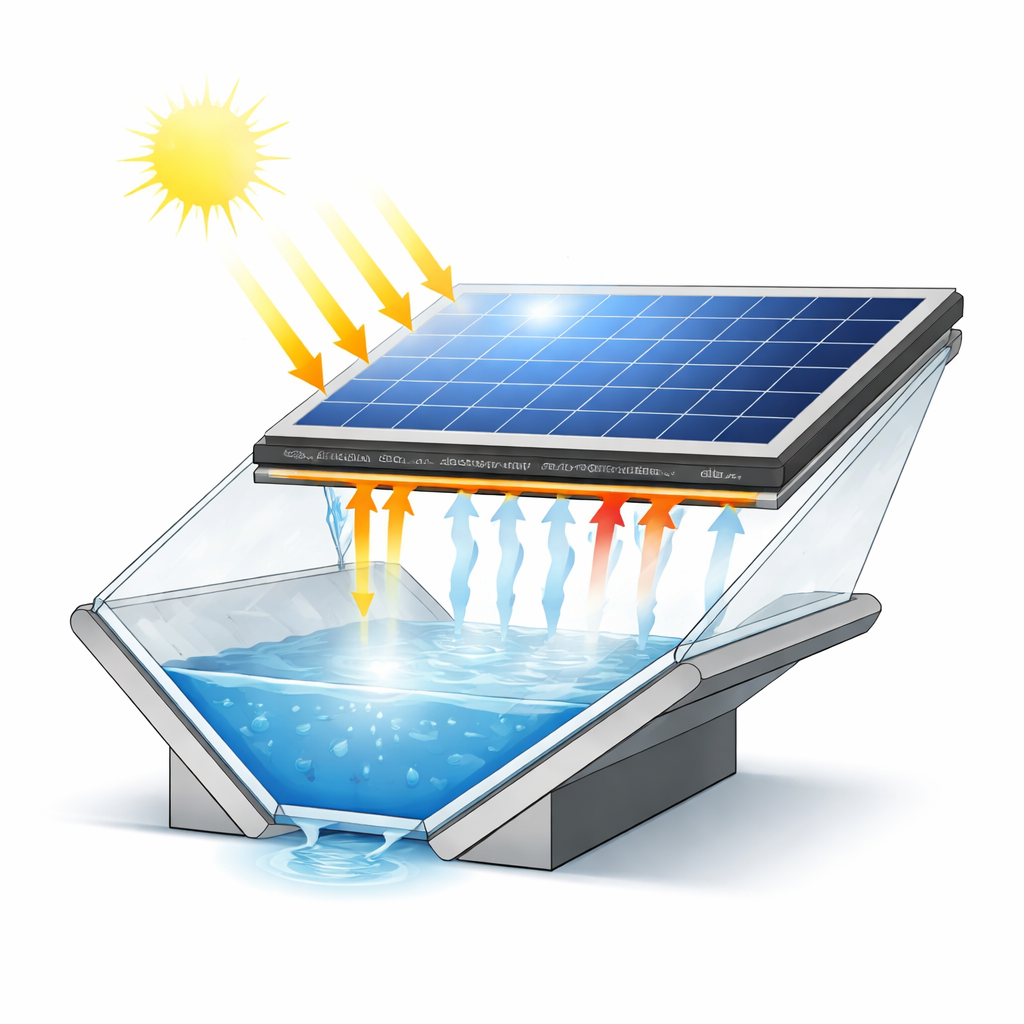
The device tested in this work is a V‑shaped basin covered by inclined glass, with a solar panel integrated as part of the roof. Salty water sits in a shallow layer at the bottom; sunlight both heats this water and powers the panel. The key innovation is a thin hybrid layer made from graphene, silver, and silica placed between the panel and the water basin. Graphene and silver are excellent at moving heat, while silica helps control expansion, spread the particles evenly, and prevent clumping or cracking. Using a statistical optimization method, the team tuned the mix so that heat flows steadily, rather than too quickly, from the panel into the water.
How The System Works Throughout The Day
Under real outdoor conditions in southern India, the researchers ran two nearly identical systems side by side: a conventional solar-panel-plus-still setup and their new design. Sensors tracked sunlight, wind, temperatures at many points, and the amount of water collected each hour. As the sun climbed, the hybrid layer and V-shape helped the improved still heat its basin water to higher temperatures and keep it warm longer into the afternoon. This led to more evaporation inside and a larger temperature difference between the warm vapor and the cooler glass cover, which encouraged condensation. At the same time, a controlled cooling loop carried away excess heat from the solar panel into the basin water, keeping the panel itself slightly cooler and more efficient.
What The Numbers Say About Water, Power, And Cost
Over a representative sunny day, the enhanced system produced about 1.99 liters of distilled water, compared with 0.88 liters from the conventional version—an increase of roughly 126 percent. The maximum electrical output from the solar panel rose from 45.7 watts to 49.7 watts, about a 9 percent gain, thanks to better temperature control of the cells. Because a single unit produces more water and power from the same footprint, the cost of each liter of freshwater drops sharply: from around 0.028 dollars per liter in the basic setup to 0.019 dollars per liter in the improved one. Economic modeling over a ten‑year lifetime shows that the upgraded design not only pays back its investment faster but also yields higher net profit under a range of financing conditions.
What This Could Mean For Dry Regions
To a non‑specialist, the takeaway is straightforward: a modest change in geometry and a carefully engineered heat‑spreading layer can turn a simple solar still into a far more productive and economical mini plant for both water and electricity. While questions remain about how the composite material will age over many years and in different climates, the concept demonstrates that a single, quiet, sun‑powered unit could help remote villages, coastal settlements, or emergency camps secure cleaner water and local power without fuel or complex infrastructure.
Citation: Selvaraju, K., Harsha, A.S., Hishikar, P. et al. Enhanced performance of a hybrid PV/T V-shaped solar still using a graphene–silver–silica composite. Sci Rep 16, 13601 (2026). https://doi.org/10.1038/s41598-026-43976-w
Keywords: solar desalination, hybrid solar still, graphene composite, off-grid water, photovoltaic thermal