Clear Sky Science · en
Automated experimentally validated antenna design framework using versatile parameterization scheme
Smart antennas without the guesswork
From smartphones and Wi‑Fi routers to medical implants and satellites, nearly every wireless gadget depends on carefully shaped bits of metal called antennas. Designing these antennas is usually slow, expert‑driven work that involves weeks of trial and error on a computer. This paper presents a way to automate much of that process, using a reusable database and a clever way of building antennas from simple geometric pieces. The goal is to get custom, high‑performance antennas in hours instead of weeks, without needing a specialist at every step.
Why antenna design is so hard today
Modern antennas must be small, cheap and able to operate over one or more precise ranges of frequencies. Engineers typically start from familiar shapes—such as metal patches or rods—and then add cuts, extra pieces, or exotic materials to get the desired behavior. Each small change must be checked with heavy‑duty electromagnetic simulations, which makes the search for a good design slow and computationally expensive. More adventurous methods that let the computer invent entirely new shapes do exist, but they often require thousands of simulations and specialized software, putting them out of reach for routine industrial use.
Building antennas from ovals and holes
Instead of letting every tiny bit of metal vary freely, the authors describe antennas as boards populated by a limited number of adjustable building blocks. The board itself is a simple rectangle with a ground plane and a feed point where it connects to electronics. On top sit several oval metal “patches” and oval “gaps,” each with tunable size and position. By turning some of these elements off (shrinking them to nothing) and repositioning the rest, the framework can produce a wide variety of unusual shapes while still describing each candidate with a manageable set of numbers. This keeps the design space rich but the optimization problem tractable.
A big library that replaces blind search
The central idea is to do the heavy lifting only once. First, the team randomly generates a large number of different antenna layouts within this oval‑and‑gap scheme and simulates each one with a slightly simplified electromagnetic model. The resulting “library” stores both the geometric settings and how each antenna behaves across frequency. When a new design task comes up—say, an antenna that must work in two separate bands or one that must be as small as possible—the system does not start optimization from scratch. Instead, it quickly scans the database to find entries whose performance is already close to the new specification, choosing one as a smart starting point. This lookup is extremely fast compared with traditional global search methods.
Fine tuning with fast local adjustments
Once a promising starting shape is found, a second stage performs local fine tuning using a more accurate simulation. Here, a gradient‑based algorithm nudges the sizes and positions of the ovals and gaps to reduce signal reflections in the desired frequency bands and to meet any extra requirements, such as staying within a fixed footprint. The authors design twelve different antennas with this two‑step process, including broadband, ultra‑wideband, dual‑band and triple‑band examples, as well as antennas deliberately shrunk in size. Each final design typically requires fewer than two hundred detailed simulations—far less than competing automated approaches—while still meeting strict performance targets.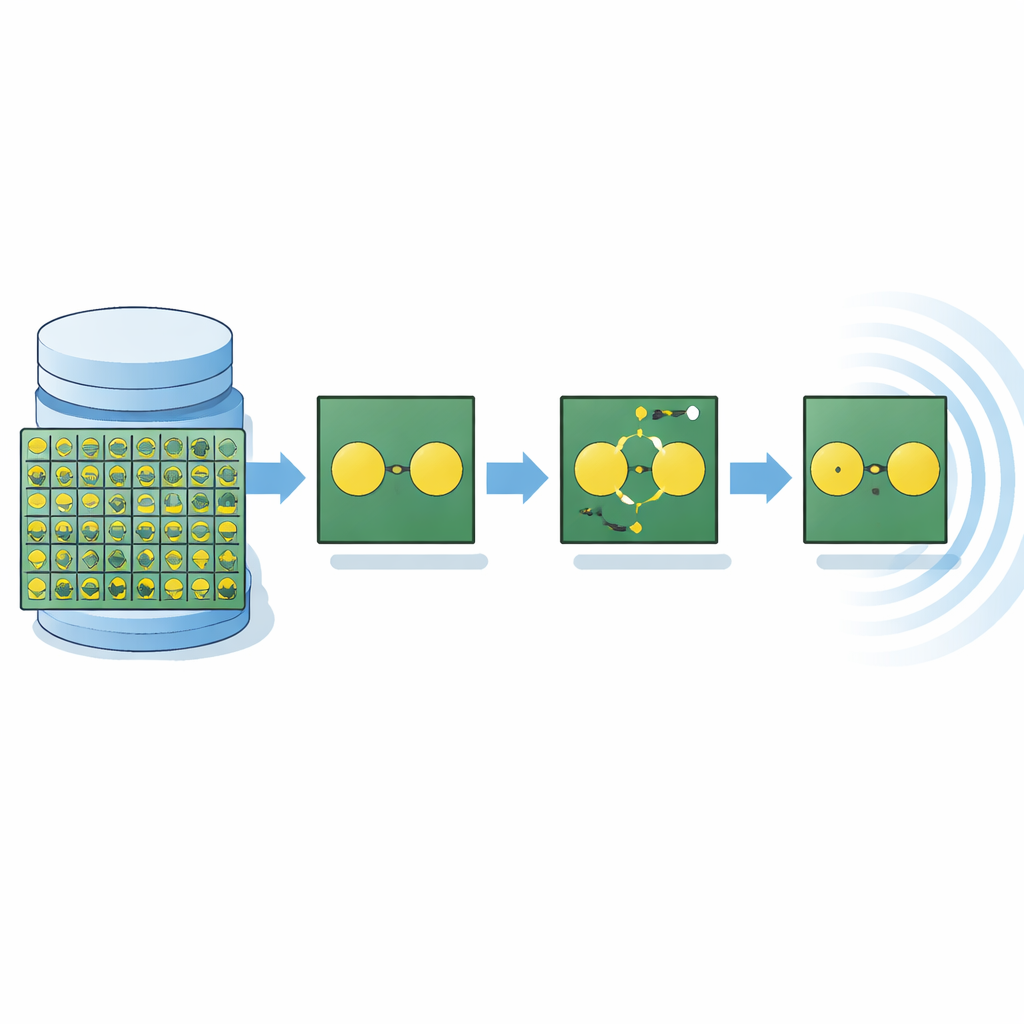
Putting the designs to the test
Because the resulting shapes look nothing like textbook antennas, the researchers emphasize experimental checks. They fabricate several of the computer‑generated designs on standard circuit boards and measure how they behave in the lab using a precision network analyzer and an anechoic test chamber. The measured responses and radiation patterns closely match the simulations, confirming that the database‑driven process not only runs quickly but also produces practical, buildable devices. This experimental step is built into the overall framework, forming a closed loop from specifications to prototype and back.
What this means for future wireless devices
For non‑specialists, the key takeaway is that antenna design can now be treated more like ordering a part than conducting a mini research project. A user specifies the frequency bands, size limits and basic material, and the framework searches its library, then polishes the best candidate into a working solution with minimal computation and no expert tweaking. As the database grows and new parameters such as different board materials are added, the same approach could support a wide range of next‑generation wireless gadgets, from tiny sensors to complex multi‑band systems, making advanced antenna technology more accessible across industry and research.
Citation: Koziel, S., Pietrenko-Dabrowska, A. & Szczepanski, S. Automated experimentally validated antenna design framework using versatile parameterization scheme. Sci Rep 16, 14015 (2026). https://doi.org/10.1038/s41598-026-43974-y
Keywords: automated antenna design, broadband antennas, wireless devices, design optimization, electromagnetic simulation