Clear Sky Science · en
A BP neural network model for intelligent quality monitoring of industry-education integration and talent cultivation
Why this matters for students and employers
Universities are under pressure to prove that they are actually preparing students for real jobs, not just handing out diplomas. At the same time, companies want graduates who can step into modern workplaces without years of extra training. This study explores how to use an artificial intelligence model to continuously monitor and improve how well universities and companies work together to train job‑ready graduates.
Turning messy education data into a clear picture
The authors focus on a popular policy idea: deep cooperation between universities and industry through joint courses, shared training bases, internships, and co‑supervised projects. In practice, universities collect huge amounts of data about these programs—budgets, teaching hours, company feedback, employment outcomes—but it is scattered, uneven in quality, and difficult to interpret. Traditional evaluation methods tend to rely on a few simple numbers, such as employment rate or satisfaction surveys, often checked only after a program ends. This makes it hard to detect problems early or understand which parts of a partnership are truly working.
Building a multi-angle scorecard
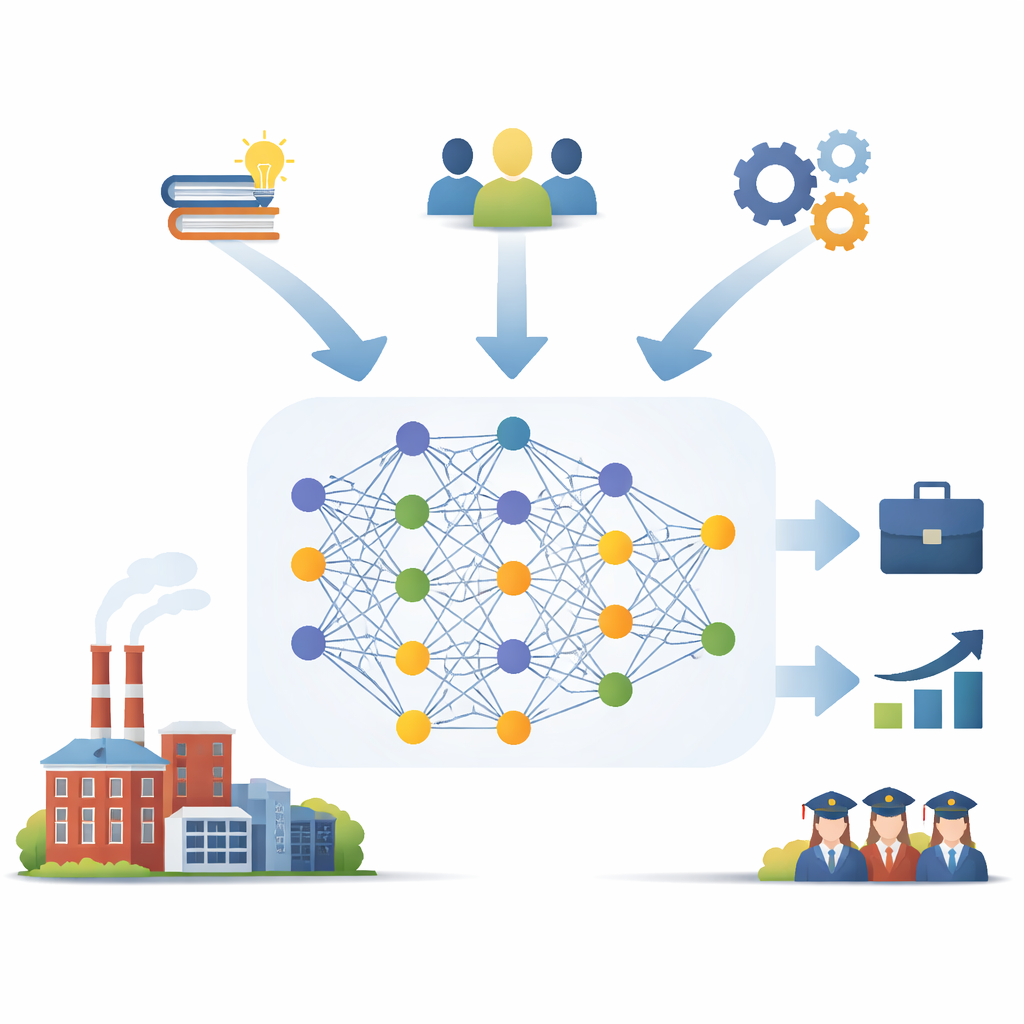
To tackle this, the researchers first design a detailed indicator system that looks at the full life cycle of university–enterprise cooperation. They group 26 measurable indicators into five areas: teaching input (such as equipment investment and training bases), teacher collaboration (for example, the share of company mentors), curriculum co‑development (jointly designed and updated courses), enterprise participation (internship places, joint projects, feedback speed), and student outcomes (employment rate, salary, promotion, entrepreneurship, competition results). Numerical indicators are carefully standardized so that very different quantities—like money, percentages, and 1–5 ratings—can be meaningfully combined in one model without any single factor dominating just because of its scale.
Letting a neural network find hidden patterns
On top of this indicator system, the team builds an enhanced Back Propagation neural network—a common type of AI model that can learn complex relationships from data. The network takes the 26 indicators as inputs and produces a single quality score between 0 and 1 for each university–enterprise project. To train it, the authors use 642 real project samples from a top Chinese university, covering eight majors in engineering and management and spanning six years of cooperation records, company feedback, and graduate follow‑up surveys. They introduce several refinements: a confidence weight for each project (so more reliable, well‑documented cases influence learning more than incomplete or noisy ones), and an information‑entropy based check to select a network size that matches the complexity of the data, helping avoid both underfitting and overfitting.
Peeking inside the black box
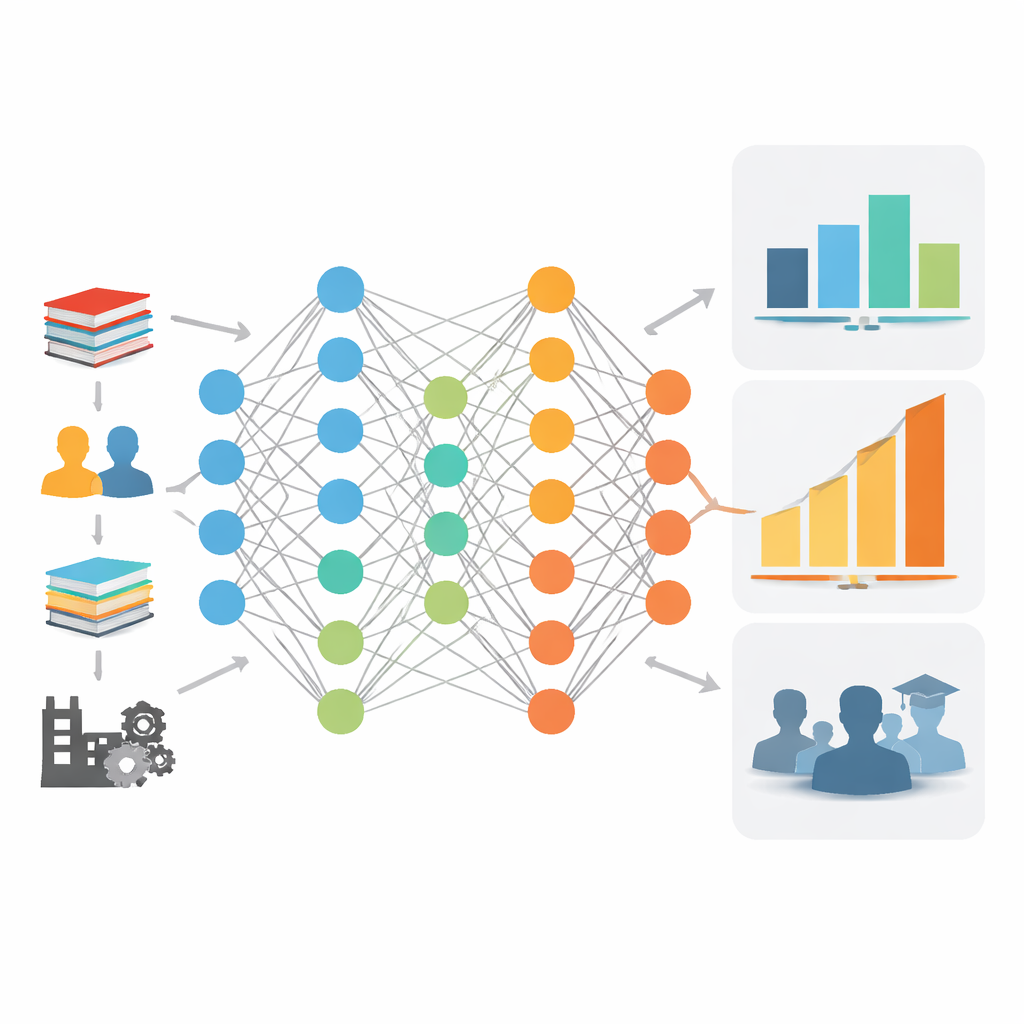
Because decision‑makers in education cannot simply accept a “black box” score, the study adds an interpretability layer using SHAP, a game‑theory based technique. SHAP estimates how much each indicator pushes a project’s quality score up or down. By turning these contributions into visual rankings and heatmaps, managers can see, for example, when a long gap between course updates or too few practical training hours is dragging scores down. The system then maps such signals to simple, actionable strategies: increase the presence of company mentors on campus, speed up feedback cycles, or adjust the mix of practice‑oriented courses. This creates a loop of “prediction → explanation → intervention,” in which the AI both detects risk and points to likely levers for improvement.
How well does the smart monitor work?
The authors compare their neural network with four common prediction methods: linear regression, decision trees, support vector regression, and the widely used XGBoost model. Using the same dataset and careful cross‑validation, the neural network delivers the best results, with a very low prediction error and a coefficient of determination (R²) close to 0.95. It maintains similarly high accuracy when tested separately on different majors and on projects led mainly by universities or by enterprises, suggesting that the model is robust across varied contexts. In many cases, it reduces prediction error by more than 20% compared with alternative approaches, showing that it better captures the tangled, nonlinear interactions among inputs, processes, and outcomes in real educational settings.
What this means for future teaching and training
For a general reader, the key takeaway is that the study shows how modern AI can turn scattered, hard‑to‑use education data into a living “dashboard” for joint university–industry programs. Rather than waiting years to see whether a cooperation model works, universities and companies could monitor quality in near real time, spot weak points early, and focus on the levers that matter most for students’ career development. The work is still based on a single university and will need to be tested more widely, but it outlines a practical path toward intelligent quality monitoring that supports better teaching, stronger partnerships, and smoother school‑to‑work transitions.
Citation: Chen, Y., Shi, J. A BP neural network model for intelligent quality monitoring of industry-education integration and talent cultivation. Sci Rep 16, 13175 (2026). https://doi.org/10.1038/s41598-026-43967-x
Keywords: industry-education integration, neural network evaluation, higher education quality, university–industry collaboration, talent cultivation