Clear Sky Science · en
Postharvest delivery of Bacillus G36 metabolites formulated in AgNP modifies Salvia rosmarinus Spenn. bioactive profiles
Why this rosemary study matters
Rosemary is more than a kitchen herb—it is a natural source of molecules linked to antioxidant, anti‑inflammatory and brain‑protective effects. The challenge for food and pharmaceutical companies is that plants do not always produce these valuable compounds at steady levels. This study tests a new, eco‑friendly way to coax harvested rosemary branches into making and preserving more of their own health‑related ingredients, using silver nanoparticles grown with the help of beneficial soil bacteria.
Tiny helpers from friendly bacteria
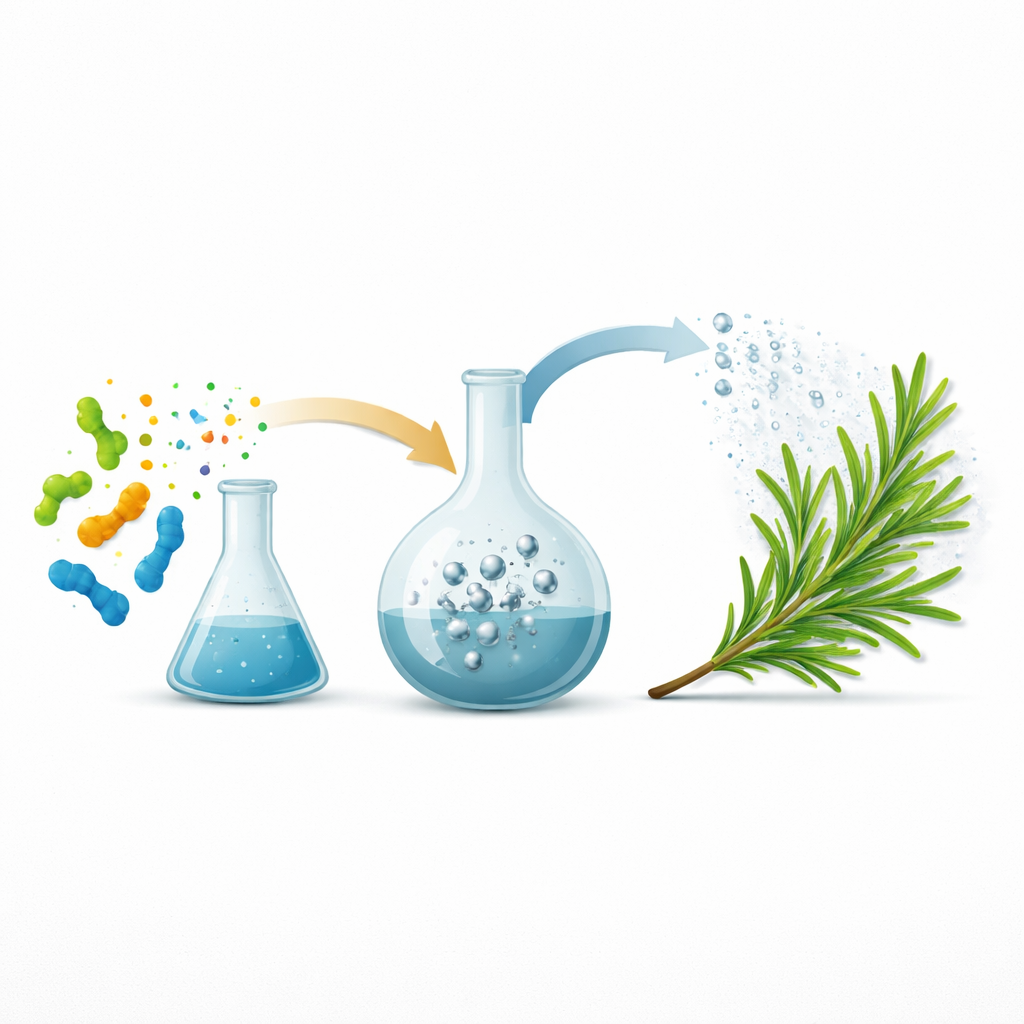
Plants live surrounded by helpful microbes that can gently “wake up” their internal defense systems. Some of these bacteria release small molecules that act as alarms inside the plant, nudging it to produce more protective substances. The researchers worked with one such bacterium, called Bacillus G36, previously found around tree roots. Instead of putting the live microbe on rosemary, they focused on the mix of molecules the bacterium secretes into its liquid growth medium, using this mix as a toolbox to build and carry signals into the plant.
Growing silver at the nanoscale
The team used the bacterial broth as a green factory to make silver nanoparticles—ultra‑small particles only a few billionths of a meter across. When silver salt was mixed with the bacterial liquid under the right conditions, the silver ions were converted to metallic silver and organized into tiny spheres. Careful tuning of temperature and acidity was crucial: a basic pH and a warm setting of 37 °C, with equal volumes of silver solution and bacterial liquid, produced especially small particles averaging about 7.5 nanometers across, labeled S3. The bacterial molecules stuck to the particle surface like an invisible coating, helping stabilize the silver and potentially acting as a biological message for the plant.
What happens when rosemary is treated after harvest
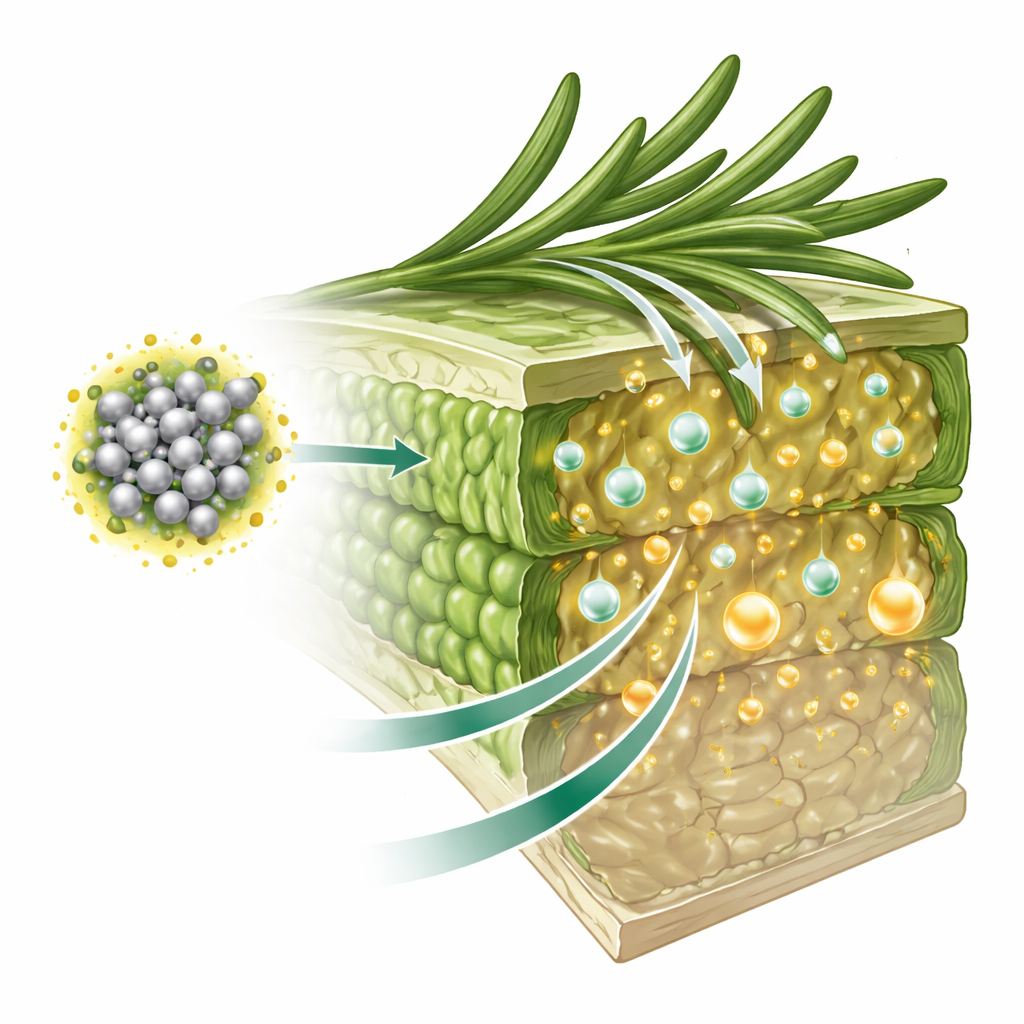
The scientists then moved from the lab bench to harvested rosemary sprigs. They sprayed detached branches with either live Bacillus cells, the bacterial liquid alone, the S3 nanoparticles, a second type of larger nanoparticle made with added rosemary extract, plain silver solution, or no treatment. Afterwards, they extracted and measured key groups of molecules: total phenols and flavonols (families of antioxidants), rosmarinic acid (a well‑known rosemary component), and diterpenes such as carnosic acid and carnosol, which are linked to antioxidant and potential brain‑protective effects. They also tested the overall antioxidant power of the extracts using an electrochemical method.
Small particles, big changes
The standout treatment was the small S3 nanoparticle. Only this formulation clearly boosted both total phenols and flavonols in the rosemary, and it increased rosmarinic acid by about 50 percent compared with untreated branches or any other treatment. Both S3 nanoparticles and live Bacillus cells raised the levels of diterpenes (reported as carnosic acid equivalents), but the plain bacterial liquid alone actually lowered these compounds, suggesting that not all bacterial molecules are beneficial in their free form. Interestingly, the total antioxidant capacity rose in rosemary treated with S3 nanoparticles or the bacterial liquid, but not with the larger nanoparticles made using rosemary extract, which were roughly eight times bigger and less effective at entering tissues.
Why nanoparticle size and coating matter
By comparing the different silver particles, the researchers showed that how nanoparticles are made strongly shapes their behavior. Adding rosemary extract during particle formation sped up silver reduction but produced much larger, less stable particles with a thinner biological coating and reduced impact on the plant’s chemistry. In contrast, the small S3 particles carried a richer layer of Bacillus‑derived molecules and had a higher surface‑to‑volume ratio, which likely helped them pass through the leaf surface, reach inner tissues, and trigger specific metabolic pathways. This combination of size and surface chemistry turned them into more efficient messengers than either the bacteria or their secreted molecules used alone.
Take‑home message for everyday use
For non‑specialists, the key message is that carefully designed, biologically made silver nanoparticles can act like tiny delivery vehicles that encourage harvested rosemary to enrich and stabilize some of its own health‑promoting ingredients, without needing to change how the plants are grown in the field. The work suggests a scalable, low‑waste way to get more consistent antioxidant content from medicinal and culinary herbs by treating them after harvest in controlled facilities. If similar strategies work in other species, this approach could help produce more reliable natural extracts for foods, supplements and medicines while keeping the process environmentally friendly.
Citation: Fuente-González, E., Plokhovska, S., Gutierrez-Albanchez, E. et al. Postharvest delivery of Bacillus G36 metabolites formulated in AgNP modifies Salvia rosmarinus Spenn. bioactive profiles. Sci Rep 16, 13854 (2026). https://doi.org/10.1038/s41598-026-43957-z
Keywords: rosemary antioxidants, silver nanoparticles, beneficial bacteria, postharvest treatment, plant bioactive compounds