Clear Sky Science · en
Towards realistic electrical double layer capacitor device with elevated energy and power densities designed from plasticized nanocomposite PVA-based electrolyte
Cleaner Power You Can Charge in a Flash
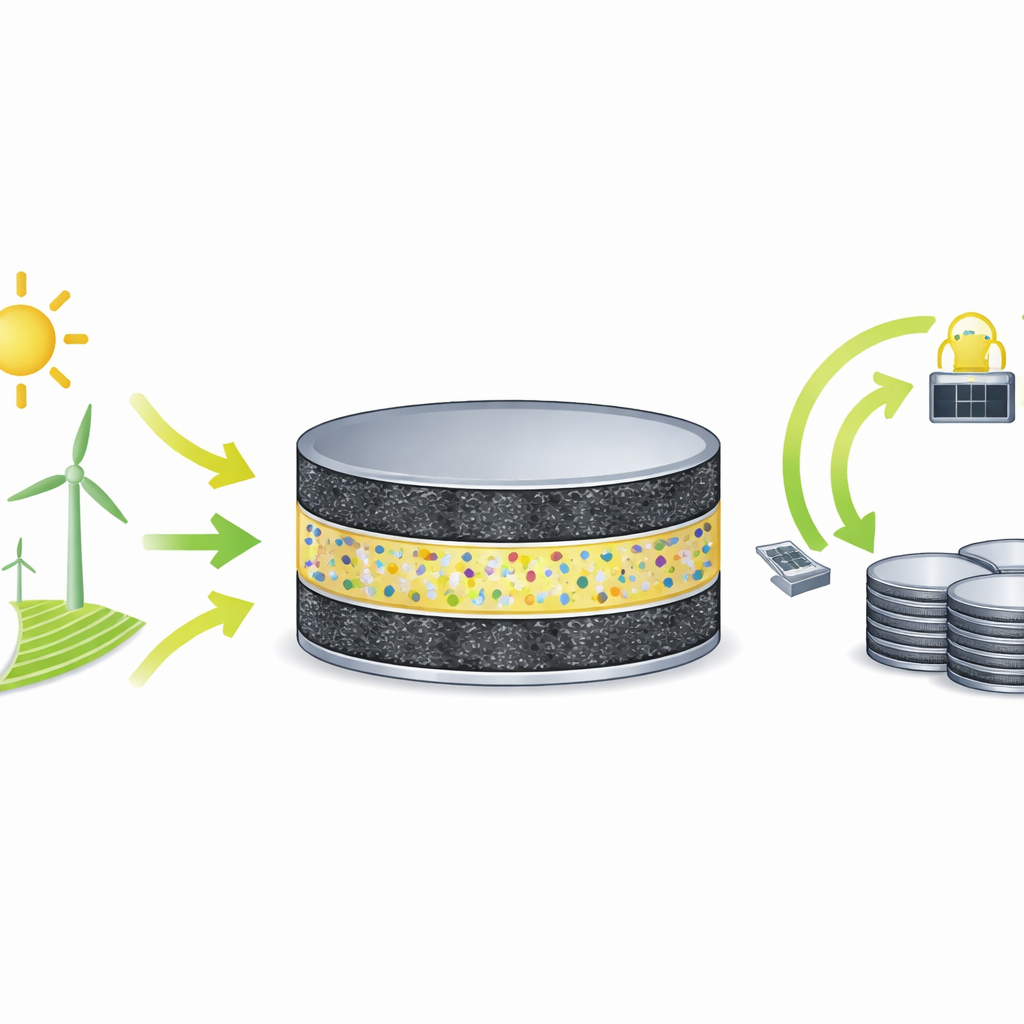
As our homes, cars, and gadgets lean more on renewable electricity, we need power sources that are both safe and fast to charge. Today’s batteries store lots of energy but can be slow to refill and rely on materials that raise safety and environmental concerns. This study explores a different kind of device, an electrical double-layer capacitor, built from a biodegradable plastic and a non‑toxic salt. The goal is to approach battery-like energy storage while keeping the speed, safety, and long life of a supercapacitor.
From Kitchen-Grade Ingredients to High-Tech Films
The researchers start with poly(vinyl alcohol), a plastic already used in everyday products and known for forming clear, flexible films. They dissolve it in water, add a common sodium salt, and blend in glycerol, a harmless liquid used in foods and cosmetics. This glycerol makes the plastic film softer and more flexible so that charged particles can move through it more easily. To push performance further, they sprinkle in tiny grains of titanium dioxide, a white mineral also found in sunscreens and paints. By carefully tuning the amount of this nanofiller, they aim to create a thin, solid sheet that conducts ions well enough to replace the liquid inside conventional supercapacitors.
How Tiny Additives Unlock Charge Flow
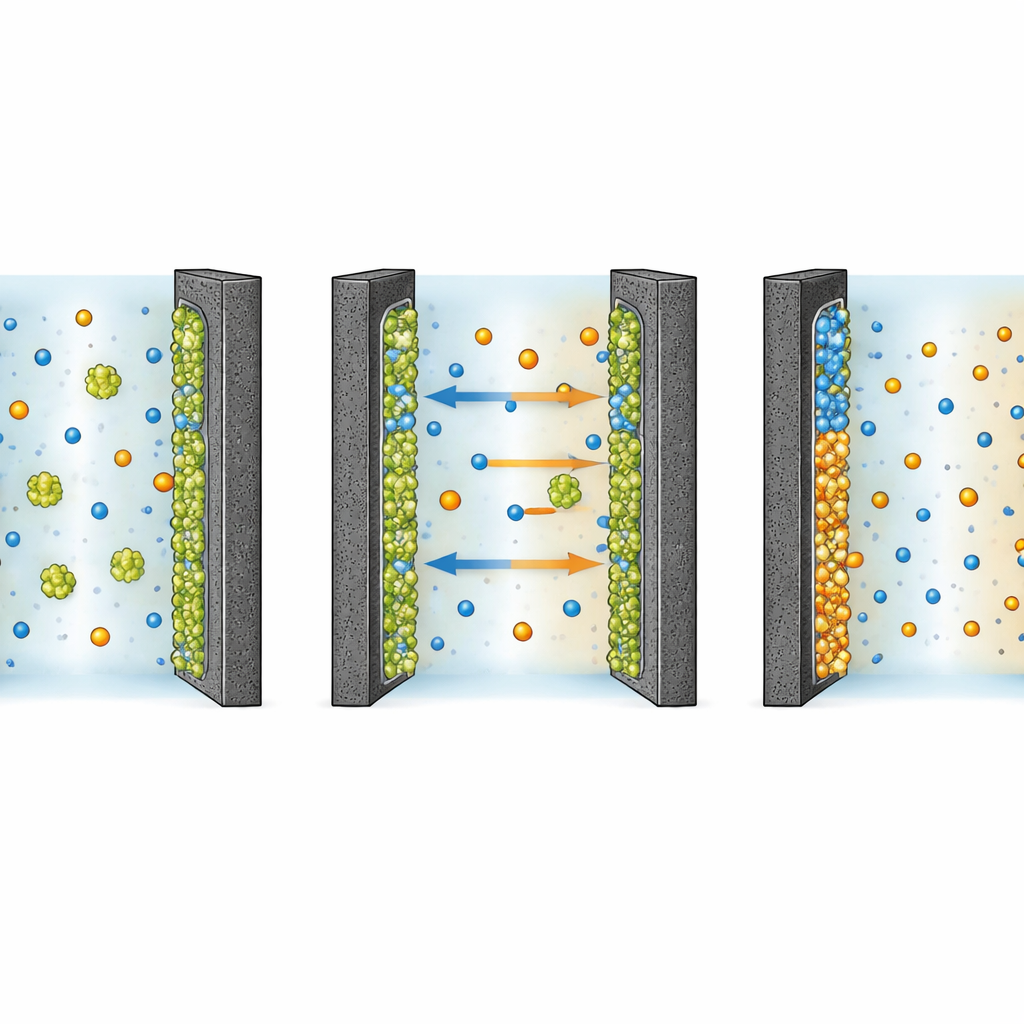
Using electrical tests, the team shows that a recipe containing 3 percent titanium dioxide by weight gives the best results. At this level, the tiny particles disrupt the plastic’s internal order just enough to create pathways for sodium ions to move, without clumping together and blocking motion. The film reaches a relatively high ionic conductivity for a solid and displays a very large ability to store electric charge, known as a high dielectric constant. Additional measurements confirm that nearly all of the current through the film is carried by ions rather than electrons, and that the material remains stable up to about 2.5 volts, which is enough for many small energy-storage cells.
Building and Testing the Prototype Device
To see how this material performs in a real device, the authors sandwich the optimized film between two discs of activated carbon, a form of charcoal riddled with tiny pores. When a voltage is applied, positive and negative ions in the plastic film crowd onto the surfaces of the carbon, forming ultra-thin layers of charge without triggering chemical reactions. This “non‑Faradaic” behavior appears in their voltage–current scans as smooth, leaf-shaped loops rather than sharp peaks. In repeated charge–discharge tests, the voltage trace looks almost like an ideal triangle, with only a small initial drop, indicating low internal resistance and good contact between the film and the carbon electrodes.
Performance That Narrows the Gap with Batteries
Over 1,000 rapid charge–discharge cycles, the device maintains a specific capacitance of about 138 farads per gram of active carbon, with very little fading. That translates into an energy storage capacity around 17 watt‑hours per kilogram and a power output near 4,000 watts per kilogram. When these numbers are plotted against other technologies, the new capacitor falls in a region usually occupied by lead–acid and nickel–cadmium batteries, while still delivering the fast bursts of power that supercapacitors are known for. Its efficiency approaches 98 percent after a short conditioning period, meaning very little energy is lost each time it is charged and discharged.
What This Means for Future Energy Storage
To a non-specialist, the key message is that a thin, flexible film made from a biodegradable plastic, a safe salt, and a common mineral can bring supercapacitors closer to the energy levels of everyday batteries, without sacrificing speed, safety, or long life. By boosting the film’s ability to hold electric charge and move ions, the titanium dioxide nanofillers help the device store more energy between each pair of carbon electrodes. While questions remain about scaling up the technology and testing it under real‑world conditions, this work points toward compact, greener energy storage units that could smooth out the flow from solar panels and wind turbines, support electric vehicles, and power portable electronics with quick, reliable charging.
Citation: Aziz, S.B., Hama, P.O., Murad, A.R. et al. Towards realistic electrical double layer capacitor device with elevated energy and power densities designed from plasticized nanocomposite PVA-based electrolyte. Sci Rep 16, 13466 (2026). https://doi.org/10.1038/s41598-026-43954-2
Keywords: electrical double-layer capacitor, solid polymer electrolyte, biodegradable energy storage, nanocomposite materials, supercapacitor performance